


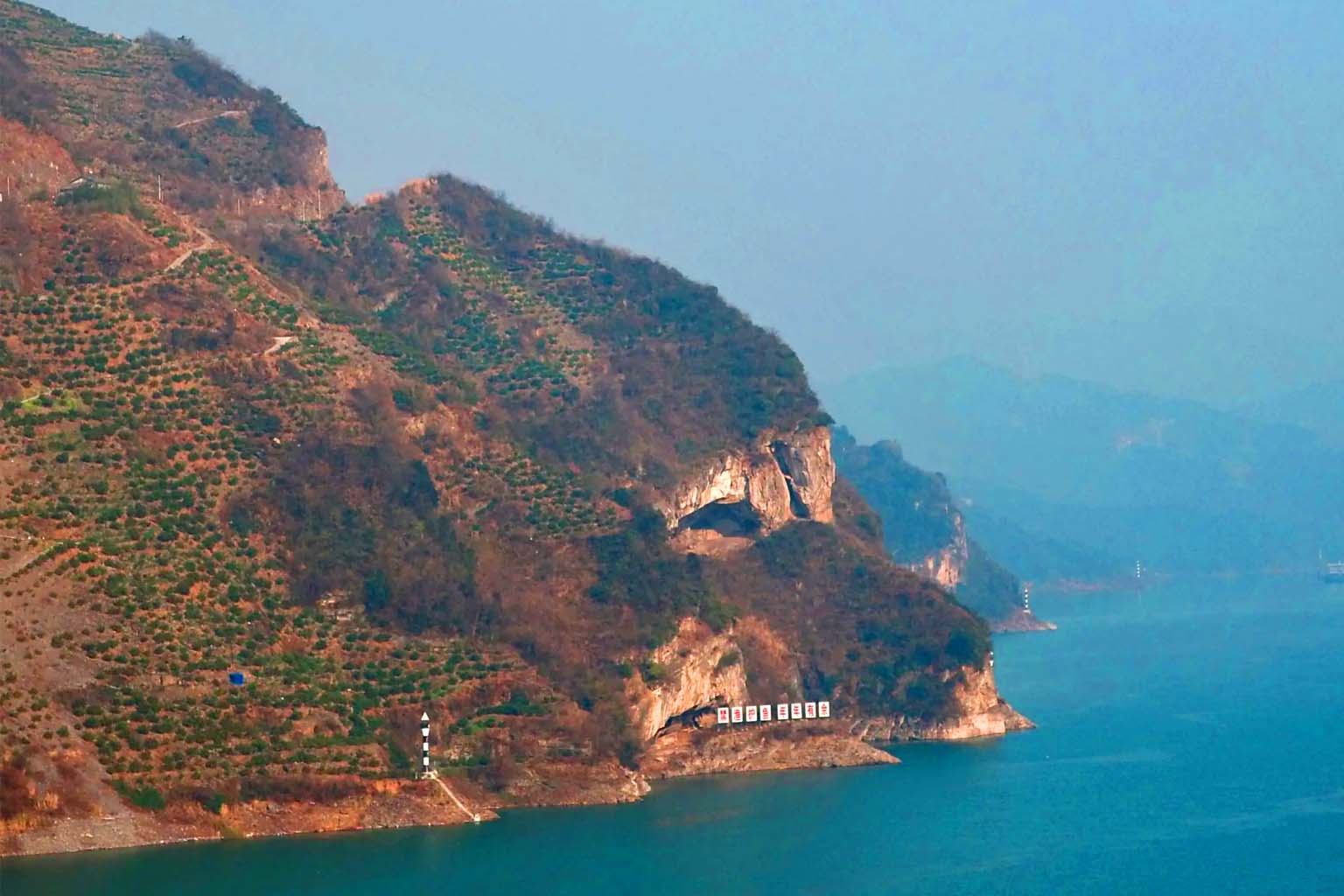
A simple vacation photo has fundamentally altered the trajectory of a remote Chinese landscape, transforming an obscure hiking spot into a pilgrimage site for millions. When Shanghai designer Guo Qingshan uploaded his snapshot from Yichang to social media on Valentine’s Day, he unknowingly triggered a phenomenon that would reshape local tourism and challenge our understanding of how digital virality can instantly rewrite the cultural significance of natural landmarks. This transformation echoes discoveries at other significant sites, such as the 1,700-year-old altar at Tikal, where new perspectives continue to reveal hidden meanings in ancient places.
The image showed what appeared to be a massive dog’s head carved from stone, seemingly drinking from the Yangtze River. Within days, #xiaogoushan had accumulated millions of views across Chinese social platforms, and tour buses began arriving at what locals now call Puppy Mountain. The speed of this transformation raises questions about the fragile boundary between digital perception and physical reality in our hyperconnected age.
What makes this story particularly fascinating isn’t just the viral nature of the image, but how it reveals the subjective lens through which we interpret our natural world. The mountain had existed in this exact form for centuries, yet it took one person’s photographic angle and creative caption to unlock its hidden identity for millions of viewers.
The Anatomy of Accidental Fame
Guo’s discovery wasn’t immediate or intentional. He photographed the landscape in January during a routine visit to his hometown, but only noticed the dog-like formation weeks later while reviewing his images. This delayed recognition speaks to how our brains process visual information and the role of context in shaping perception.
The viral trajectory followed a predictable pattern for Chinese social media. The initial post on Xiaohongshu accumulated 120,000 likes within ten days, then exploded across Weibo where broader audiences amplified the content. Research published in Nature has examined how short-form video content significantly influences tourist travel intentions and destination choice behavior. Local businesses quickly capitalized, creating merchandise featuring the mountain’s silhouette, while tour operators began offering specialized packages to view the formation.
“Social media video content demonstrates measurable impact on the behavioral inclinations of prospective tourists, fundamentally altering destination choice patterns” – Nature research study
The phenomenon demonstrates how social media algorithms can transform obscure geographical features into cultural touchstones overnight. The mountain’s fame wasn’t built on historical significance or natural wonder, but on the simple human tendency to recognize familiar shapes in abstract forms—a psychological process called pareidolia.
The Retroactive Discovery Effect
Perhaps the most intriguing aspect of Puppy Mountain’s rise involves the retroactive recognition experienced by locals who had previously visited the area. Residents began searching through old photographs, discovering they had unknowingly captured the same canine silhouette years earlier without recognizing it. This phenomenon of delayed recognition mirrors how researchers studying 20,000-year-old cave etchings continue to uncover new meanings in ancient markings that were hiding in plain sight.
Yichang resident Shi Tong found a 2021 photograph showing the identical formation, admitting he had noticed the resemblance at the time but never considered it remarkable enough to share. This retroactive awareness suggests that viral fame doesn’t just create new attractions—it can fundamentally alter how we remember and value past experiences.
The discovery of older images has created an unexpected archive of the mountain’s evolution over time. Social media users now debate whether natural erosion has subtly altered the puppy’s appearance, turning geological analysis into a form of crowd-sourced scientific observation. Just as paleontologists have made breakthrough discoveries about hidden dinosaur muscle structures that were previously overlooked, the mountain’s viral fame has prompted closer examination of geological features that were always present but never properly recognized.
Digital Pilgrimage in the Modern Age
The influx of tourists to Puppy Mountain represents a new category of travel motivation. Visitors aren’t drawn by historical significance or natural beauty alone, but by the desire to experience a viral moment in physical space. Many tourists bring their own dogs to pose alongside the mountain, creating a feedback loop where the digital and physical worlds continuously reinforce each other.
Studies from ScienceDirect have explored the behaviors of social media-induced tourists and the interventions needed to manage this phenomenon. This phenomenon reflects broader changes in how younger generations approach travel and experience. The destination’s value lies not in its inherent qualities, but in its social media recognition and the photographic opportunities it provides. The mountain has become a three-dimensional meme, existing simultaneously as geological formation and cultural artifact.
Local authorities in Zigui County have had to rapidly adapt infrastructure to accommodate the unexpected tourist surge. What was once a quiet hiking trail now requires crowd management and expanded facilities, demonstrating how viral fame can overwhelm unprepared communities within weeks.
The Psychological Architecture of Viral Recognition
The Puppy Mountain phenomenon reveals something deeper about human pattern recognition and collective meaning-making. The same geological formation that went unnoticed for centuries suddenly became irresistibly charming once framed through the lens of anthropomorphic interpretation. This transformation suggests our relationship with nature is increasingly mediated by digital platforms that reward novelty and emotional resonance over traditional measures of significance.
Research in cognitive psychology shows that humans are evolutionarily predisposed to recognize faces and familiar forms in abstract patterns. Social media amplifies this tendency by providing instant feedback loops that validate and spread these recognitions. The mountain didn’t change, but our collective ability to see and share its dog-like qualities created an entirely new reality around it. This mirrors how scientists continue to make astonishing discoveries in places like the Red Sea, where new perspectives reveal previously hidden aspects of familiar environments.
“Behavioral interventions serve as both subtle and salient tools for managing destinations experiencing social media-induced tourism phenomena” – Tourism behavior research
The speed with which businesses adapted to capitalize on the trend also illustrates how modern tourism operates in an attention economy. Cultural significance can now be manufactured and monetized within weeks, rather than developing organically over generations.
The story of Puppy Mountain ultimately reflects our era’s unique relationship with place and meaning. In a world where viral recognition can instantly transform the cultural significance of any location, we might wonder what other hidden shapes and stories are waiting in plain sight, needing only the right angle and timing to reshape our understanding of the landscapes around us.