


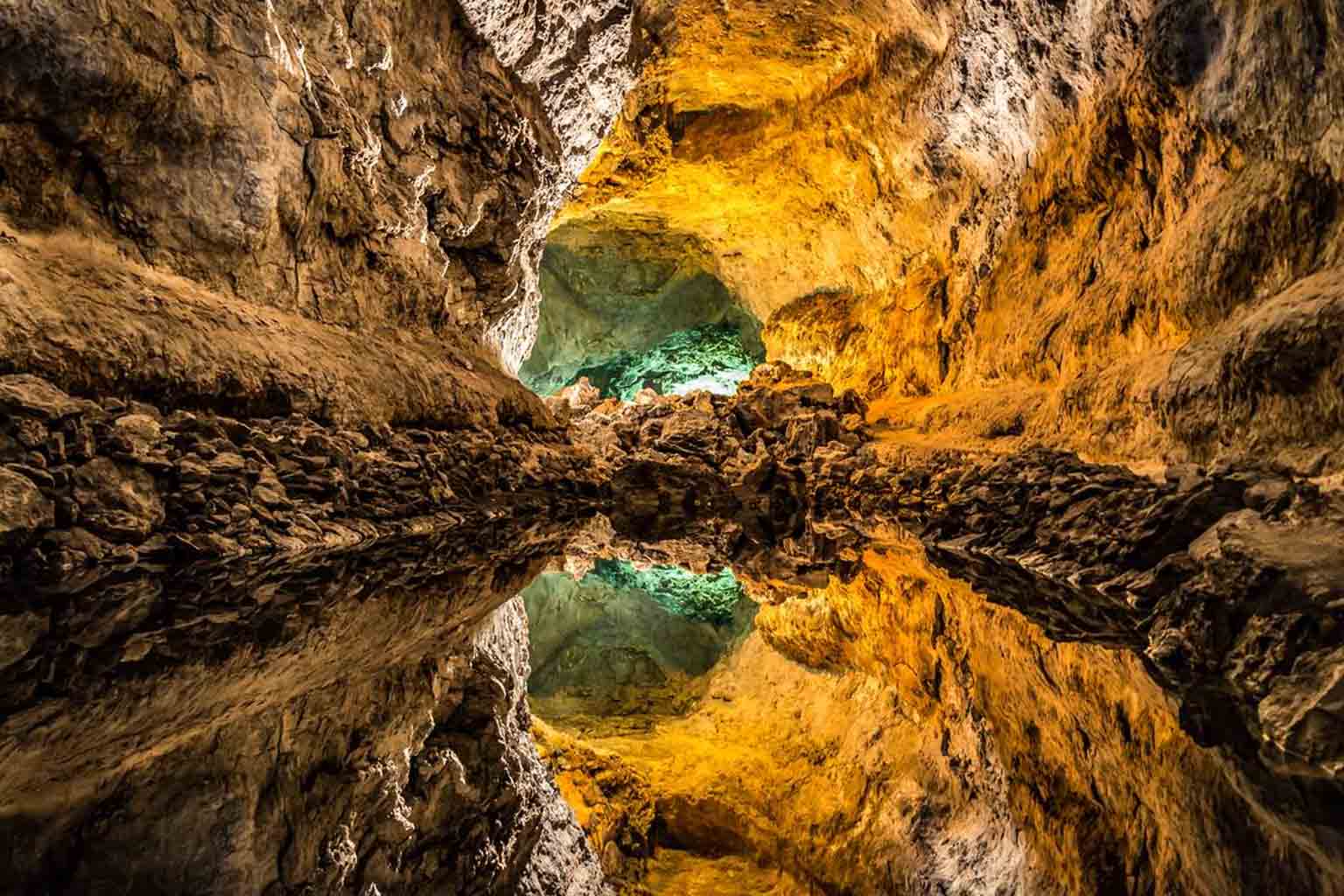
Deep beneath the volcanic landscape of Lanzarote, where the Atlantic Ocean meets ancient fire, lies a geological secret that challenges our understanding of Earth’s underground architecture. The La Corona volcanic tube system stretches nearly five miles through darkness, representing one of the planet’s most extraordinary examples of how molten rock can carve permanent pathways through solid ground.
This isn’t merely another cave system. Created 20,000 years ago during a violent eruption of the Corona Volcano, this underground network extends both beneath land and sea, forming what scientists now recognize as one of the longest volcanic tunnels in the world. Like the remarkable 20,000-year-old cave etchings discovered in France, this ancient formation provides a window into Earth’s distant past. The International Union of Geological Sciences is currently evaluating it for World Geological Heritage Site status, a designation that would place it among the planet’s most significant natural wonders.
The implications extend far beyond tourism or geological curiosity. This system represents a living laboratory where researchers study how life adapts to extreme environments, how volcanic processes shape underwater landscapes, and how ancient geological events continue to influence modern ecosystems.
The Architecture of Ancient Fire
Understanding how the La Corona system formed requires grasping the precise mechanics of lava tube creation. When the Corona Volcano erupted, molten rock flowed steadily outward, cooling on its exterior surfaces while remaining liquid within. This process created natural conduits through which lava continued to flow long after the initial eruption ceased.
The resulting structure spans 4.7 miles in total length, with nearly a mile extending beneath the Atlantic Ocean. Research from the University of South Florida has highlighted the La Corona system’s significance in understanding large-scale volcanic formations. Three distinct sections emerge from this geological architecture: Cueva de los Verdes with its remarkable acoustic properties, Jameos del Agua featuring underground lakes, and the mysterious Atlantis Tube that remains completely submerged beneath sea level.
“The La Corona lava tube system represents one of the most extensive and well-preserved examples of volcanic cave formation, providing crucial insights for planetary geology research” – University of South Florida research
Each section tells a different story of how volcanic forces interact with water, time, and biological systems. The precision with which these tunnels were carved demonstrates the consistent power of volcanic flows, creating chambers and corridors with mathematical regularity that human engineering would struggle to replicate.
An Ecosystem Frozen in Evolutionary Time
Within Jameos del Agua, researchers have documented one of nature’s most remarkable evolutionary adaptations. The albino blind crabs that inhabit the underground lake represent a species found nowhere else on Earth, having evolved in complete darkness over millennia. These creatures, technically classified as Munidopsis polymorpha, have lost both pigmentation and vision while developing enhanced sensory capabilities.
The presence of these specialized organisms raises profound questions about evolutionary isolation and adaptation. Scientific research suggests that these crabs descended from deep-sea ancestors who became trapped when sea levels shifted, forcing them to adapt to an environment radically different from their oceanic origins. Such dramatic environmental changes echo discoveries like the ancient tsunami evidence preserved in Japanese amber, demonstrating how geological events can preserve biological history.
This biological discovery transforms the La Corona system from a geological curiosity into a crucial research site for understanding how species respond to extreme environmental constraints. The crabs’ survival demonstrates life’s remarkable ability to find pathways to existence even in seemingly impossible conditions.
The Underwater Frontier
The Atlantis Tube represents perhaps the most scientifically significant portion of the entire system. As one of the longest underwater lava tunnels on Earth, it provides researchers with access to geological formations that have remained largely untouched by surface influences for twenty millennia.
Diving expeditions into this submerged section have revealed unique mineral formations and structural features that differ significantly from their terrestrial counterparts. The constant interaction between seawater and volcanic rock has created chemical processes that continue to reshape the tunnel’s interior, offering insights into how marine environments influence volcanic geology over extended periods. Studies published in planetary science research have emphasized the La Corona system’s importance as a geological analogue for understanding similar formations on other planets.
The challenges of exploring this underwater labyrinth mean that much of its extent remains unmapped. Advanced diving technology and underwater imaging systems are gradually revealing the full scope of this submerged world, but complete exploration may take decades to accomplish. Such dedicated scientific research missions often require years of planning and specialized equipment to unlock nature’s secrets.
The Acoustic Mysteries Hidden Underground
Beyond its geological and biological significance, the La Corona system presents acoustic phenomena that challenge conventional understanding of underground sound behavior. The natural auditorium within Cueva de los Verdes demonstrates acoustic properties that rival purpose-built concert halls, with sound waves bouncing off volcanic surfaces in ways that create perfect resonance.
Research into these acoustic properties has revealed how the specific mineral composition and geometric structure of volcanic tubes can create almost perfect sound environments. The implications extend to architectural acoustics and our understanding of how ancient peoples might have utilized natural spaces for ceremonial or communication purposes.
Musicians and acoustic engineers study this natural phenomenon to understand how geological processes can accidentally create spaces with acoustic perfection. The consistency of sound quality throughout different chambers suggests that volcanic tube formation follows patterns that naturally optimize acoustic properties. Like the unexpected discoveries found in deep ocean environments, these underground spaces continue to reveal surprising characteristics that challenge our understanding of natural systems.
As scientific exploration of the La Corona system continues, each new discovery reinforces its significance as more than just a geological curiosity. This underground world represents a intersection of volcanic science, evolutionary biology, and acoustic research that offers insights into Earth processes we’re only beginning to understand. Whether it achieves World Heritage status or not, the tunnel system will continue serving as a natural laboratory where fire, water, and time have collaborated to create something genuinely extraordinary.