


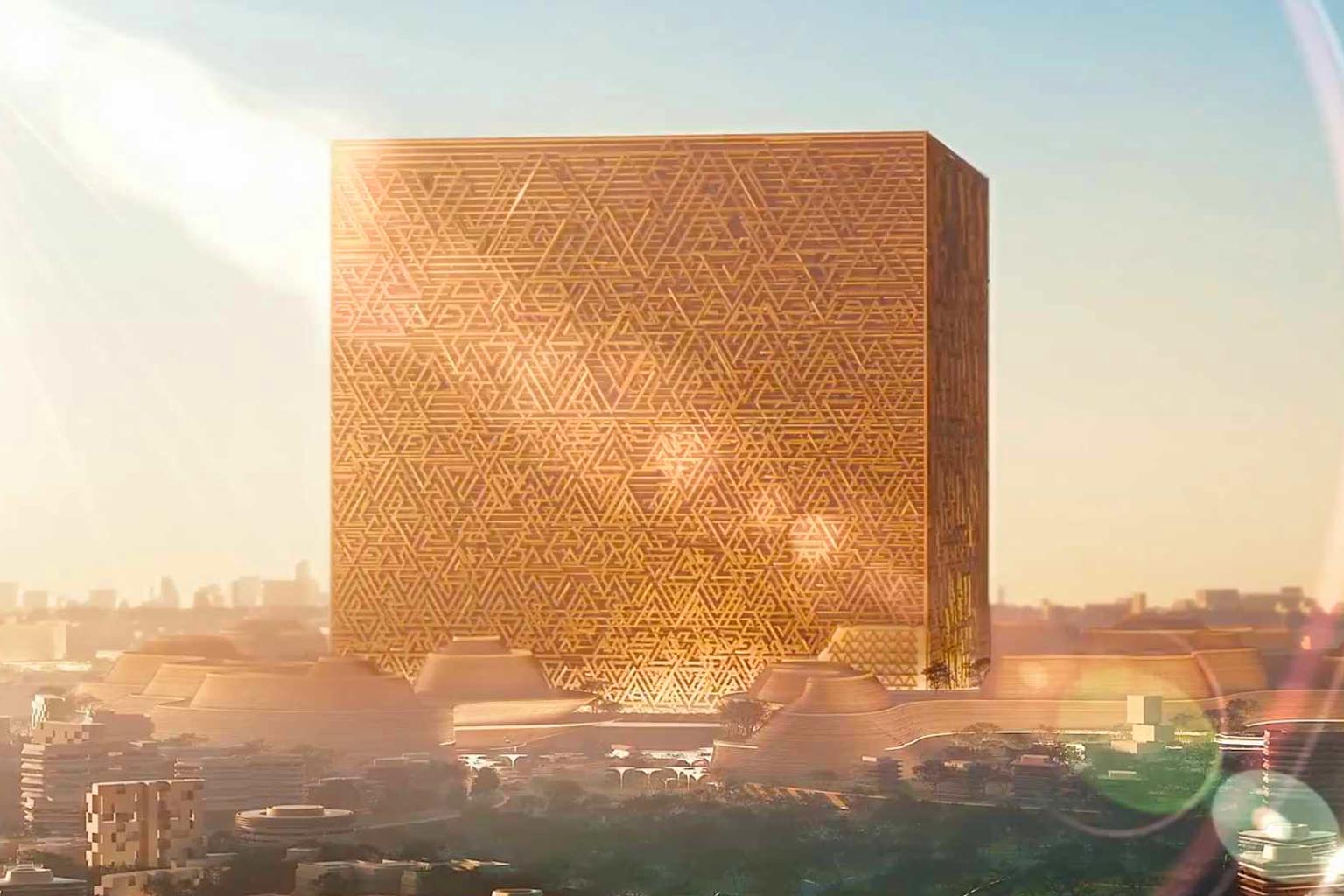
In the vast expanse of Saudi Arabia’s Riyadh desert, a project of staggering ambition is taking shape that challenges every conventional notion of urban development. The Mukaab, a 400-meter cube designed to house 400,000 people, represents more than architectural audacity—it embodies a fundamental reimagining of how humans might live, work, and interact in the 21st century.
This isn’t simply about building big. The sheer scale defies easy comprehension: imagine a structure that could contain the entire Empire State Building within its walls, yet extends equally in all directions rather than piercing skyward. What emerges isn’t just a building but a self-contained universe, complete with holographic projections capable of transforming interior environments at will. The question isn’t whether such a structure can be built—engineering has conquered far stranger challenges—but whether it should be, and what it means for the future of human habitation.
The timing feels deliberate. As cities worldwide grapple with sprawl, resource depletion, and environmental degradation, Saudi Arabia’s Vision 2030 positions the Mukaab as both solution and statement. While other ambitious urban projects have emerged globally with their own technological innovations, the Mukaab’s scale remains unprecedented. Yet between vision and reality lies a chasm filled with technical, social, and ecological uncertainties that even the most advanced engineering cannot easily bridge.
The Engineering Marvel and Its Mathematical Reality
The numbers surrounding the Mukaab reveal the project’s extraordinary scope. At 400 meters in each dimension, this vertical city would contain approximately 64 million cubic meters of space—roughly equivalent to 200 conventional skyscrapers compressed into a single geometric form. The structural engineering alone requires innovations in materials science, load distribution, and climate control that push current technology to its limits.
Construction experts note that traditional building methods become inadequate at this scale. The cube’s interior will require advanced climate control systems operating continuously to maintain livability across multiple microzones. Each face of the structure must withstand desert winds while supporting the immense weight of the levels above, creating engineering challenges that dwarf those faced by conventional high-rises.
The integration of holographic projection technology adds another layer of complexity. Creating immersive digital environments throughout a structure this size requires computing power and energy infrastructure typically reserved for entire city districts. The technical specifications suggest a building that operates more like a massive computer than traditional architecture. Interestingly, just as ancient cultural narratives were once carved into cave walls to create immersive environments, the Mukaab seeks to use cutting-edge technology to craft entirely artificial worlds within its walls.
Social Dynamics in Enclosed Megastructures
Living within the Mukaab raises profound questions about human psychology and social organization. Research published in environmental health studies suggests that enclosed environments, regardless of their sophistication, can trigger claustrophobia and social tension when sustained over long periods. The absence of natural weather patterns, seasonal changes, and direct contact with earth and sky may create psychological stress that no amount of digital simulation can fully address.
“High-density urban living environments show significant correlations with increased stress responses and social behavioral changes in adult populations” – Environmental health research
The social stratification within such a structure presents additional concerns. With 400,000 residents distributed across multiple levels, questions arise about mobility between floors, access to amenities, and the inevitable formation of vertical neighborhoods with distinct characteristics. Studies from psychological research institutions suggest that architectural solutions alone cannot prevent the emergence of social hierarchies and territorial disputes in high-density living conditions.
Community formation in the Mukaab will likely differ dramatically from traditional urban development. The controlled environment may foster a unique culture, but it could also create insularity that separates residents from broader Saudi society and the natural world beyond their walls.
Environmental Impact in Desert Ecosystems
The ecological implications of constructing the Mukaab extend far beyond its immediate footprint. Desert ecosystems, while appearing barren, support complex webs of adapted flora and fauna that evolved over millennia. The massive foundation required for a 400-meter cube, combined with the resource extraction necessary for construction, will inevitably disrupt these delicate balances. The construction process will generate enormous amounts of waste, though some materials might contain valuable resources—similar to how electronic waste contains recoverable gold, construction debris could present both environmental challenges and economic opportunities.
Water consumption presents perhaps the greatest environmental challenge. Supporting 400,000 people in a desert climate requires enormous quantities of water for drinking, cooling, and waste processing. The energy demands for desalination and distribution could offset any efficiency gains from the compact urban design. Climate scientists warn that such intensive resource use in arid regions may exacerbate regional environmental stress.
The carbon footprint of the Mukaab’s construction and operation raises additional questions about Saudi Arabia’s environmental commitments. While the project aims to support economic diversification away from oil dependence, its immediate environmental cost may undermine longer-term sustainability goals.
The Unexamined Precedents of Megaproject Failures
The Mukaab’s ambitious timeline and scope invite comparison with other megaprojects that promised transformation but delivered complications. The history of urban planning includes numerous examples of visionary projects that encountered unforeseen obstacles, from cost overruns to social rejection by intended residents.
Saudi Arabia’s own experience with The Line—the 170-kilometer linear city—offers sobering insights. Originally announced with great fanfare, the project has seen its scope repeatedly scaled back as practical realities emerged. The Mukaab faces similar challenges, but with the added complexity of vertical integration and enclosed living systems that have never been tested at this scale. Unlike ancient defensive structures that were built to last millennia with proven construction methods, modern megaprojects often struggle with the long-term durability of their innovative approaches.
International examples of failed megastructures provide additional cautionary tales. Projects that looked revolutionary in conceptual phases often struggled with basic issues like emergency evacuation, maintenance access, and social cohesion once occupied. The Mukaab’s unique design may solve some traditional problems while creating entirely new ones that won’t become apparent until after completion.
The Mukaab represents humanity’s ongoing tension between technological possibility and livable reality. As construction progresses, it will test not only engineering capabilities but also our understanding of what makes spaces truly habitable for human communities. Whether it becomes a model for future urban development or a monument to architectural overreach may depend less on its successful completion than on how well it serves the actual needs of those who call it home. The desert will witness either the birth of a new form of human settlement or a powerful reminder that some visions, however compelling, may be better left as dreams.