


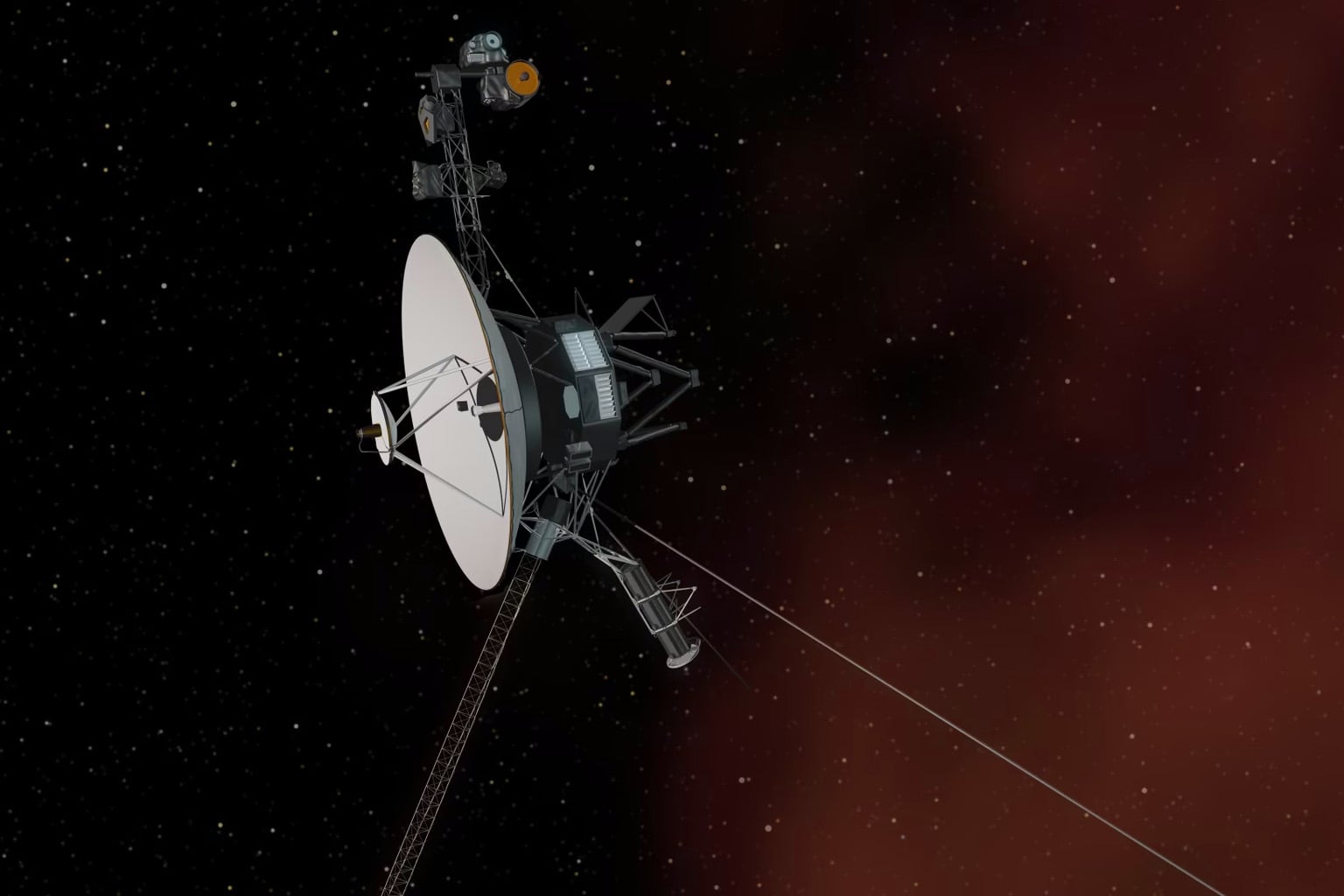
If you’ve ever wondered how far humanity has really reached into the vastness of space, prepare to be astonished. Voyager 1, the remarkable spacecraft launched from Earth over four decades ago, is on the brink of achieving an absolutely mind-bending milestone. By November 15, 2026, this legendary probe will be so distant that radio signals from Earth will require a full day—yes, 24 hours—to reach it. Can you imagine? Sending a message today, with no reply until tomorrow. Then another full day passes before hearing back.
It’s the latest surreal chapter in Voyager 1’s iconic journey, a reminder of our tiny place in a massive cosmos.
The Distance to Voyager 1
Let’s dive right into the mind-boggling stats. As of now, Voyager 1 is cruising at roughly 15.7 billion miles from our pale blue dot. In practical terms, that’s about 23 hours and 32 minutes for a one-way light-speed message. As it relentlessly moves forward, it’s closing in on that spellbinding 16.1 billion-mile mark—at which point, communication will officially span a full light day.
But how does that compare to other celestial bodies? Well, here’s a quick rundown:
– The Moon is a mere 226,000 miles away, with a light travel time of approximately 1.3 seconds.
– Average distance to Mars? A hefty 140 million miles, translating to around 4 minutes via light speed.
– Jupiter sits snugly at 484 million miles, equivalent to 52 light minutes.
– Tiny Pluto lingers at 3.7 billion miles—a leisurely 6.8 light hours.
And then there is Voyager 1, in 2026, at its otherworldly 16.1 billion miles—arm’s stretch across the stars.
Light Travel Delays
Light speed, we often take for granted. Flick a switch and light fills the room instantly, or so it seems. Yet, out there in the cosmic expanse, those minutes, and later hours, start to add up. Remember the Apollo era? Communication lagged just a few seconds, noticeable yet manageable. But as distances grow, so do these delays, turning them from mild irritations into significant obstacles.
So what happens if engineers wish to send a command to Voyager 1 in 2026? It’s eye-opening:
1. That command signal takes 24 hours to arrive.
2. Voyager then responds, echoed 24 hours later.
3. Two full days pass for a single command to be answered.
No wonder it’s built to autonomously solve some problems—it’s out there, after all, flying blind in the void.
The Loneliest Journey
It’s truly a voyage for the ages. Voyager 1 took off in 1977, tasked with paying visits to Jupiter and Saturn. Yet, having completed its initial mission—destined only for those close neighbors—it just kept going. Now it sails through the uncharted waters of interstellar space, impervious to time, and beyond our Sun’s comforting presence.
Its power is waning, though—a nuclear heart slowly fading. Scientists estimate that by next year, or soon after, its voice may go silent forever. But isn’t it awe-inspiring that something built in the 1970s is operating in conditions that would daunt the hardiest machine?
So yes, very vintage. Yet still, that tiniest vestige of humanity whispers from the edge of nowhere.
Voyager’s Current Status
With technology from an era most of us remember fondly for disco, Voyager 1 still communicates with us, thanks to an incredible ground system: NASA’s Deep Space Network with its giant radio antennas literally positioned around the globe.
Where do both Voyagers stand as of now?
– **Voyager 1:** Around 15.7 billion miles out, with light reaching it in about 23 hours and 32 minutes.
– **Voyager 2:** Trailing behind at approximately 13.1 billion miles, or roughly 19-and-a-half light hours away.
And even today, they return nuggets of data, invaluable insights into things like cosmic rays and interstellar particles. After all, these are, and may always be, our farthest explorers.
“These kinds of missions remind us of the endless possibilities if we dare to explore the unknown,” expressed a NASA spokesperson.
The Legacy of Voyager 1
Someday, Voyager 1 will fall silent, but it won’t be forgotten. It carries the Golden Record, a cosmic time capsule brimming with music, sounds, and greetings from Earth. Can you picture it lasting through eons, beyond us and our woes, a spark of curiosity adrift in eternity?
When you think of distances measured in light-days, recall what it represents: we, the curious beings, sent a fragment of our essence so far, even light cannot catch it quickly. It’s a milestone not just in science but in our poetic quest for understanding and connection.
And next time you encounter a minor delay with modern tech, think of Voyager, patiently waiting, listening—your message is a full day away.
Feeling inspired by this incredible journey? Keep exploring space news, follow Voyager’s updates, and perhaps engage in your own stargazing. There’s a lot more out there than meets the eye.