


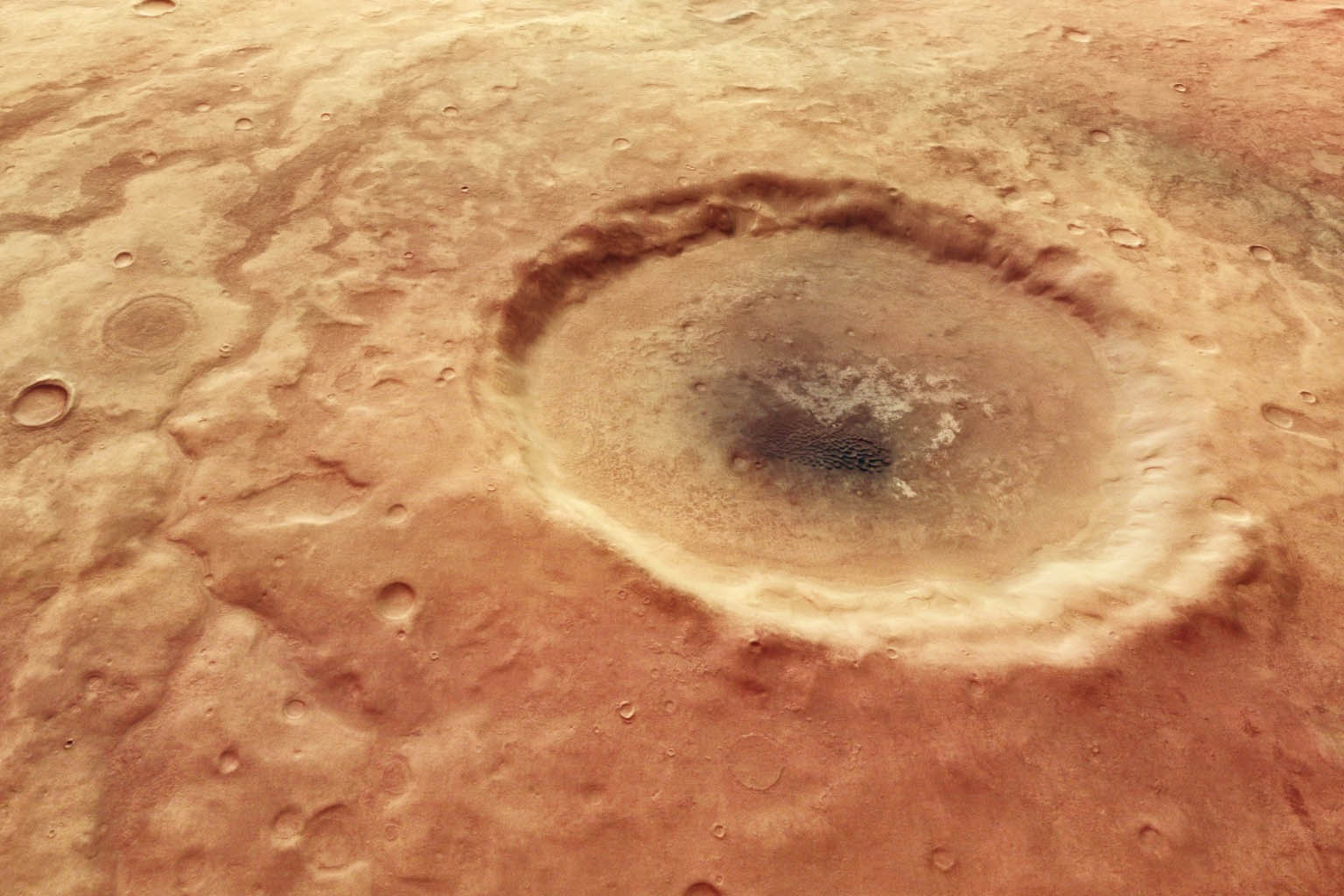
Mars continues to surprise us with its geological peculiarities, and the latest video from the European Space Agency’s Mars Express spacecraft offers a striking example. Deep within the northern lowlands of Mars, in a region called Idaeus Fossae, lies what scientists have dubbed a “butterfly crater” – a formation so unusual that it challenges our typical understanding of impact geology.
Most craters on Mars follow a predictable pattern. When space rocks slam into the planet’s surface, they create circular, symmetrical depressions with debris scattered evenly in all directions. This butterfly crater breaks that mold entirely. Instead of a neat circle, we see two uneven wings extending from a rounded center, resembling the delicate shape of a butterfly when viewed from orbit. Such unique geological formations remind us of how ancient civilizations also left distinctive patterns on Earth’s surface, much like the 3,000-year-old village recently discovered in France, which revealed unexpected rectangular dwelling patterns that challenged archaeologists’ understanding of prehistoric settlements.
The formation tells a story of cosmic violence delivered at just the right angle to create something unexpectedly beautiful. The shallow-angle impact that carved this feature sent debris streaming in two primary directions rather than radiating outward uniformly, creating wings that stretch across the Martian landscape like frozen motion.
The Mechanics Behind an Unusual Impact
The butterfly crater measures approximately 12 miles from east to west and around 9 miles from north to south at its main pit. What makes this formation particularly fascinating is how the impacting object approached Mars at such a low angle that it fundamentally altered the physics of crater formation. Instead of punching straight down into the surface, the space rock skipped and gouged, creating those distinctive lobes of debris that extend toward opposite corners of the impact site.
The texture surrounding the crater reveals another layer of the story. Much of the material appears unusually smooth and rounded, suggesting something more complex happened during the impact event. The fluidized debris patterns indicate that the tremendous heat generated by the collision likely melted subsurface ice, temporarily turning solid ground into a flowing mixture of rock, water, and debris.
This process, while dramatic, occurs frequently across Mars and serves as a reminder that frozen water lies beneath much of the planet’s surface. The butterfly crater essentially became a brief, violent excavation project that exposed and melted this hidden ice, creating the smooth, flowing textures we observe today. This type of geological excavation shares similarities with archaeological discoveries on Earth, where layers of history are revealed through careful excavation, such as the 3,000-year-old fortress uncovered beneath Jerusalem’s streets, which exposed ancient defensive structures hidden for millennia.
Volcanic Remnants in the Surrounding Terrain
While the butterfly crater commands immediate attention, the broader landscape provides context for Mars’s complex geological history. Scattered across the region are steep, flat-topped mesas that rise from the otherwise level terrain like ancient monuments. These formations represent the stubborn remnants of much larger rock structures that once dominated the area.
The dark layers visible along the edges of these mesas bear a strong resemblance to volcanic rock formations found on Earth, particularly those rich in iron and magnesium. This suggests the region experienced significant volcanic activity in its past, with successive layers of lava and ash building up over time before being buried and later exposed again through natural erosion processes. The ability to read geological history through surface features parallels how ancient peoples recorded their understanding of landscapes, as demonstrated by the 20,000-year-old cave etchings in France that revealed sophisticated topographical mapping techniques.
Long, folded features known as wrinkle ridges crisscross the surface, formed when ancient lava flows cooled and contracted, causing the surface to buckle and crumple. These ridges serve as geological fingerprints, providing evidence that volcanic processes played a major role in shaping this particular corner of Mars.
A Fractured Landscape Tells Multiple Stories
The butterfly crater exists within a broader context of geological upheaval. The Idaeus Fossae region takes its name from a nearby system of valleys located just a few miles west of the crater, and the entire area bears the scars of extensive fracturing and collapse. One particularly large valley cuts clearly across the terrain, while smaller ridges and channels create a complex network of geological features.
A dramatic cliff approximately 1.2 miles high marks the edge of the Tempe Terra plateau, adding vertical drama to an already complex landscape. The combination of valleys, ridges, and steep escarpments creates an environment that appears perpetually unsettled, shaped by millions of years of stress, collapse, and erosion.
Interestingly, Mars hosts at least one other butterfly-shaped crater in Hesperia Planum, located far to the south. The presence of similar formations in different regions supports the theory that these unusual shapes result from impact angle dynamics rather than unique local surface characteristics, suggesting that such shallow-angle impacts may be more common than previously thought. This pattern of discovering multiple examples of rare phenomena echoes archaeological findings on Earth, where isolated discoveries often reveal broader cultural patterns, much like the Tikal archaeological site that revealed unexpected connections between distant Mesoamerican civilizations.
The Hidden Complexity of Martian Impact Physics
What many discussions of Martian craters overlook is how profoundly the planet’s unique environmental conditions influence impact outcomes. Mars possesses a much thinner atmosphere than Earth, which means incoming objects experience less atmospheric braking and often strike the surface at higher velocities and more extreme angles than would be typical on our planet.
The presence of subsurface ice across much of Mars adds another variable that dramatically affects crater formation. When an impact generates enough heat to melt this hidden ice, it essentially creates a temporary liquid environment that can flow, mix, and redistribute debris in ways that would be impossible on a completely dry world. This process helps explain the unusually smooth textures observed around the butterfly crater.
The Mars Express orbiter, operational since 2003, continues to map these features in unprecedented detail, building a comprehensive picture of how impact processes work in the Martian environment. Each new discovery adds to our understanding of planetary geology and the complex interplay between cosmic impacts and local surface conditions.
As we study formations like the butterfly crater, we gain insights not only into Mars’s past but into the fundamental processes that shape rocky worlds throughout the solar system. The delicate wings of this cosmic butterfly remind us that even violent geological events can create something unexpectedly graceful, frozen in time across the red planet’s ancient landscape.