


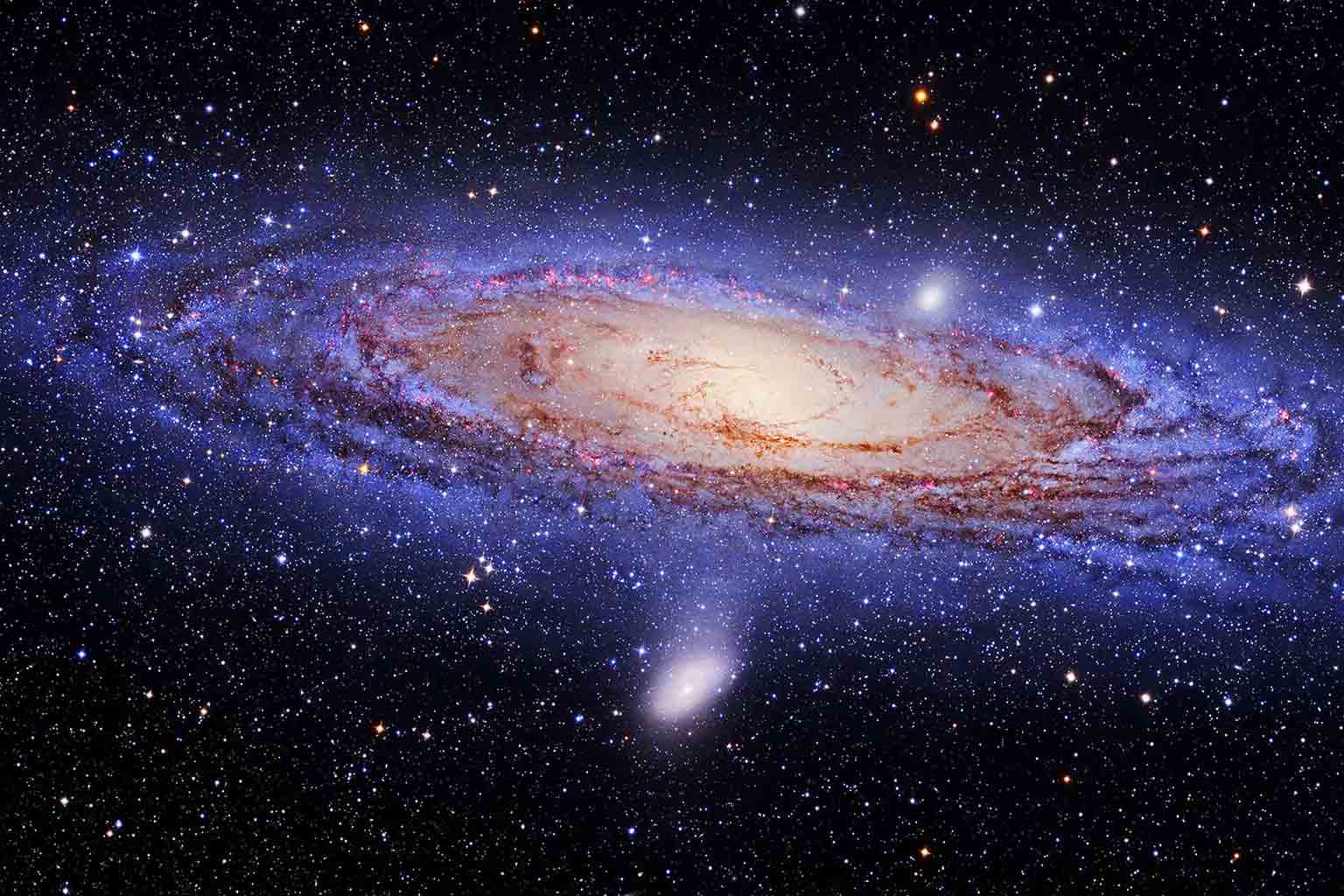
Our nearest galactic neighbor has been hiding secrets in plain sight. For decades, the Andromeda Galaxy has served as astronomy’s most accessible laboratory for understanding how massive galaxies evolve, sitting just 2.5 million light-years from Earth like a cosmic mirror reflecting our own Milky Way’s potential future. Yet recent findings from an unprecedented Hubble Space Telescope survey reveal that Andromeda tells a fundamentally different story than we expected.
The galaxy we thought we understood appears to be a cosmic crime scene, frozen in the aftermath of ancient violence. Where astronomers expected to find order and predictable patterns, they instead discovered asymmetrical chaos that challenges decades of theoretical models. This isn’t just another astronomical discovery—it’s a revelation that forces us to reconsider how we think about galactic evolution itself, much like how 5,000-year-old fortification discoveries challenge our understanding of ancient civilizations.
Using over 1,000 Hubble orbits, scientists have created the first three-dimensional map of Andromeda’s satellite galaxy system, uncovering evidence of a tumultuous past that continues to shape the present. According to research from NASA’s Hubble Space Telescope, this comprehensive survey represents the largest photomosaic ever assembled from Hubble observations. The implications extend far beyond a single galaxy, questioning whether our home galaxy represents the norm or merely one path among many possible evolutionary trajectories.
The Satellite Galaxy Paradox
Andromeda’s collection of 36 satellite galaxies defies conventional wisdom about how small galaxies should behave. While the Milky Way’s satellite companions largely exhausted their star-forming capabilities billions of years ago, Andromeda’s dwarf galaxies have continued creating new stars far longer than theoretical models predict.
This extended star formation period suggests something fundamental about galactic ecosystems that current simulations fail to capture. The satellite galaxies appear to have maintained access to gas reservoirs for unprecedented durations, feeding slow but steady stellar nurseries when they should have gone dormant. The phenomenon contradicts computer models so thoroughly that researchers openly admit they don’t know how to interpret it.
The discovery reveals how a massive galaxy’s gravitational influence can reshape smaller neighbors in unexpected ways. Andromeda’s immense pull, combined with the lingering effects of past cosmic collisions, has created conditions that simply don’t exist in our local galactic environment. Each satellite tells a story of disruption and renewal, suggesting that galactic neighborhoods are far more dynamic than previously understood.
Evidence of Ancient Cosmic Violence
The most compelling evidence of Andromeda’s violent past lies in the bizarre arrangement of its satellite galaxies. Nearly half occupy a single orbital plane, all moving in the same direction—a configuration so improbable that it demands explanation through catastrophic events rather than gradual evolution.
This ordered chaos points toward a major galactic merger that occurred billions of years ago, possibly involving another large galaxy that fundamentally reshaped Andromeda’s structure. The collision would have scattered satellites across new orbits while triggering bursts of star formation, leaving behind the asymmetrical patterns visible today. Similar to how archaeologists uncover evidence of ancient disruption in sites like the 3,000-year-old village discovered beneath France, these cosmic patterns preserve evidence of transformative events.
The suspect in this cosmic crime may be M32, Andromeda’s most prominent satellite galaxy. Research suggests M32 could be the stripped core of a much larger galaxy that merged with Andromeda eons ago. If true, we’re observing the aftermath of a galactic collision frozen in time, with M32 serving as the primary evidence of an ancient cosmic catastrophe.
Challenging the Milky Way Standard
For generations, astronomers have used our home galaxy as the template for understanding how large spiral galaxies evolve. This Milky Way bias has shaped theoretical models and influenced expectations about galactic behavior throughout the universe. Andromeda’s revelations suggest this approach may be fundamentally flawed.
The stark differences between our galactic neighborhood and Andromeda’s chaotic satellite system indicate that galactic evolution follows multiple pathways rather than a single predictable pattern. What we’ve considered normal galactic behavior may actually represent just one possible outcome among many evolutionary scenarios. Just as the 3,000-year-old fortress beneath Jerusalem reveals unexpected defensive strategies, Andromeda’s structure challenges our assumptions about galactic development.
This diversity has profound implications for cosmological models that attempt to predict how galaxies form and evolve across cosmic time. If nearby galaxies can differ so dramatically in their evolutionary histories, extrapolating from local examples to understand distant galaxies becomes far more complex and uncertain.
The Theoretical Gaps Nobody Anticipated
The extended star formation periods observed in Andromeda’s satellites expose a critical weakness in current galactic evolution models. Computer simulations consistently predict that dwarf galaxies should cease star formation much earlier than what Hubble observations reveal, creating a disconnect between theory and reality that researchers are struggling to explain.
“The comprehensive survey of M31 satellite galaxies reveals homogeneous distance measurements to 38 associated stellar systems, providing unprecedented insight into galactic evolution patterns” – Hubble Space Telescope astronomical research
This theoretical gap suggests that our understanding of how small galaxies interact with their massive neighbors remains incomplete. The mechanisms that allowed Andromeda’s satellites to maintain star-forming capabilities for billions of years longer than expected aren’t captured in existing models, indicating missing physics or poorly understood processes. Studies from the Astrophysical Journal have documented these discrepancies through systematic observations of RR Lyrae stars in M31’s satellite system.
The implications extend beyond satellite galaxies to our broader comprehension of cosmic evolution. If fundamental processes can operate differently than predicted in our nearest galactic neighbor, what other assumptions about the universe might require revision? These observations hint at complexities in galactic ecosystems that current theoretical frameworks simply cannot accommodate, much like how discoveries at the Tikal archaeological site reveal unexpected cultural interactions in ancient Mesoamerica.
Andromeda’s revelations force us to confront an uncomfortable truth about astronomical knowledge: proximity doesn’t always guarantee understanding. Our nearest major galactic neighbor continues to surprise us, suggesting that the universe maintains reserves of mystery even in its most studied corners. As we prepare for Andromeda’s eventual collision with the Milky Way in roughly 4.5 billion years, these discoveries raise intriguing questions about what kind of galactic hybrid might emerge from that future cosmic encounter.