


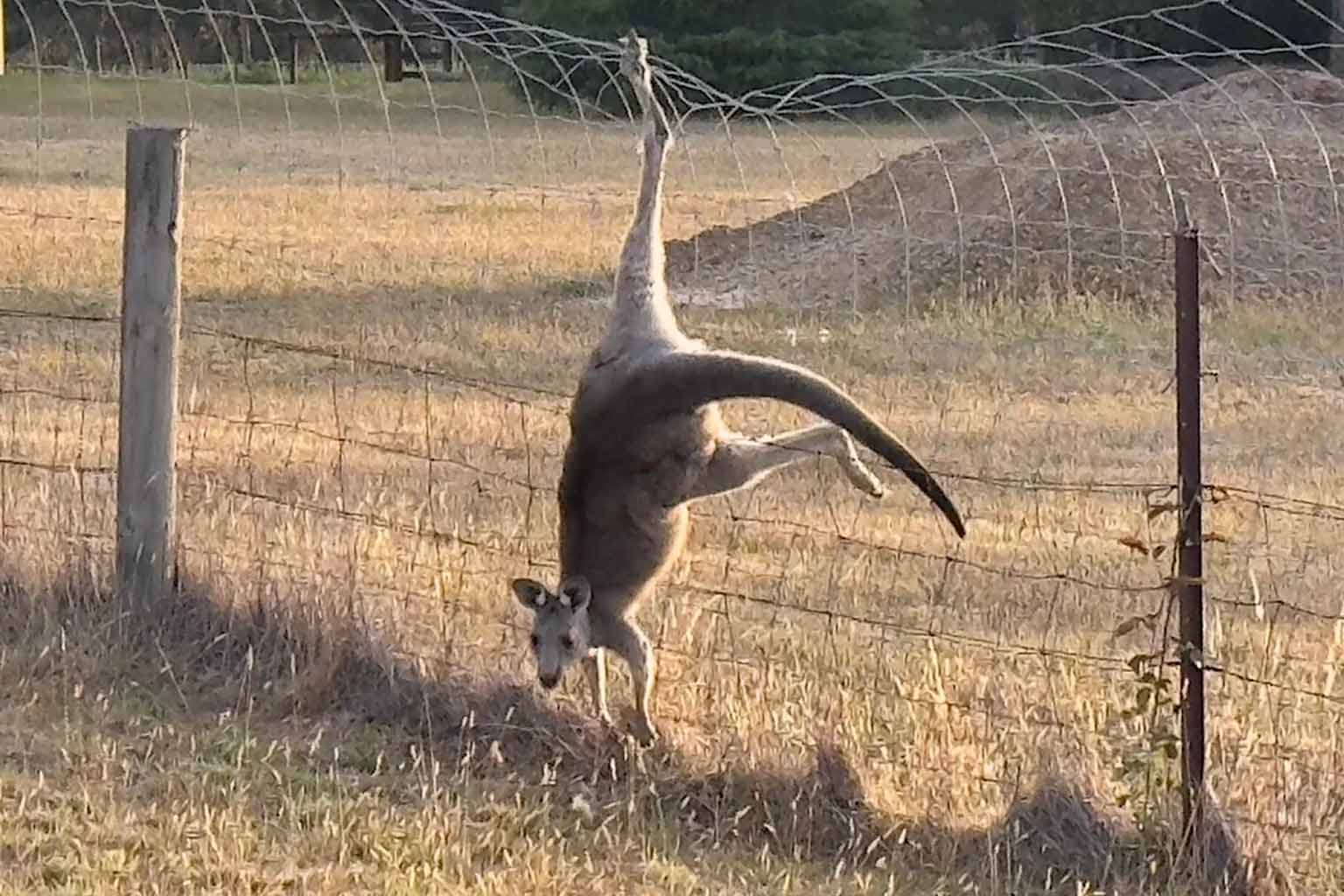
The sight of a mother kangaroo suspended lifeless from a barbed wire fence, her joey tucked helplessly in her pouch, represents more than just another wildlife tragedy. It’s a stark reminder of how human infrastructure creates invisible death traps across Australia’s rural landscape. This particular incident in Victoria’s Sutherlands Creek has once again brought attention to what wildlife rescuers call a silent epidemic claiming native animals every single day.
Wildlife rescuer Angela Summer arrived at the scene knowing there was little hope. The mother kangaroo had been trapped overnight, her body already showing signs of prolonged suffering. The joey inside her pouch was too young to survive independently. What makes this tragedy particularly devastating is its preventable nature—and its frequency. Research from the Australian Wildlife Hospital confirms that rescuers report finding approximately one kangaroo per day caught in fencing across rural Australia, transforming what should be simple property boundaries into systematic wildlife killers.
“Tens of thousands of native animals die every year on barbed-wire fences, with the Australian Wildlife Hospital treating over 80 different species found caught in these deadly traps” – Australian Wildlife Hospital research
The mechanics of these accidents reveal why they’re so common and so deadly. Kangaroos are powerful jumpers, but they frequently misjudge distances, particularly when fleeing predators or moving between feeding areas. The top strand of barbed wire becomes a snare, catching animals by the neck, limbs, or body as they attempt to clear fences.
The Anatomy of a Wire Trap Death
Understanding how kangaroos become fence hangers illuminates the cruel physics of these accidents. When a kangaroo’s jump falls short, barbed wire doesn’t simply scratch—it grips. The animal’s weight and struggle only tighten the wire’s hold, creating what wildlife experts describe as a slow-motion execution.
The injuries sustained during these encounters are severe. Animals suffer deep lacerations that sever muscles and tendons, broken bones from thrashing attempts to escape, and spinal injuries that cause paralysis. Those found alive often require euthanization due to the extent of their trauma. Research conducted by wildlife rehabilitation centers shows that even rescued kangaroos face long recovery periods, with many never regaining full mobility.
The temporal aspect makes these incidents particularly cruel. Unlike vehicle strikes that cause instant death, fence entrapment subjects animals to hours or days of suffering. They die from a combination of blood loss, shock, and exhaustion, often in full view of their mob, which typically remains nearby until the trapped animal’s death.
Property Rights Versus Wildlife Protection
The tension between landowner autonomy and wildlife conservation creates a complex challenge across rural Australia. Farmers and rural property owners rely on barbed wire fencing for legitimate reasons—it’s cost-effective, durable, and provides security for livestock and crops. Replacing existing infrastructure represents significant financial investment, particularly for large properties.
Simple modifications could dramatically reduce wildlife casualties without compromising fence effectiveness. Wildlife advocates recommend adding reflective tape or white markers to increase fence visibility, particularly along known wildlife corridors. Some suggest replacing only the top strand of barbed wire with plain wire or electric fencing alternatives. Similar conservation efforts have proven successful with other species, as demonstrated by the genetic research protecting Caribbean crocodile species through habitat modification.
Doug Gimesy’s decision to remove 17 kilometers of barbed wire from his Victorian property demonstrates that individual action can make a difference. His year-long project required walking his fence lines twice, methodically cutting and removing the deadly top wires. While extreme, his approach eliminated fence-related wildlife deaths on his land entirely.
The Economics of Wildlife-Safe Fencing
Cost considerations dominate landowner decision-making regarding fence modifications. Standard barbed wire costs significantly less than wildlife-friendly alternatives, and retrofit projects require substantial labor investment. For properties spanning hundreds of acres, even minor modifications can cost thousands of dollars.
Studies published in conservation research examining the economic impact of wildlife-safe fencing reveal mixed results. While initial costs are higher, reduced wildlife cleanup, decreased insurance claims from vehicle collisions with escaped livestock, and potential eco-tourism benefits can offset expenses over time. Some regions have explored government incentive programs to encourage fence modifications, though funding remains limited.
“Fencing infrastructure influences landscapes across space and time, with significant impacts on wildlife and ecosystems that require greater attention from conservation policy makers” – Conservation Biology research
The insurance industry has begun recognizing wildlife-vehicle collisions as a growing concern, particularly in areas with high kangaroo populations. This economic pressure may eventually drive policy changes that make wildlife-safe fencing more financially attractive to property owners.
The Psychological Toll on Rural Communities
Wildlife rescuers working these cases develop what researchers call compassion fatigue from repeatedly encountering preventable animal suffering. The emotional impact extends beyond rescue organizations to include rural residents, farmers, and even children who discover trapped animals on their properties.
Many rural communities report that frequent wildlife deaths create a sense of helplessness and moral conflict. Farmers who depend on traditional fencing methods often struggle with guilt when they discover fence casualties, particularly when young animals are involved. This psychological burden represents an often-overlooked cost of current fencing practices. Conservation success stories, like the harpy eagle comeback in the Lacandon Jungle, demonstrate that wildlife protection efforts can yield positive outcomes when properly implemented.
Mental health professionals working in rural areas note increased counseling requests related to wildlife trauma exposure. The cumulative effect of witnessing repeated animal suffering affects community well-being in ways that traditional policy discussions rarely address. Just as archaeological discoveries like the 1,700-year-old altar at Tikal reveal complex historical relationships, the fence mortality crisis exposes intricate connections between human development and wildlife survival.
The broader question emerging from incidents like the Sutherlands Creek tragedy isn’t whether solutions exist—they clearly do. The challenge lies in creating incentive structures that make wildlife-friendly choices more appealing than maintaining deadly status quo practices. Until that balance shifts, wildlife rescuers will continue racing against time, knowing that tomorrow will likely bring another call about another fence hanger somewhere across Australia’s rural landscape.