


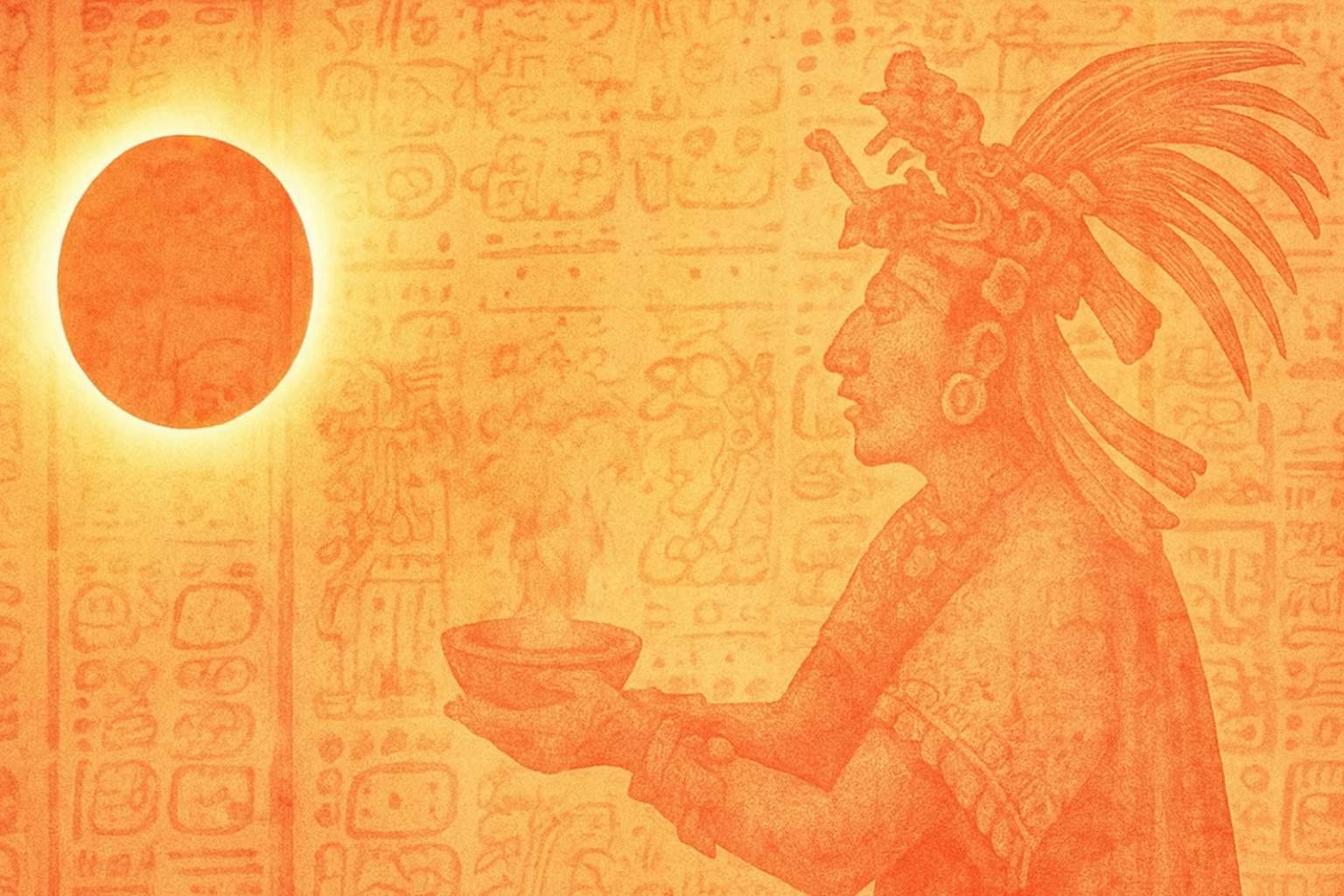
The ancient Maya civilization continues to astonish us with discoveries that challenge our understanding of their knowledge systems. From astronomy to mathematics and ritual calendars, new research reveals just how sophisticated the Maya were—far beyond the mystical reputation often attributed to them.
These findings come from the Maya calendar, specifically the enigmatic Dresden Codex, a surviving pre-Columbian manuscript that has captivated scholars for over a century. What scientists are uncovering today about this calendar not only shifts our perspective on Maya science but also highlights their extraordinary intellectual achievements.
The Dresden Codex: A precious window into Maya science
The Dresden Codex stands as one of the four surviving Maya codices — invaluable rare manuscripts that escaped destruction during the Spanish colonial conquest in the 16th century. This accordion-folded book contains 39 bark-paper pages densely inscribed with hieroglyphs and vividly colored illustrations. While copied around the 13th or 14th century, much of its content traces back to the Maya Classic Period (250–900 AD).
Preserved today at the Saxon State Library in Dresden, Germany, the codex holds detailed astronomical tables, including eclipse predictions that have intrigued scientists for more than 100 years. The precision of the eclipse data seemed almost uncanny, prompting a recent in-depth analysis published in Science Advances in 2025.
This new research reveals that the eclipse tables were not originally designed solely to forecast solar eclipses—a common assumption. Instead, they emerged as a byproduct of a much broader system aligning the Maya’s complex calendar cycles.
Harmonizing lunar and ritual calendars
The Maya operated with multiple calendars simultaneously, including the lunar calendar based on monthly moon phases and the ritualistic Tzolk’in calendar of 260 days. The recent study shows that the eclipse tables resulted from carefully synchronizing these two calendrical systems.
By overlapping the lunar and Tzolk’in cycles, Maya scribes detected intervals correlating with eclipse events. These eclipses weren’t just random occurrences predicted by chance but rather “emergent phenomena” of their internally consistent timekeeping framework.
This breakthrough elevates our appreciation of how the Maya ingeniously combined different temporal rhythms into a unified system. As shown in the codex illustrations, the red-highlighted eclipse tables reflect this sophisticated integration (Codex eclipse tables shown © Justeson and Lowry, 2025, Science Advances).
Unmatched precision through cumulative calculations
One of the most remarkable aspects of Maya astronomy is the long-term accuracy of their predictions. The study explains this by revealing a cumulative correction process: rather than relying on a single cycle repeatedly, the Maya layered multiple tables that interacted to offset deviations from natural astronomical drifts.
This method of redundancy and adjustment granted the Maya eclipse forecasts an astonishing accuracy—comparable in some ways to modern mathematical astronomy.
As Dr. Michael Justeson, co-author of the study, notes, “The Maya devised a system of astronomical prediction remarkably akin to current scientific methods, blending empirical observations with advanced mathematical computation.”
This innovative approach dispels outdated stereotypes portraying Maya knowledge as purely mystical or anecdotal. Instead, it reflects a scientifically rigorous civilization with a keen grasp of celestial mechanics.
A scientific and spiritual masterpiece
The Dresden Codex emerges not just as a calendar or an astronomical handbook but as an integrated treatise combining science, spirituality, and ritual. Its function extended beyond observational purposes; it was deeply woven into the Maya cosmology and religious worldview, embodying their conception of time as a living, cyclical force.
This dual nature—both empirical and symbolic—explains why the codex has confounded and fascinated researchers for centuries. Decoding its contents underscores how the Maya were profound thinkers of both the cosmos and the concept of time, blending intellectual rigor with cosmological meaning.
For additional context, NASA’s history of eclipse prediction notes the importance of cycle synchronization in early astronomy, supporting the Maya’s approach of layered calendrical systems for enhanced accuracy. According to a NASA report, “Ancient civilizations used the Saros cycle and other periods to forecast eclipses effectively.”
The enduring brilliance of the Dresden Codex continues to inspire modern scholars and enthusiasts alike. This blend of precise, empirically grounded knowledge with rich spiritual symbolism confirms the Maya as one of history’s most intellectually vibrant cultures.
“The Mayan calendar doesn’t just mark time; it reveals a civilization’s deep connection with the cosmos and an unrivaled mastery of astronomy.” — Dr. Michael Justeson, Linguist and Maya specialist
Have these insights changed your view of the ancient Maya? Share your thoughts or questions below and join the conversation about one of history’s most fascinating civilizations.