


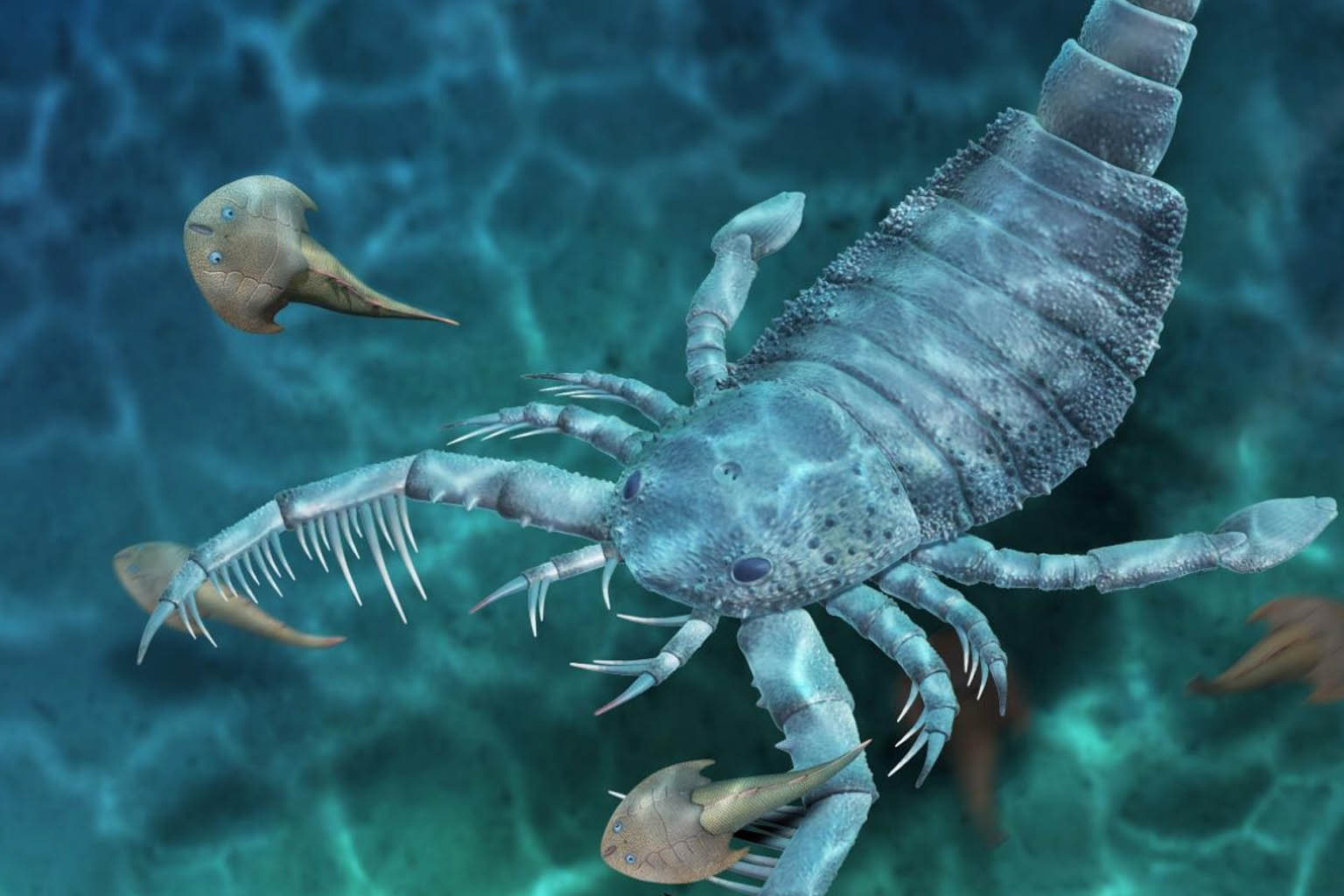
The discovery of ancient life forms continues to reshape our understanding of prehistoric ecosystems, but few finds capture the imagination quite like predatory arachnids from the age of dinosaurs. When paleontologists uncovered a 125-million-year-old scorpion fossil in China’s renowned Yixian Formation, they weren’t just finding another specimen. They were revealing a window into the complex predator-prey relationships that existed during the Early Cretaceous period, much like other remarkable discoveries such as the tiny dinosaur in 99-million-year-old amber that has similarly transformed our understanding of prehistoric life.
The newly identified species, Jeholia longchengi, measured an impressive 4 inches in length, making it a giant among its contemporaries. This prehistoric predator roamed the diverse landscapes of what is now northeastern China, hunting insects, small reptiles, and possibly tiny mammals while simultaneously serving as prey for larger vertebrates, including dinosaurs. The fossil represents only the fourth known terrestrial scorpion fossil found in China and the first from the Mesozoic era, marking it as an extraordinary contribution to our understanding of ancient arachnid evolution.
What makes this discovery particularly remarkable is how it challenges our assumptions about prehistoric ecosystems. The Jehol Biota wasn’t simply a world dominated by massive dinosaurs, but rather a intricate web of predators and prey spanning multiple size categories and ecological niches.
Exceptional Preservation in an Unlikely Medium
Scorpion fossils represent some of the rarest finds in paleontology, despite these creatures having stalked the Earth for more than 400 million years. Their burrowing behavior and preference for terrestrial habitats create conditions that rarely favor fossilization. Most Mesozoic scorpion specimens that researchers do encounter are preserved in amber rather than sedimentary rock, similar to other remarkable finds like the amber fossil that captured a 100-million-year-old spider attack.
The preservation of Jeholia longchengi in sedimentary rock layers offers researchers an unprecedented opportunity to study the creature in its natural environment. Research published by scientists from the Nanjing Institute of Geology and Palaeontology reveals intricate anatomical details that would be impossible to observe in amber-preserved specimens. The fossil’s rounded spiracles and distinctive breathing apparatus show clear evolutionary links to modern Asian scorpion families, suggesting that certain anatomical features have remained remarkably consistent across geological time periods.
A Predator Built for Its Time
Jeholia longchengi possessed anatomical features that set it apart from both its ancient contemporaries and modern descendants. Its long legs and slim pincers suggest hunting strategies quite different from the powerful, crushing claws we associate with many modern scorpions. The slender pedipalps lacked certain spurs found in other species, indicating specialized predatory adaptations that may have been perfectly suited to the prey available in Early Cretaceous ecosystems.
Research indicates that this species occupied a mid-level predatory role within the complex food web of the Jehol Biota. While it hunted smaller creatures, it simultaneously had to avoid becoming prey itself for the numerous vertebrate predators that shared its environment. This delicate balance required both hunting prowess and defensive capabilities, reflected in the scorpion’s robust yet agile build. Such complex defensive strategies were essential for survival in these ancient ecosystems.
Scientists speculate that if Jeholia longchengi existed in modern ecosystems, it would likely dominate as a predator of insects, amphibians, and juvenile vertebrates. Its size advantage over contemporary scorpions would have provided significant hunting advantages in the diverse prehistoric landscape.
Life in the Jehol Biota Ecosystem
The Yixian Formation has yielded some of the most spectacular fossil discoveries of recent decades, revealing an ecosystem of remarkable diversity and complexity. During the Early Cretaceous period, this region supported dinosaurs, primitive birds, early mammals, amphibians, and numerous arthropod species. Within this complex food web, Jeholia longchengi carved out its ecological niche as both predator and prey.
Evidence suggests that the climate and environmental conditions of the Jehol Biota provided ideal hunting grounds for a large terrestrial scorpion. The abundance of suitable prey species, combined with sufficient shelter and appropriate climatic conditions, created an environment where these arachnids could thrive alongside much larger and more famous prehistoric creatures. This period also witnessed dramatic geological events during the Early Cretaceous period that shaped these ancient ecosystems.
The fossil’s current home at the Fossil Valley Museum in Chaoyang, China, ensures that ongoing research will continue to unlock secrets about how these early arachnids adapted to life during the age of dinosaurs.
The Evolutionary Puzzle This Discovery Solves
Beyond its immediate scientific value, Jeholia longchengi addresses several long-standing questions about arachnid evolution during the Mesozoic era. The fossil provides crucial data points for understanding how scorpions adapted to changing environmental conditions and evolving ecosystems. Its anatomical features bridge gaps between earlier Paleozoic forms and later Cenozoic species, offering insights into evolutionary adaptations that occurred during a critical period in Earth’s history.
The discovery also highlights how predatory relationships shaped evolution in ways that pure size and strength couldn’t determine. While dinosaurs dominated through sheer scale, creatures like Jeholia longchengi succeeded through specialized hunting techniques and ecological flexibility. This suggests that evolutionary success in prehistoric ecosystems depended on finding the right balance between offensive capabilities, defensive strategies, and environmental adaptation.
Research findings indicate that the scorpion’s unique combination of size, mobility, and predatory tools made it particularly well-suited to exploit ecological opportunities that might have been unavailable to either smaller or more heavily-built contemporaries.
As paleontologists continue studying this remarkable specimen, they’re uncovering evidence that prehistoric ecosystems operated with far greater complexity than previously understood. The existence of specialized predators like Jeholia longchengi suggests that even 125 million years ago, evolutionary pressures were creating intricate ecological relationships that mirror the sophisticated predator-prey dynamics we observe in modern environments. Perhaps the most intriguing question isn’t what this ancient scorpion hunted, but what evolutionary pressures ultimately led to its extinction while smaller, seemingly less capable relatives survived to populate today’s world.