


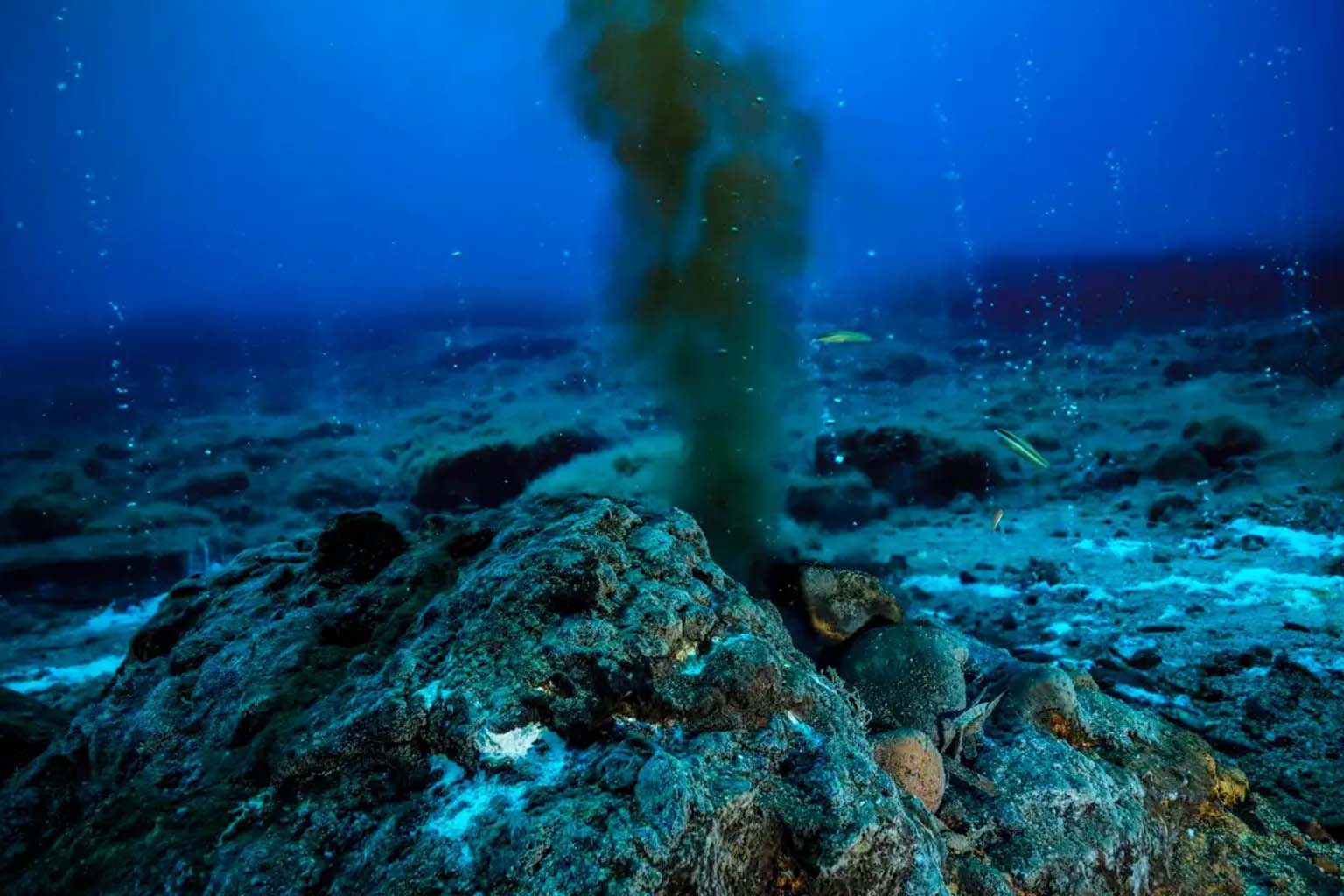
The deep ocean continues to reveal secrets that challenge our most basic assumptions about life on Earth. When marine biologists descended to explore what they believed was a long-dormant underwater volcano off the Pacific coast of Canada, they expected to find a cold, lifeless mountain rising from the seafloor. Instead, they discovered something extraordinary: an ancient seamount still pulsing with volcanic heat and serving as an unlikely nursery for nearly a million mysterious deep-sea eggs. Such groundbreaking discoveries remind us that our planet continues to yield secrets across different environments and time periods, much like how LiDAR technology revealed ancient Romanian defenses hidden beneath modern landscapes.
This discovery fundamentally alters our understanding of how life persists in the planet’s most extreme environments. The volcano, towering 3,600 feet above the seafloor and sitting nearly a mile beneath the ocean surface, was supposed to be extinct. The presence of active hydrothermal vents and an entire ecosystem thriving in this isolated environment suggests we’ve barely scratched the surface of what lies hidden in our oceans’ depths.
The implications extend far beyond a single volcanic seamount. If this “dead” volcano turned out to be vibrantly alive, how many others have we misclassified? And what does this mean for our understanding of deep-sea biodiversity in an era when these environments face increasing threats from human activity?
When Dead Volcanoes Come Back to Life
The expedition team, led by Cherisse Du Preez from Fisheries and Oceans Canada, approached the seamount with standard expectations for a dormant volcanic structure. What they found through their remotely operated vehicles completely upended those assumptions. Warm, mineral-rich water was actively seeping from cracks in the rock, creating localized environments that could support complex life forms in an otherwise hostile deep-sea desert.
This discovery highlights a critical gap in our knowledge of underwater volcanic systems. Scientists have traditionally classified seamounts as active or extinct based on limited data, often collected from surface observations or brief surveys. The reality appears far more nuanced, with volcanic systems existing in various states of semi-activity that we’re only beginning to understand.
Research indicates that many seamounts previously considered dormant may actually be releasing heat at levels sufficient to create these unique ecological niches. The challenge lies in detecting this activity from the surface, particularly when thermal output is moderate rather than dramatically obvious. Just as scientists have discovered how genetic diversity can collapse suddenly in populations, these volcanic systems may shift between active and dormant states more rapidly than previously understood.
The Pacific White Skate’s Extraordinary Strategy
The most striking aspect of this discovery wasn’t just the active volcano, but its role as a massive incubator for Pacific white skate eggs. These deep-sea predators, relatives of sharks and rays, have developed what appears to be a sophisticated reproductive strategy that takes advantage of geothermal heat in the ocean’s depths.
The eggs themselves are remarkable specimens. Known as “mermaid purses” due to their distinctive rectangular shape, these protective cases house developing embryos for up to four years before hatching. In the frigid temperatures typical of deep ocean environments, such extended development periods represent enormous risks for the species’ survival.
Research from NOAA has shown that the warmth from hydrothermal vents can significantly accelerate development times for deep-sea species. For Pacific white skates, this could mean the difference between successful reproduction and evolutionary dead ends. The species inhabits depths between 2,600 and 9,500 feet, where finding reliable heat sources becomes crucial for reproductive success.
“Deep-sea corals and sponges to commercially important fish and migratory species converge at seamounts, creating critical habitat connections” – NOAA Marine Sanctuaries
A Coral Garden in the Abyss
Beyond serving as a nursery, the seamount’s summit has developed into what researchers describe as an underwater oasis. The combination of volcanic heat and mineral-rich water has created conditions that support a diverse coral garden ecosystem in depths where such communities rarely exist.
This environment provides multiple advantages for developing skate embryos. The coral formations offer physical protection from deep-sea predators, while the elevated position on the seamount’s summit provides better water circulation and potentially higher oxygen levels. Young skates can mature in this relatively protected environment before venturing into the deeper, more challenging waters where adults typically hunt. This strategic use of elevated terrain for protection mirrors how ancient civilizations, such as those who built prehistoric settlements in France, chose advantageous locations for survival.
The discovery parallels similar findings near the Galápagos Islands in 2018, where researchers also found skate eggs clustered around hydrothermal vents. This pattern suggests that the behavior may be more widespread than previously understood, representing an evolved adaptation to the extreme conditions of deep-sea life.
The Uncharted Territory of Seamount Ecology
This revelation opens entirely new questions about the role of supposedly extinct volcanoes in supporting deep-sea biodiversity. Current estimates suggest there are tens of thousands of seamounts worldwide, but only a tiny fraction have been thoroughly explored. If even a small percentage of these “dormant” structures are actually supporting active ecosystems, the implications for marine conservation are profound.
The Pacific white skate discovery also raises concerns about how little we understand regarding the reproductive cycles and habitat requirements of deep-sea species. These animals face increasing pressure from deep-sea mining, climate change, and ocean acidification, yet their basic life histories remain largely mysterious to science. Studies published in Deep Sea Research indicate that seamount summits may serve as crucial nursery areas for multiple deep-sea species.
“Abundance of Arctic Skate eggs suggests seamount summit to be a nursery area, highlighting the critical importance of these deep-sea habitats” – Deep Sea Research findings
Expert analysis suggests that seamount ecosystems may serve as crucial stepping stones for deep-sea species migration and genetic diversity maintenance. The loss of even seemingly insignificant volcanic features could have cascading effects on species we haven’t yet discovered, let alone studied in detail. Understanding these complex systems becomes as crucial as uncovering ancient defensive structures that reveal how civilizations adapted to their environments.
As we push further into the deep ocean for resources and commercial opportunities, discoveries like this volcanic nursery remind us how much we still don’t know about our planet’s most extensive habitat. The million eggs scattered across this ancient seamount represent not just one species’ remarkable adaptation, but a window into the complex relationships that sustain life in Earth’s final frontier.