


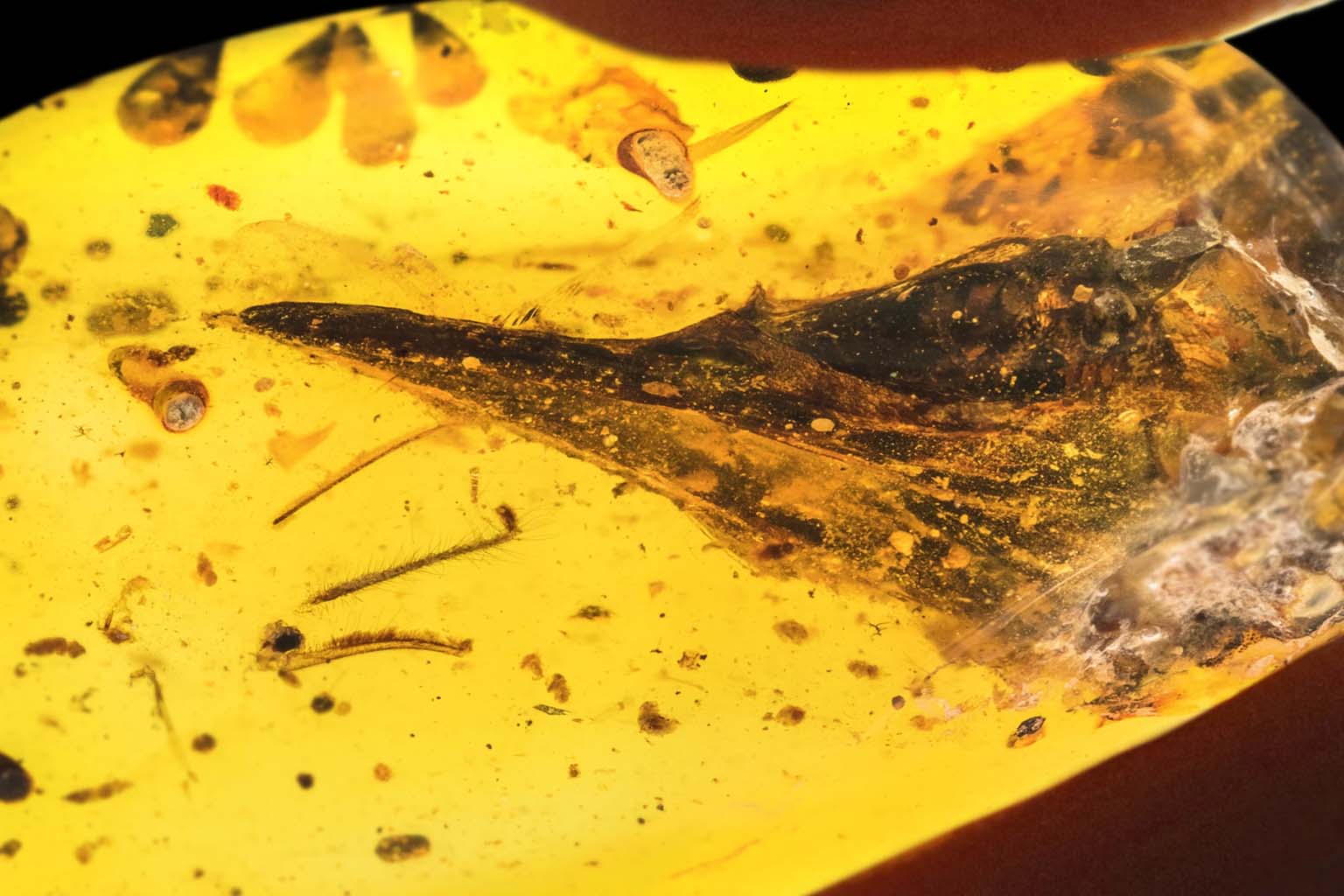
Prepare to be amazed by a discovery that’s turning the world of paleontology on its head. Imagine, if you will, a **dinosaur no bigger than a hummingbird**, perfectly preserved in amber for 99 million years. Sounds like something out of a sci-fi movie, doesn’t it? Yet, this is the reality with the discovery of *Oculudentavis khaungraae*, the tiniest dinosaur fossil ever found, challenging everything we thought we knew about prehistoric life.
In the lush, prehistoric realms of what is now Myanmar, this extraordinary fossil was unearthed. The skull of this diminutive creature was found encased in amber, acting like nature’s time capsule. According to a study published in Nature, *Oculudentavis* boasted a startling set of over 100 razor-sharp teeth and unusually large eye sockets. Such features are not only rare in fossils but also quite unlike any species alive today. Imagine lizard-like eyes paired with a feather-light frame—stunning and *really* unsettling at the same time.
Have you ever wondered just how ancient civilizations really looked like, down to the smallest details? This diminutive dinosaur is offering us surprising and critical insights into corners of the dinosaur ecosystem that are so often overlooked. “When you have an animal preserved in amber, it looks like it just died yesterday,” said a paleontologist involved in the study. The amber has preserved not just bones, but feathers, skin, and even the most delicate tissues with a clarity that’s astonishing. This allows scientists to recreate the past with remarkable detail.
What truly sets *Oculudentavis* apart is its high tooth count packed into such a tiny skull— *over 100 teeth!* Can you imagine such a thing? “These weird eyes sticking off looking to the side. There’s nothing like this alive today,” commented one expert. Adding to the mystery is the fact that island dwarfism usually results in fewer teeth and larger eyes—yet, here it’s a different story. This peculiar set of traits, with more teeth than any ancient bird we’ve ever found, stands as a testament to nature’s incredible unpredictability.
In the field of paleontology, discoveries like these are not just rare—they’re transformative. With its exaggerated eyes and multitude of teeth, *Oculudentavis* contributes a unique piece to the puzzle of how dinosaurs evolved into the birds we know today. It’s difficult to fathom but mix in this tiny predator who likely feasted on insects and small invertebrates, and you have an evolutionary tale that’s more intricate than the most skilled storyteller could spin. Paleontologist Lida Xing, who has a penchant for discovering dinosaurs in amber, acknowledges that this find dramatically expands our understanding of dinosaur diversity.
A video that highlights the details of this extraordinary creature can be viewed here:
So, what does this mean for our understanding of prehistoric life? Quite simply, it tells us that there’s still so much left to uncover, so many incredible mysteries hiding in plain sight or buried in amber. Hopefully, the story of *Oculudentavis khaungraae* inspires both awe and curiosity. Much like reading a captivating mystery novel, wouldn’t you want to unravel more?
If dinosaurs and ancient life fascinate you, stay tuned. There’s always another question waiting to be answered, another layer of the past waiting to be peeled back. Who knows what other prehistoric wonders might be lying in wait, just a discovery away?