


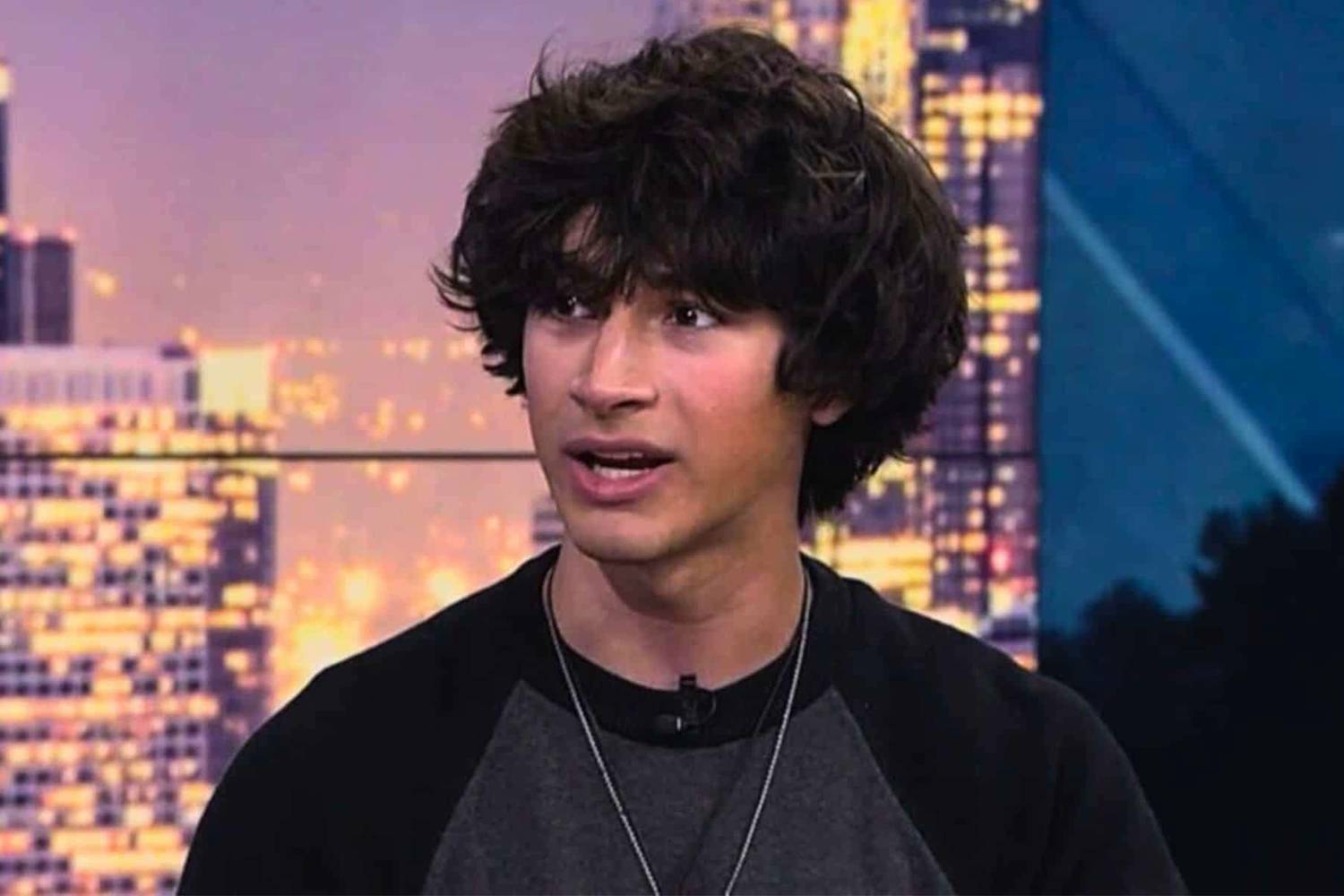
A high school senior from California just stunned the scientific community by uncovering over 1.5 million hidden celestial objects lurking in deep space. Using a clever AI algorithm he built himself, this teenager has peeled back layers of the infrared universe previously invisible even to seasoned astronomers. His discovery not only challenges what we thought we knew about the cosmos but also reveals the incredible power of young minds combined with advanced technology.
A Teenager’s Breakthrough in Cosmic Discovery
Seventeen-year-old Matteo Paz from Pasadena did not find these cosmic treasures by accident. With a deep passion for astronomy and remarkable coding skills, he engineered a specialized machine learning pipeline to comb through NASA’s NEOWISE mission data—more than 200 billion rows of infrared sky observations collected over a decade. What his model uncovered were faint flickers, pulses, and dimming events in the infrared sky—signals often too subtle or slow-changing for traditional detection methods.
Launched in 2009, NEOWISE was designed to track near-Earth asteroids, amassing a treasure trove of infrared data. Despite its massive archive, only fragments had been analyzed for time-domain phenomena, such as stars that vary in brightness or other transient cosmic events. Most of this data remained a sleeping giant waiting for new tools to breathe life into it.
Mentored by Davy Kirkpatrick, a senior scientist at Caltech’s Infrared Processing and Analysis Center (IPAC), Paz suggested a radical approach: instead of manually studying a small sample, he would apply a comprehensive AI model to analyze the entire dataset. This idea immediately bore fruit, uncovering a wealth of previously ignored celestial activity.
Harnessing AI to Reveal the Universe’s Hidden Signals
The heart of Paz’s discovery lies in his algorithm’s sophisticated blend of Fourier transform and wavelet analysis techniques. These mathematical methods allow it to detect tiny fluctuations in light intensity—signatures of astrophysical phenomena like quasars, supernovae, and eclipsing binary stars that had eluded human observers. The AI flagged millions of unique light curves, compiling a catalog of 1.5 million newly identified celestial objects.
“This suggests that our universe holds vast hidden layers of activity, accessible only through advanced data processing,” Kirkpatrick remarked. Supporting this, a recent 2023 study published in The Astronomical Journal highlights how AI and machine learning are revolutionizing astronomy by unlocking new discoveries from legacy datasets.
These findings have far-reaching implications, potentially transforming how scientists understand stellar evolution and map the architecture of our galaxy. What’s more, some signals could point to entirely undiscovered astrophysical phenomena awaiting confirmation by cutting-edge observatories like the Vera Rubin Observatory and NASA’s James Webb Space Telescope.
Beyond Astronomy: AI’s Broader Impact on Time-Series Data
Paz’s algorithm, while tailored for star variability, is fundamentally designed to detect patterns in any time-series data. This opens exciting doors beyond astrophysics. Similar AI-driven methods could enhance monitoring of environmental pollution, seismic vibration patterns, or even fluctuations in financial markets.
“Detecting change over time is the crucial skill,” Paz explained in an interview at Caltech. “Whether it’s stars or stock prices, once you understand that, the possibilities are endless.”
NASA itself is ramping up investments in AI-enhanced workflows, recognizing such models’ potential to reshape data analysis across the scientific spectrum. Paz’s accomplishment stands as a strong proof-of-concept: when combined with human ingenuity and mentoring, machine learning can do more than accelerate analysis—it can transform entire fields of research.
Mentorship and Education Fueling Tomorrow’s Innovators
Behind this groundbreaking discovery is a story of mentorship and opportunity. Kirkpatrick, a respected astrophysicist known for advancing brown dwarf research, has been an outspoken advocate for expanding access to astronomy for underrepresented groups. “We have an ocean of data but far too few eyes trained on it,” he said. “Talented young people like Matteo remind us what’s possible with the right support.”
Paz’s journey began early. He is part of Pasadena Unified School District’s Math Academy, a program accelerating gifted students through college-level courses long before graduation. By eighth grade, he had completed AP Calculus BC; by senior year, he had published a solo paper in one of the field’s top journals.
His story highlights how early academic preparation, mentorship, and open data initiatives converge to empower young scientists. It also underscores how fresh perspectives can unlock dormant scientific treasures in legacy datasets.
If you’re captivated by this blend of youth, AI, and space exploration, we would love to hear your thoughts. How do you envision AI shaping the future of astronomy? Share your reactions and join this exciting conversation.