


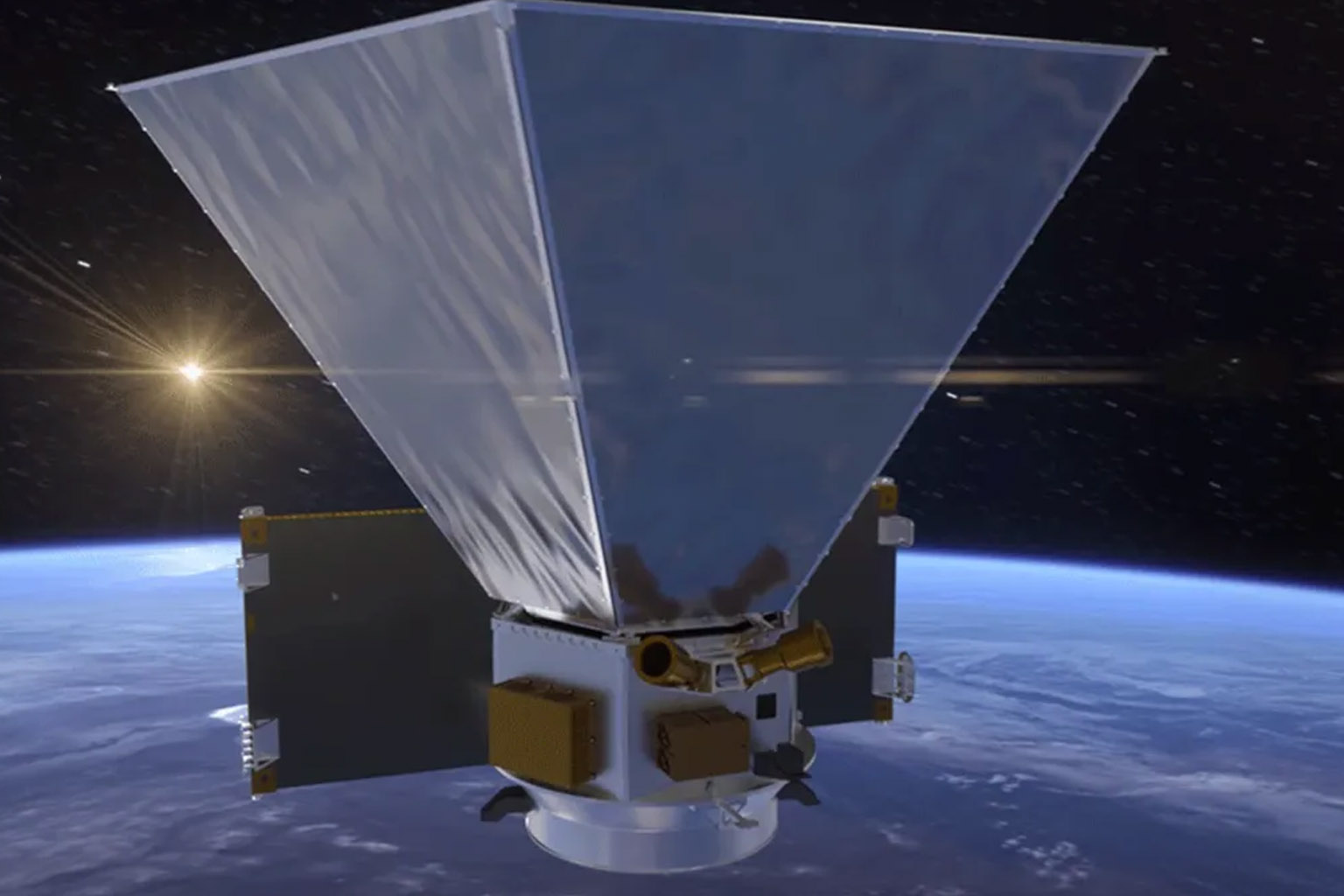
The cosmos has always been humanity’s greatest puzzle, but we stand at a remarkable threshold where technology might finally deliver answers to questions that have haunted us for millennia. Just as archaeologists uncover ancient mysteries that reveal humanity’s deep past, astronomers are preparing to unveil cosmic secrets that stretch back to the universe’s very beginning. On March 4, NASA will launch SPHEREx, a telescope that promises to revolutionize our understanding of both the universe’s violent birth and the chemical foundations of life itself.
Unlike the focused gaze of telescopes like James Webb, which peer deeply into specific cosmic neighborhoods, SPHEREx will cast its net across the entire sky. This all-sky infrared survey represents a fundamentally different approach to astronomy—one that prioritizes breadth over depth, seeking patterns and connections that can only emerge from a comprehensive view of our cosmic environment.
What makes this mission particularly compelling is its dual purpose: investigating the universe’s earliest moments while simultaneously mapping the very molecules that might seed life across countless worlds. These aren’t separate scientific pursuits but interconnected threads in the same cosmic story.
Mapping the Molecular Foundation of Life
SPHEREx will spend two years creating an unprecedented catalog of water and organic molecules scattered throughout space. These aren’t random chemicals drifting in the void—they represent the fundamental building blocks from which life emerges. According to research from NASA’s SPHEREx mission team, the telescope’s spectrophotometer will detect these molecules in more than 100 different infrared wavelengths, revealing their distribution across molecular clouds where stars and planets are born.
“The mission will create the first all-sky spectral survey, measuring both the positions and colors of celestial objects to unlock cosmic mysteries spanning from our local solar system to the most distant galaxies” – NASA SPHEREx Mission
The implications extend far beyond simple detection. Scientists have long suspected that complex organic compounds travel from interstellar space to newly forming planetary systems, but the mechanism remains unclear. By mapping where these life-building molecules concentrate and how they move through space, SPHEREx could help predict which stellar systems are most likely to harbor habitable worlds.
Research suggests that the abundance and distribution of these compounds might follow patterns that could revolutionize our estimates of life’s prevalence in the universe. If organic molecules cluster in specific regions or follow predictable pathways to planetary systems, it would provide the first comprehensive framework for understanding how life’s ingredients spread across the galaxy.
Decoding the Universe’s First Moments
The telescope’s cosmological mission tackles one of physics’ most perplexing mysteries: cosmic inflation. In the first fraction of a second after the Big Bang, the universe underwent an expansion so rapid and dramatic that it challenges our understanding of fundamental physics. The energy scales involved dwarf anything we can replicate or study on Earth, leaving scientists to piece together this cosmic puzzle through indirect evidence.
SPHEREx will create a three-dimensional map of over 450 million galaxies, tracing the faint ripples that cosmic inflation left embedded in the universe’s structure. These ripples, stretched across billions of light-years, represent the fossil remains of quantum fluctuations from the universe’s infancy. By analyzing their patterns and distribution, scientists hope to identify the specific physics that drove this primordial expansion.
The challenge lies in extracting meaningful signals from an almost incomprehensibly vast dataset. The patterns SPHEREx seeks are subtle variations in galaxy distribution that could easily be masked by other cosmic processes. Success would provide the most detailed evidence yet for inflation theory and potentially reveal new physics operating at energy scales far beyond our current experimental capabilities.
The Hidden Universe of Interstellar Dust
While astronomers traditionally view interstellar dust as an observational nuisance that obscures distant objects, SPHEREx will reveal it as a crucial component of cosmic evolution. This dust doesn’t simply exist passively between stars—it actively shapes star formation, planet development, and the chemical evolution of galaxies. Much like how LiDAR technology reveals hidden ancient structures on Earth, SPHEREx’s infrared vision will unveil the hidden architecture of cosmic dust.
The telescope’s comprehensive survey will map dust distribution with unprecedented detail, revealing how it moves through space and influences the birth of new stellar systems. Understanding dust patterns could refine models of planet formation and help explain why some regions of the galaxy produce more habitable worlds than others.
Studies indicate that dust composition varies significantly across different galactic environments, suggesting that planetary systems forming in dust-rich regions might have fundamentally different chemical compositions than those in dust-poor areas. This variation could profoundly impact the types of planets that form and their potential for supporting life. Just as archaeological discoveries at sites like Tikal archaeological site reveal complex cultural interactions across ancient civilizations, SPHEREx may reveal complex chemical interactions across cosmic environments.
The Technical Challenges Behind Cosmic Cartography
Creating an all-sky survey presents unique engineering and analytical challenges that don’t affect targeted observations. Studies from the SPHEREx mission team indicate that the telescope must maintain consistent calibration across its entire two-year mission while scanning the sky four complete times. Any drift in instrument sensitivity or systematic errors could compromise the subtle patterns the telescope seeks to detect.
The data processing requirements are staggering. Converting raw infrared measurements into meaningful maps of molecular distribution and galaxy positions requires sophisticated algorithms that can distinguish genuine cosmic signals from instrumental artifacts. The telescope will generate petabytes of data that must be processed and cross-referenced to extract the faint signatures of cosmic inflation and molecular clouds. This computational challenge mirrors the complexity faced by archaeologists analyzing discoveries like the 5,000-year-old fire altar in Peru, where multiple layers of evidence must be carefully separated and interpreted.
Perhaps most challenging is the need to separate overlapping signals. The same patch of sky might contain light from nearby dust clouds, distant galaxies from the early universe, and everything in between. Extracting meaningful information about each component requires careful modeling and statistical analysis that pushes current computational capabilities to their limits.
When SPHEREx begins its observations, it will represent more than another step in space exploration—it embodies our species’ persistent drive to understand our place in an vast and ancient universe. The telescope might finally answer whether life’s building blocks are common throughout space, or reveal new physics governing the cosmos itself. As we await its first images, we’re really waiting to see how much stranger and more wonderful our universe might be than we’ve ever imagined.