


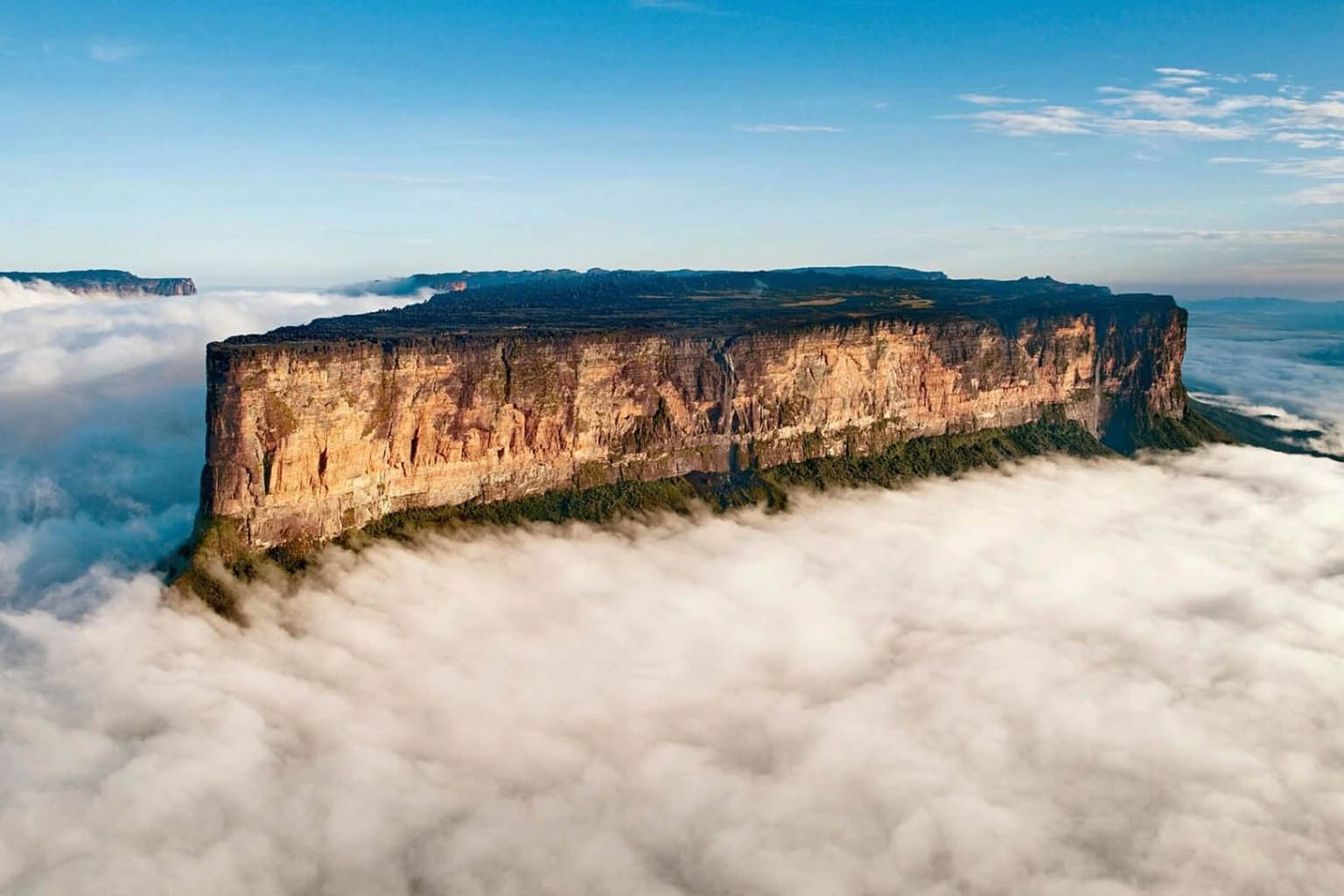
Rising from the Venezuelan savanna like a fortress carved by time itself, Mount Roraima challenges everything we thought we knew about evolution and isolation. This ancient tepui—one of Earth’s oldest geological formations at nearly 2 billion years old—has long been considered a biological island, completely cut off from the world below by sheer cliffs that tower over 3,000 feet straight up.
For generations, scientists believed that the unique creatures living on Roraima’s summit were evolutionary relics, trapped in splendid isolation for millions of years. The mountain’s endemic species, from carnivorous plants to the tiny Roraima black frog, seemed to tell a story of perfect biological separation. But recent genetic research has shattered this romantic notion, revealing that even the most isolated places on Earth aren’t as untouchable as they appear—much like how Indigenous knowledge has long recognized connections between ancient landscapes and prehistoric life that modern science is only beginning to understand.
This discovery forces us to reconsider not just Mount Roraima’s story, but our entire understanding of how life adapts and spreads in extreme environments. The implications reach far beyond this single mountain, touching on questions that matter deeply as our planet’s climate shifts and habitats fragment.
The Fortress That Time Built
Mount Roraima stands as a monument to deep time, its sandstone summit representing some of the oldest exposed rock on our planet. Research on the Precambrian Roraima Formation confirms the mountain’s extraordinary geological age through isotopic dating of volcanic rocks, establishing its formation at nearly 2 billion years ago. Unlike mountains born from volcanic fury or tectonic collision, tepuis like Roraima were sculpted by patience itself—millions of years of wind and water slowly carving away everything around them, leaving behind these impossible-looking plateaus.
“The Precambrian Roraima Formation represents one of Earth’s most ancient exposed geological structures, with isotopic evidence confirming formation periods extending back nearly 2 billion years” – Geological research studies
The mountain’s 9,219-foot elevation creates a world unto itself, where temperatures drop, rainfall patterns shift, and the very chemistry of life changes. Crystal-clear pools dot the summit, fed by waterfalls that plunge into the clouds below. This isn’t just geological spectacle—it’s a natural laboratory where evolution has been running experiments in isolation.
What makes Roraima particularly fascinating is how its vertical walls create what scientists call a “sky island” ecosystem. The summit receives different rainfall, experiences cooler temperatures, and faces unique environmental pressures that have shaped every living thing up there. The result is a collection of species found nowhere else on Earth, each one telling a story of adaptation to this aerial world.
When DNA Rewrites the Story
The revelation that changed our understanding of Mount Roraima came from an unexpected source: frog DNA. Research published in Evolution examined genetic material from endemic tree frog species across various tepuis, expecting to find evidence of ancient separation stretching back tens of millions of years. This type of genetic research has proven instrumental in revealing hidden biodiversity and evolutionary connections across isolated ecosystems.
Instead, scientists discovered that these supposedly isolated species shared common ancestors as recently as 5.3 million years ago. This finding demolished the idea that tepui ecosystems developed in complete biological isolation. Somehow, life has been finding ways to move between these aerial islands, even across seemingly impossible barriers.
The genetic evidence suggests that Mount Roraima’s unique species aren’t ancient holdovers from a lost world, but rather relatively recent arrivals that have undergone rapid evolutionary changes. This reframes the entire narrative of how species adapt to extreme environments and how quickly evolution can work when populations face new challenges.
The Sacred Dimension Modern Science Often Overlooks
While researchers focus on DNA sequences and evolutionary timelines, the Pemon people have always understood Mount Roraima differently. To them, it’s not a geological curiosity but the “House of the Gods”—a sacred space where the physical and spiritual worlds intersect. Their mythology describes the mountain as the stump of a cosmic tree that once held all the world’s fruits and vegetables.
This spiritual perspective offers insights that purely scientific approaches might miss. The Pemon understanding of Roraima as a gateway between worlds reflects a truth that genetic research is only now revealing: these mountains aren’t isolated fortresses but active participants in larger ecological networks. Indigenous knowledge systems often recognize connections that Western science takes decades to discover, similar to how ancient Mesoamerica reveals complex cultural and spiritual connections across vast distances.
The tension between viewing Roraima as either a biological laboratory or a sacred landscape highlights broader questions about how we understand nature itself. Both perspectives reveal important truths, but they also show how our assumptions about isolation and connection can blind us to realities that don’t fit our preconceptions.
Climate Change and the Future of Sky Islands
The new understanding of Mount Roraima’s biological connectivity takes on urgent relevance as climate change accelerates. If species have been moving between tepuis more readily than previously thought, these mountains might serve as crucial refuges and stepping stones for life adapting to changing conditions.
Rising temperatures are already pushing species to higher elevations worldwide. Roraima’s summit ecosystem, with its unique climate and proven track record of supporting rapid evolutionary change, could become increasingly important as a climate refuge. But this also means the mountain faces new pressures as lowland species seek higher ground. The concept of natural fortresses providing protection mirrors how ancient civilizations built defensive structures to safeguard against environmental and human threats.
Research indicates that the same pathways that allowed historical species migration could become highways for climate refugees in the coming decades. Understanding how Mount Roraima’s ecosystem has maintained its unique character while remaining connected to the broader biological world becomes essential for predicting how these systems will respond to unprecedented environmental changes.
The story of Mount Roraima ultimately reflects our evolving relationship with the concept of isolation itself. As genetic tools reveal hidden connections and climate change forces us to think about ecosystem resilience, perhaps the mountain’s greatest lesson is that even the most remote places on Earth are part of larger, more dynamic systems than we ever imagined. The question now is whether we can protect these connections before they’re lost to a rapidly changing world.