


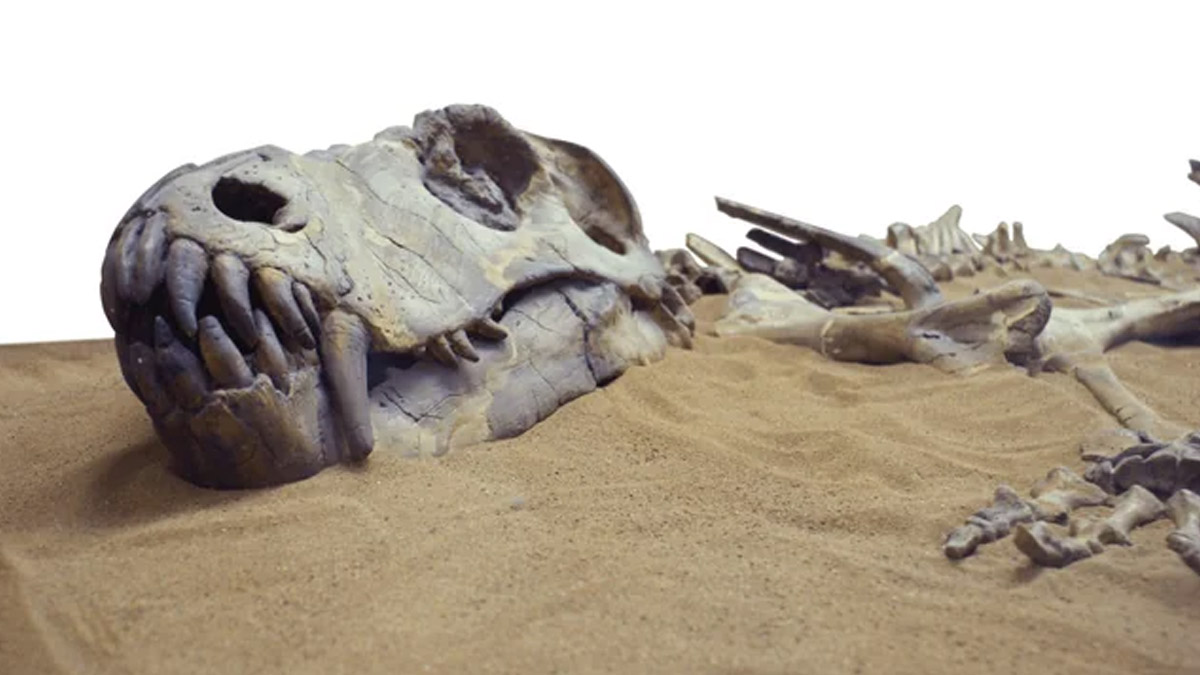
A groundbreaking fossil discovery in Spain is rewriting the story of one of the most iconic dinosaurs ever known—the stegosaur. Unearthed in the rugged hills of Riodeva, this find is the most complete stegosaur skull ever discovered in Europe, shedding new light on the anatomy and evolution of these plated giants. Far beyond a simple fossil, this remarkable specimen is challenging long-held ideas about dinosaur development and behavior.
A Rare and Remarkably Preserved Stegosaur Skull Unearthed
Buried within the Están de Colón quarry in Teruel province, Spain, lies a paleontological treasure: a 150-million-year-old stegosaur skull belonging to Dacentrurus armatus. Although this species was named over 150 years ago, it has remained mysterious due to incomplete specimens—until now. The newly unearthed skull includes critical parts such as the snout, upper jaw, and braincase, regions that rarely survive fossilization because of their delicate structure.
Sergio Sánchez Fenollosa, lead paleontologist at Fundación Dinópolis, explained, “Dinosaurian skulls are rarely preserved due to the extreme fragility of their bones. This discovery is key to understanding how stegosaurian skulls evolved.” This exceptional preservation opens new avenues for studying not just the skull’s anatomy but also functional traits related to feeding and sensory capabilities.
According to a recent report in Vertebrate Zoology, such an intact skull provides rare data that can deeply refine the stegosaur evolutionary lineage.
Juvenile and Adult Fossils Together: A Rare Insight into Dinosaur Growth
Adding to the discovery’s significance, the site yielded over 200 bones, representing at least two individuals—a juvenile and an adult. This mixed-age assemblage is extremely rare for stegosaurs, whose fossils are usually found in isolation or fragmented. As Sánchez Fenollosa notes, “Such mixed-age material is a particularly rare combination in this type of dinosaurs.”
This precious mix allows scientists to examine growth stages in the same species. From skull proportions to muscle attachment spots, researchers can chart how Dacentrurus evolved from youth to maturity. The presence of both juveniles and adults in the same location hints at complex social behaviors or family groupings previously unconsidered for stegosaurs. This discovery parallels evidence seen in other dinosaur species that suggests social structures, enriching our understanding of their ecology.
Redefining Stegosaur Evolution Through Skull Analysis
Using detailed measurements from the new skull, the research team conducted a comprehensive analysis of 30 stegosaur species with 115 anatomical traits. This study led to the proposition of an entirely new clade called Neostegosauria, grouping large, plated stegosaurs from multiple continents across the Jurassic to Early Cretaceous periods.
Instead of focusing on commonly studied armor plates or limb bones, this research prioritized skull traits—offering sharper evolutionary insights. The skull’s unique features suggest that classic stegosaur hallmarks, like their distinctive plated backs and spiked tails, may have evolved independently in various lineages, a finding that could reshape how scientists view dinosaur evolutionary pathways.
Sánchez Fenollosa highlighted, “The detailed study of this exceptional fossil has allowed us to reveal previously unknown aspects of the anatomy of Dacentrurus armatus, the quintessential European stegosaur.”
Elevating Spain’s Fossil Reputation on the Global Stage
This discovery is not just a win for science; it’s thrusting Spain into the global spotlight as a key player in dinosaur research. The Teruel region, historically overshadowed by famous North American and African fossil sites, is becoming a crucial hub for Jurassic paleontology.
Alberto Cobos, managing director at Fundación Dinópolis, emphasizes the wider potential: “This dual achievement – both the study of an exceptional fossil and the proposal of a new evolutionary hypothesis – positions this research as a global reference in stegosaurian studies.”
The Están de Colón quarry holds promise beyond the skull: postcranial elements from the same adult specimen and more juvenile fossils are being uncovered, ensuring Spain’s role in reshaping our understanding of dinosaur biodiversity will continue.
Dr. Paul Barrett, a leading paleontologist at the Natural History Museum in London, commented on the discovery: “This find is truly remarkable. Intact dinosaur skulls that provide evolutionary context are incredibly rare, and this will substantially impact stegosaur studies worldwide.”
This fossil is far more than a remarkable specimen; it’s a vivid reminder of how every discovery can challenge and enrich our understanding of life on Earth millions of years ago. The more we uncover, the clearer the complex story of dinosaurs becomes.
Have thoughts or questions about this extraordinary stegosaur find? Share your views and join the conversation! Your insight helps us all appreciate the incredible journey of paleontology.