


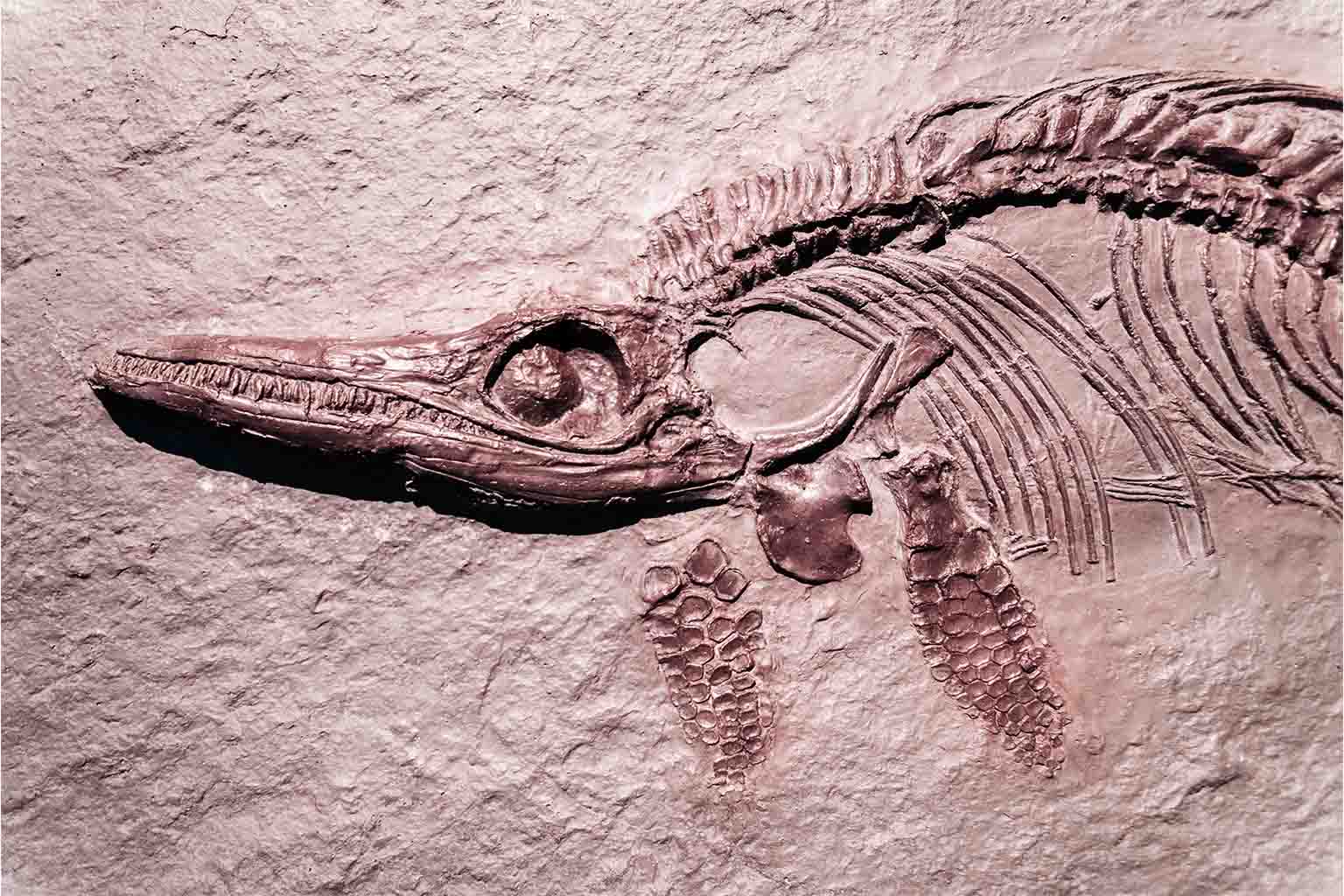
Unearthed along the windswept shores of Portugal lies a fossil that’s shaking up our understanding of ancient marine life. A newly discovered ichthyosaur species is rewriting the evolutionary story of Jurassic sea reptiles, offering a stunning glimpse into Earth’s watery past that experts never expected.
A Jurassic discovery that redefines marine reptile history
Paleontologists have identified a brand-new genus and species of ichthyosaur—Gadusaurus aqualigneus—from a fossilized skull uncovered in the Água de Madeiros Formation of Portugal. This finding, detailed in a recent study published in Acta Palaeontologica Polonica, dates back to roughly 193 million years ago during the Early Jurassic period. What makes this discovery particularly groundbreaking is that ichthyosaur fossils in the Iberian Peninsula are exceptionally rare and usually fragmented. This nearly complete skull, approximately 13.9 inches long, is one of the most intact specimens ever found in this region, dramatically enhancing our knowledge of Jurassic marine ecosystems in southern Europe.
At an estimated length of just around 6.6 feet, Gadusaurus aqualigneus was a relatively small marine predator. The fossil was excavated along Água de Madeiros beach, a coastal boundary between the municipalities of Marinha Grande and Alcobaça, a hotspot for Jurassic paleontological treasures. This site lies within the Lusitanian Basin, a geological formation known for preserving a rich record of Early Jurassic marine life, though ichthyosaur fossils there have been sparse until now.
The remarkable significance of ichthyosaurs in marine evolution
Ichthyosaurs were a group of swift, fish-shaped reptiles that thrived after evolving from terrestrial ancestors and readapted to marine environments during the Mesozoic Era. Dr. João Pratas E Sousa from Universidade Nova de Lisboa, lead author of the study, emphasizes, “Ichthyosaurs flourished from the Early Triassic through to the Late Cretaceous, yet their fossil record is patchy especially in southern Europe.” This discovery fills a major gap in the Iberian ichthyosaur record, shedding light on the diversity and dispersal of these fascinating reptiles in a region previously understudied.
Understanding ichthyosaur diversity during the Early Jurassic provides critical context as paleontologists piece together how marine ecosystems adapted following the end-Triassic extinction. Through the discovery of Gadusaurus aqualigneus, experts can reexamine ecological dynamics and evolutionary pathways of these ancient sea creatures.
The Lusitanian Basin: a geological snapshot of Jurassic seas
The Lusitanian Basin, located on Portugal’s western Atlantic margin, is a north-south oriented sedimentary basin thought to have formed during the opening of the Atlantic Ocean. This basin features sedimentary layers spanning from the Upper Triassic to the Upper Cretaceous, which have preserved a remarkable marine fossil record. “Situated between the Iberian Massif and the Variscan Berlenga Horst, the Lusitanian Basin offers a unique window into Early Jurassic marine environments,” the research team notes.
Its complex rifting and sedimentation events created ideal conditions for fossil preservation. This makes the basin incredibly valuable for understanding how marine reptiles like ichthyosaurs evolved and spread across prehistoric seas. The fossil discovery contributes to ongoing international efforts to reconstruct Jurassic marine biodiversity and paleoecology.
Why this discovery matters today
The finding of Gadusaurus aqualigneus not only enriches the fossil record but also helps paleontologists understand how ancient marine reptiles responded to environmental changes over millions of years. According to a recent Smithsonian article, ichthyosaurs were among the earliest marine reptiles to transition from land to sea, symbolizing a major evolutionary adaptation.
Discoveries like this offer critical insights into evolutionary biology, ancient climate, and marine ecosystems. By expanding the known diversity of ichthyosaurs in southern Europe, the research highlights how regional fossil findings can reshape global scientific narratives. As Dr. Pratas E Sousa explains, “Each new fossil snapshot deepens our understanding of Jurassic life and the complex history of marine reptile adaptation.”
For scholars, enthusiasts, and curious minds alike, the emergence of Gadusaurus aqualigneus is a thrilling reminder of how much of Earth’s deep past remains to be discovered—often just beneath our feet along a quiet coastline.
What do you think about this extraordinary Jurassic sea beast? Share your thoughts or questions below, and let’s keep the conversation flowing about our planet’s fascinating prehistoric marine life!