


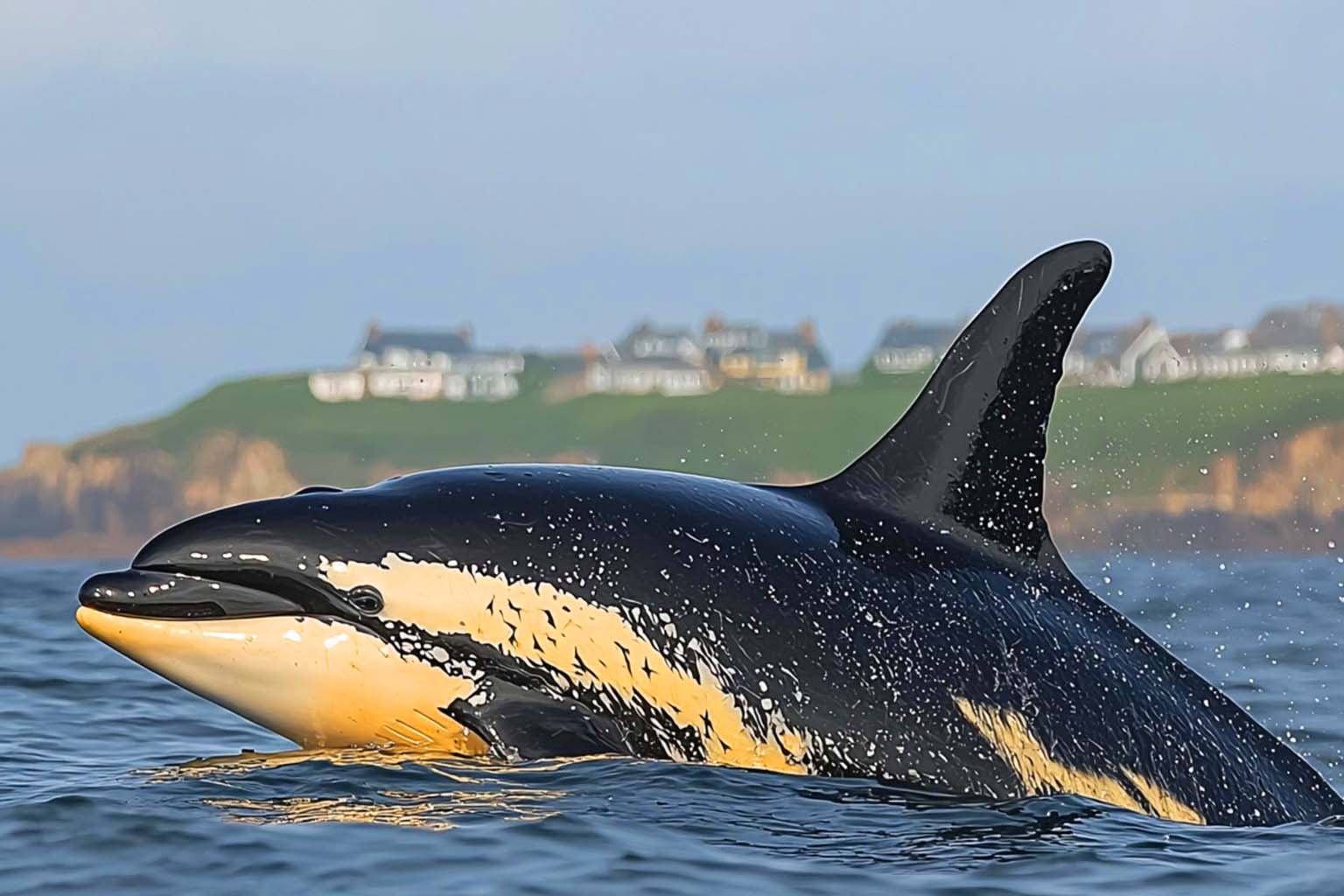
It looks like a dolphin, swims like a whale, and defies what science expected: this extraordinary sea creature is rewriting the rules of marine life. Born from two distinct species, the wholphin is a rare hybrid that has mystified researchers for decades—and its story doesn’t end with survival.
The Birth of an Unbelievable Hybrid
In 1985, the waters off Oahu witnessed a marine marvel at Sea Life Park. Punahele, a female bottlenose dolphin, and I’Anui, a male false killer whale, produced an offspring unlike any ocean dweller scientists had seen before. This calf, Kekaimalu, was not just a simple mix; she belonged to a category that stretches the imagination—a wholphin, a blend of “whale” and “dolphin.”
Despite the misleading name, the false killer whale isn’t a true whale but part of the dolphin family, helping explain the possibility of this intersection. Kekaimalu’s physique was a perfect in-between: a body size falling between dolphins (around 8 feet) and false killer whales (up to 20 feet), darker gray skin than a typical dolphin, and an unusual dental pattern—66 teeth, sitting between a dolphin’s 88 and a false killer whale’s 44.
Scientists have marveled at the rarity of such a hybrid birth. Interspecies mating between cetaceans is extremely rare, given their differing behaviors and social structures. The fact that Kekaimalu survived and thrived was already extraordinary, but what followed was even more astonishing.
Defying the Odds: Wholphins That Reproduce
From a biological standpoint, interspecies hybrids like mules are typically sterile. But Kekaimalu challenged this expectation. She gave birth in 1995 to a calf that tragically did not survive. Undeterred, she had another calf, Kawili Kai, in 2004, who not only survived but continues life at Sea Life Park.
This fertility among hybrids opens new doors to understanding marine genetics and reproduction. The wholphin’s ability to reproduce reveals that nature, particularly under controlled circumstances like captivity, can blur boundaries once thought absolute. This resilience and biological success suggest that hybridization could have more significance in evolutionary processes than previously appreciated.
Dr. Lisa Nguyen, a marine biologist studying cetacean hybrids, explained in a 2024 report by the National Oceanic and Atmospheric Administration (NOAA Education Center) that such interspecies breeding “provides insightful clues on the flexibility of cetacean genetics and the potential impacts of environmental changes on marine biodiversity.”
Behavioral Mysteries of the Wholphin
Kekaimalu’s hybrid traits extended beyond her appearance. Behaviorally, she offered a fascinating mixture of her parents’ characteristics. She showed the friendly, intelligent, and sociable nature commonly observed in dolphins, engaging readily with trainers and peers. Yet, at times, she exhibited the quieter, more reserved tendencies typical of false killer whales.
These blended behaviors have posed a challenge in understanding how hybrids might function in the wild, where social structures and communication are vital to survival. Experts speculate that such hybrids, if born outside captivity, would face complex social integration issues, making their survival in natural habitats uncertain.
The artificial environment of captivity created a unique opportunity for researchers to observe not only the physical but also the psychological makeup of Kekaimalu. It’s an invaluable case study highlighting how selective conditions can alter the natural course of animal interactions.
Why We Haven’t Seen Wild Wholphins
Despite the captivating story of Kekaimalu, wild sightings of wholphins remain unverified. The natural world holds many barriers that likely prevent such hybrids from forming in open oceans. Dolphins and false killer whales generally inhabit different regions or form distinct social groups, with little overlap.
Furthermore, their complex communication and mating rituals typically prevent interspecies breeding. Some mysterious accounts of atypical cetaceans in the wild have sparked curiosity, but they lack conclusive proof as hybrids.
The wholphin case emphasizes the limits of nature versus captivity. While captivity facilitates close quarters and interactions that rarely happen in the vast ocean, it also provides researchers with precious insights into evolutionary biology and cetacean diversity.
This video from Sea Life Park offers a rare glimpse into Kekaimalu’s daily life and interactions, helping viewers appreciate the unique blend of dolphin and whale behavior in action.
The Wholphin’s Legacy and What It Means for Conservation
The story of the wholphin stretches beyond fascination; it has implications for conservation and species management. As marine environments change rapidly due to climate shifts, pollution, and human activity, understanding hybridization could reveal how species adapt—or struggle—to survive.
Experts believe that hybrid animals, like Kekaimalu and her offspring, might represent a form of nature’s experimentation, possibly shaping future marine biodiversity. The challenge lies in protecting natural habitats while recognizing that artificial environments reveal untapped biological potentials.
Marine specialists and conservationists continue to monitor these hybrids, debating the best strategies to support both natural species and hybrids in captivity. Such studies underline the crucial balance between honoring nature’s original designs and embracing unexpected biological phenomena.
If the wholphin has taught us anything, it’s that the ocean remains full of mysteries—and that sometimes, life finds a way even when the odds say otherwise.
What do you think about this extraordinary hybrid’s story? Share your thoughts below or pass this tale of resilience and wonder along to fellow ocean lovers!