


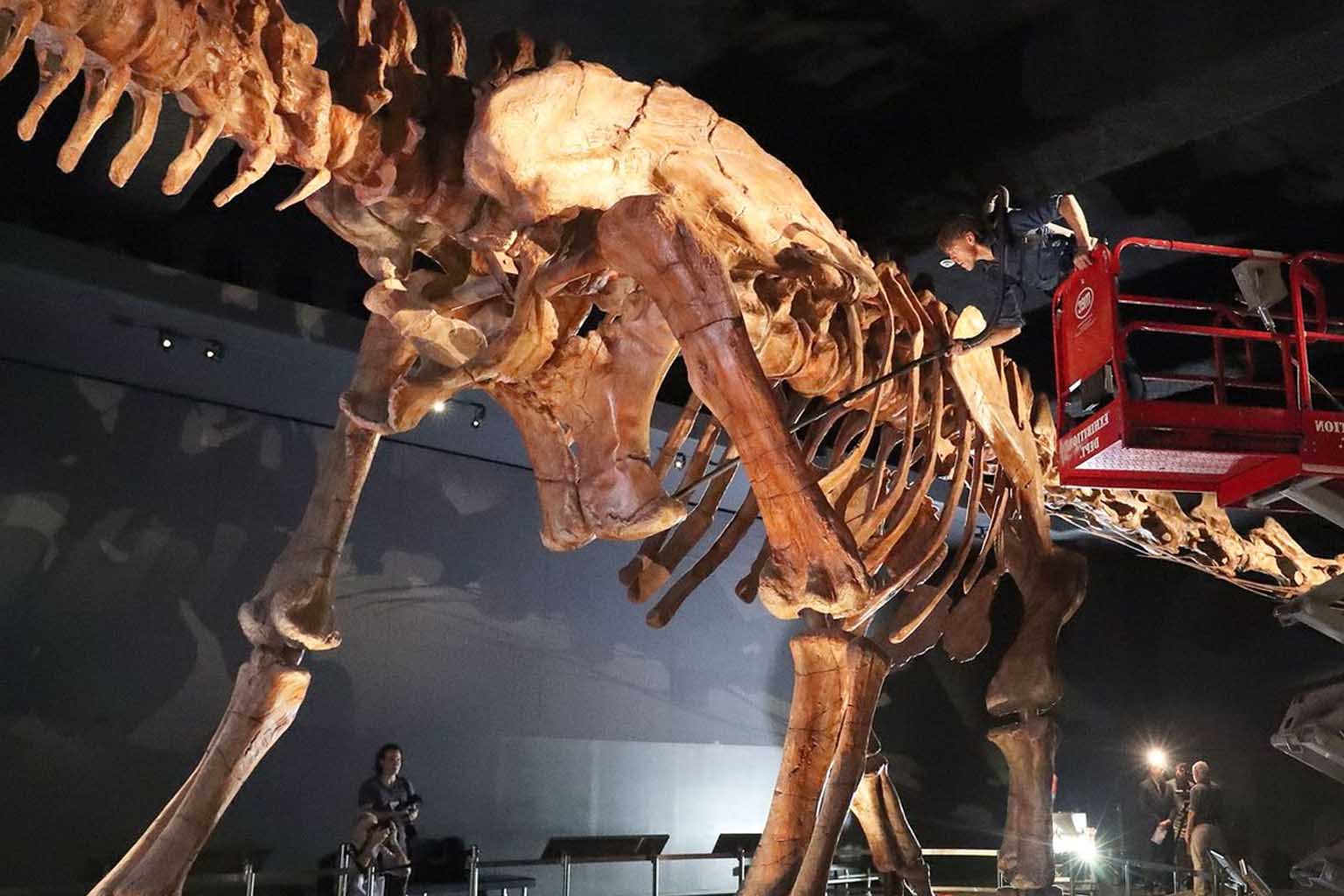
When Damien Boschetto took his dog for a walk through the forests of southern France in May 2022, he had no idea he was about to make one of the most significant paleontological discoveries in decades. The 25-year-old amateur fossil hunter noticed something protruding from a collapsed cliff face near Montouliers—what turned out to be part of a 70-million-year-old titanosaur skeleton preserved in near-perfect condition.
This discovery represents far more than just another dinosaur find. The skeleton remains connected from skull to tail in anatomical position, a preservation state so rare that it offers scientists an unprecedented window into how these massive creatures actually lived and died. While fragmented titanosaur bones have been found across Europe before, finding one this complete changes everything we thought we knew about these prehistoric giants. Such remarkable preservation echoes other extraordinary finds, like the tiny dinosaur preserved in amber that has similarly revolutionized our understanding of ancient life.
The implications extend beyond paleontology itself. This find arrives at a time when advanced imaging and analysis techniques can extract information from fossils that previous generations of scientists could only dream of accessing.
A Window Into the Final Chapter of Dinosaur Evolution
The timing of this particular titanosaur’s existence makes it especially significant. Dating to between 70 and 72 million years ago, this specimen lived during the final chapters of dinosaur dominance on Earth, just before the mass extinction event that would end their reign.
Titanosaurs represented the evolutionary peak of sauropod development. These weren’t just large animals—they were biological marvels that had solved the engineering challenges of supporting bodies that could reach lengths of 10 meters or more while maintaining the ability to move, feed, and reproduce effectively.
The French specimen provides evidence of how successful these adaptations were. Research indicates that titanosaurs had developed sophisticated air-sac systems similar to modern birds, allowing them to efficiently oxygenate their massive bodies. The anatomical positioning of this skeleton should reveal crucial details about their bone density, muscle attachment points, and internal organ placement.
The Montouliers Site Reveals an Ancient Ecosystem
The discovery site in Montouliers has emerged as what paleontologists call a bone bed—an area where multiple species accumulated over time, creating a snapshot of an entire prehistoric ecosystem. Alongside the titanosaur, excavation teams have uncovered remains of Rhabdodon herbivores, carnivorous theropods related to Tyrannosaurus rex, and ancient crocodile species. This diversity of extinct species demonstrates how paleontological sites can preserve entire ancient communities.
This diversity suggests that 70 million years ago, southern France supported a complex web of prehistoric life. The presence of both herbivores and carnivores indicates a functioning ecosystem with established predator-prey relationships. Ancient crocodiles suggest nearby water sources, while the variety of dinosaur species points to different ecological niches being filled. Such predator-prey interactions preserved in the fossil record provide crucial insights into ancient ecosystem dynamics.
Studies of similar bone beds have shown that these sites often form during specific environmental conditions—typically when seasonal flooding or drought cycles concentrate animals in particular areas. The preservation quality at Montouliers suggests rapid burial, possibly during a catastrophic event that simultaneously killed and preserved multiple species.
What Complete Skeletons Reveal About Titanosaur Behavior
The anatomical positioning of the French titanosaur offers insights that scattered bone fragments simply cannot provide. When paleontologists find bones in their original positions, they can analyze muscle attachment sites, joint flexibility, and even posture with unprecedented accuracy.
Previous research based on partial skeletons had led to debates about how titanosaurs held their necks, how they moved their massive tails, and whether they could rear up on their hind legs to reach high vegetation. This complete skeleton should settle many of these questions definitively.
Evidence suggests that titanosaurs were more agile than their size would imply. Computer modeling based on complete skeletal data indicates these animals could achieve surprising speeds when necessary and possessed remarkable flexibility in their spinal columns. The positioning of this specimen’s vertebrae should provide crucial data for refining these models.
The Overlooked Significance for Museum Education
Beyond its scientific value, this discovery addresses a persistent challenge in paleontological education. Most museum dinosaur displays rely on composite skeletons—bones from multiple individuals assembled to create a complete display. While scientifically valid, these reconstructions lack the authenticity that captivates public imagination.
The Montouliers titanosaur offers something different: a single individual that lived, died, and was preserved as a complete entity. This anatomical authenticity transforms how museums can present prehistoric life to visitors. Instead of explaining which bones came from which specimens, educators can focus on how this specific animal lived, moved, and interacted with its environment. Such complete specimens rival other remarkable fossil findings that have revolutionized our understanding of dinosaur evolution.
Museum research suggests that visitors connect more deeply with exhibits when they understand they’re viewing remains from a single creature rather than a composite reconstruction. This emotional connection proves crucial for inspiring the next generation of scientists and maintaining public support for paleontological research.
The careful analysis now underway at the Cruzy Museum laboratory will likely take years to complete, but each finding will add to our understanding of how life on Earth transitioned through one of its most dramatic periods. The skeleton represents not just a remarkable individual, but a bridge connecting us to an entire world that vanished 66 million years ago—yet continues to shape how we understand life’s resilience and complexity today.