


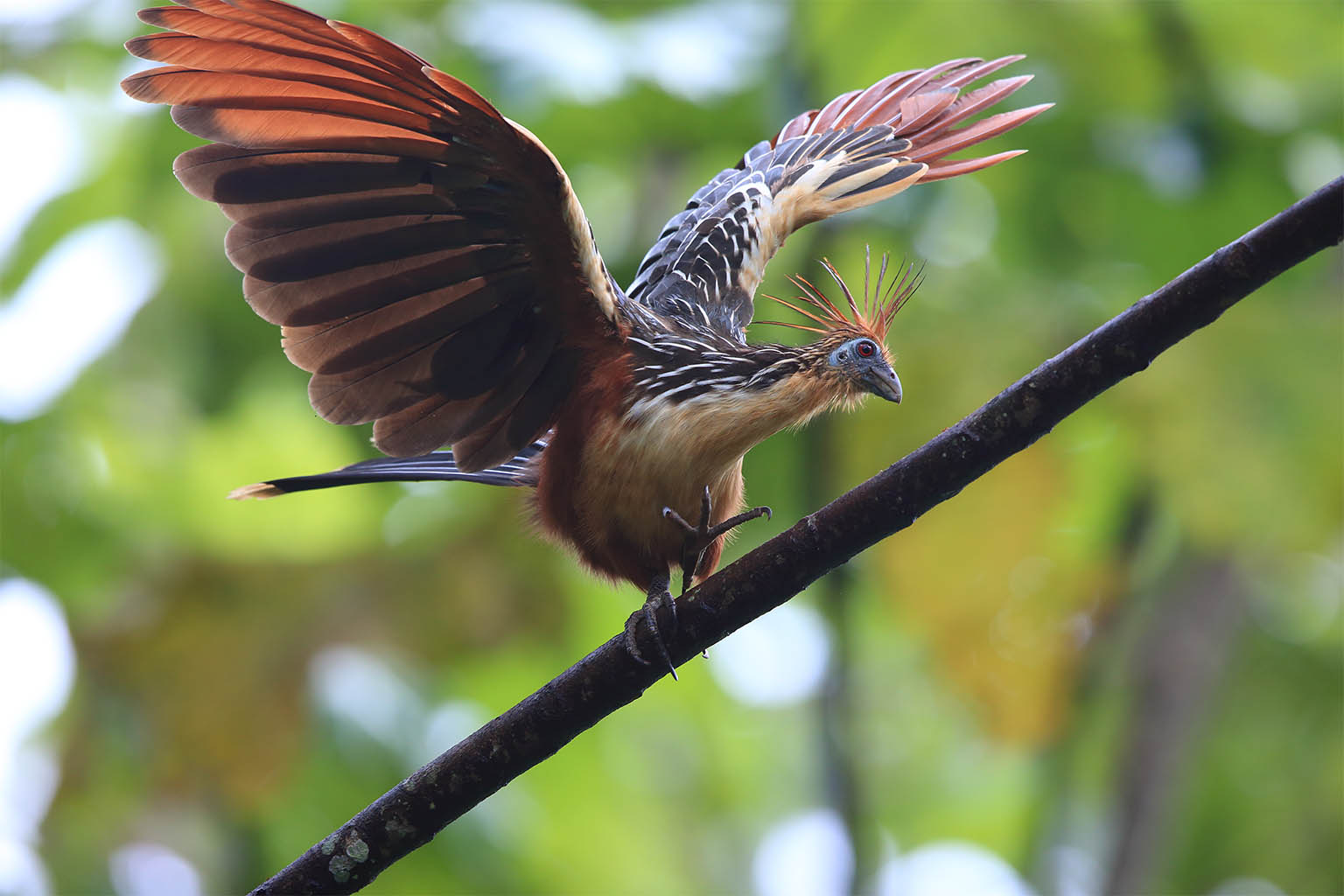
Clawed wings, a pungent odor, and a digestive system unlike any other bird—meet the hoatzin, one of the most fascinating and mysterious creatures of the Amazon rainforest. This unusual bird has captured the imagination of scientists and bird enthusiasts alike with its seemingly prehistoric traits and baffling evolutionary history.
The Hoatzin: Amazon’s Living Fossil with a Stink
Known colloquially as the “stinkbird,” the hoatzin (Opisthocomus hoazin) emits a strong, manure-like odor that sets it apart from other birds. This unique smell stems from its unusual digestive process; the hoatzin ferments leaves in its foregut in a manner similar to cows. The bird’s large, chambered crop acts like a fermentation vat, breaking down tough plant fibers and aiding digestion but also producing gases responsible for its distinctive scent. This natural defense, experts believe, helps repel predators by making the hoatzin smell foul and unappetizing.
Unlike most birds that thrive on seeds, insects, or fruits, the hoatzin’s diet consists mainly of leaves—a rarity among avian species. This leaf-heavy diet requires its specialized digestive system, which, while effective, dramatically affects the bird’s mobility. The fermentation process slows the hoatzin down, making it a clumsy flyer at best. This trade-off between an efficient herbivorous diet and limited flight ability is a remarkable example of evolutionary adaptation.
Ancient Relic or Modern Marvel? The Hoatzin’s Evolutionary Puzzle
For decades, the hoatzin has puzzled scientists trying to locate it on the avian family tree. A seminal 2015 study published in Nature proposed that the hoatzin’s lineage dates back about 64 million years, shortly after the dinosaurs vanished. This interpretation framed the hoatzin as a “living fossil,” carrying ancestral traits like wing claws and a rudimentary digestive system that hint at a distant evolutionary past.
Yet, a more recent comprehensive 2024 study in the Proceedings of the National Academy of Sciences (PNAS) complicates this picture. By examining genetic data from over 360 bird species, researchers found that the hoatzin does not fit neatly into any major bird family. Instead, it emerges as an evolutionary “orphan,” with no close living relatives. This suggests the hoatzin’s bizarre traits might be the product of more recent environmental adaptations in the Amazon, rather than direct remnants of ancient avian ancestors.
Clawed Wings: A Primitive Trait for Life in the Trees
One of the hoatzin’s most captivating features is that hatchlings are born with small claws on their wings. These claws—a trait otherwise lost in modern birds—allow young hoatzins to climb trees and grasp branches with agility before they develop flight feathers. In the predator-dense jungles of the Amazon, this climbing ability provides a critical survival advantage for vulnerable chicks.
Unlike typical baby birds, hoatzin chicks can’t fly immediately. Instead, they use their wing claws to navigate dense foliage and escape danger. This behavior is reminiscent of ancient bird species and dinosaurs, which also sported clawed forelimbs. Whether these claws are a throwback to prehistoric times or a response to ecological pressures remains an open question.
The presence of clawed wings beautifully illustrates how evolutionary biology works in layers—blending ancient features with new survival strategies. It encourages researchers to consider that some traits may persist not simply as “living fossils,” but because they continue to offer real advantage in a species’ current habitat.
What Makes the Hoatzin an Evolutionary “Orphan”?
Classifying the hoatzin has long challenged ornithologists because of its blend of archaic and unique features. The 2024 genetic study grouped the hoatzin with a loose collection of birds including cranes and shorebirds but acknowledged its exact evolutionary relationships remain elusive. This “orphan” status indicates that the hoatzin’s lineage split early and evolved on a separate path from better-known bird families.
This unsettled classification reflects broader gaps in our understanding of bird evolution. The hoatzin’s blend of features—from its herbivorous gut to wing claws—defies simple categorization and forces scientists to rethink how ecological and evolutionary forces shape species over time. Ongoing genetic analyses and fossil discoveries will be vital in unraveling the hoatzin’s evolutionary story.
For an immersive visual and scientific overview, this engaging YouTube video on the hoatzin’s evolutionary traits offers stunning footage and expert insights that highlight the bird’s uniquely complex biology.
A Bird That Keeps Scientists Guessing
In many ways, the hoatzin symbolizes the marvelous unpredictability of nature. Its bizarre anatomy and mysterious origins prompt a deeper appreciation for evolution’s creativity and complexity. Are we witnessing a direct connection to the age of dinosaurs? Or a striking example of how species innovate to survive in a challenging environment? The answer may be both.
By studying the hoatzin, scientists uncover clues not only about avian evolution but also about the intricate interplay between biology, ecology, and time. This bird remains one of the most evocative reminders that the natural world still holds secrets waiting to be discovered.
What do you think about the hoatzin’s enigmatic traits? Have you encountered stories or sightings of this unusual bird? Share your thoughts and join the conversation below!
The hoatzin’s clawed wings, unique digestive system, and mysterious evolutionary path continue to captivate researchers and bird lovers worldwide, making it a true Amazonian marvel.
According to a 2024 PNAS report, the hoatzin’s genetic ambiguity underlines the challenges in tracing avian evolutionary history, showcasing the complexity of nature’s timelines.