


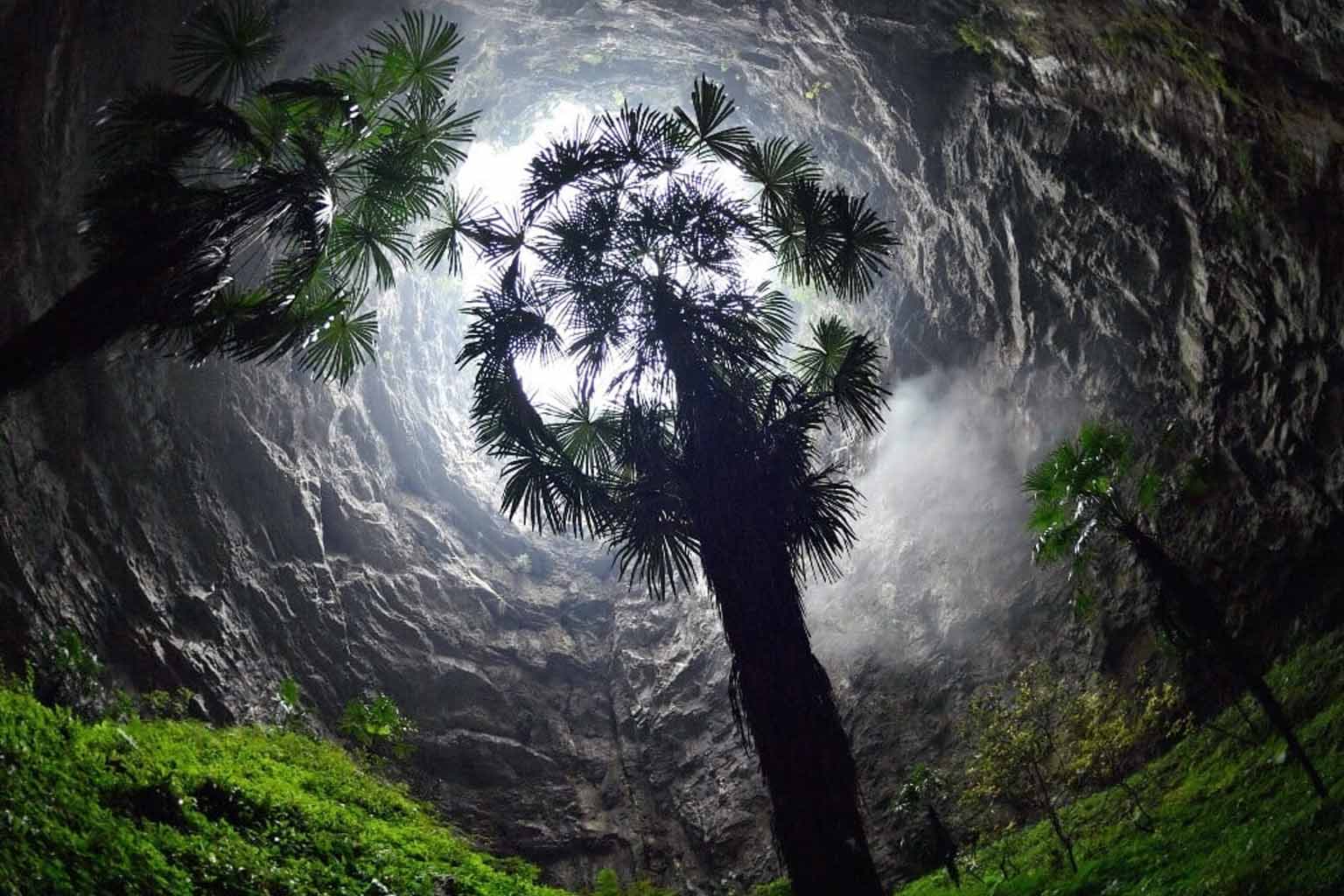
Deep beneath southwestern China’s rugged terrain, colossal sinkholes called tiankeng harbor something extraordinary: ancient forests that have remained untouched for millennia. These aren’t ordinary depressions in the landscape. Some span over 1,000 feet across and plunge more than 2,000 feet into the earth, creating isolated worlds where towering trees and dense undergrowth flourish in perpetual twilight.
The discovery of these subterranean ecosystems challenges our understanding of how life adapts and survives in extreme isolation. When Chinese exploration teams descended into a previously unexplored sinkhole in Guangxi Province in 2022, they found 131-foot trees and undergrowth so thick it reached their shoulders. The implications extend far beyond the spectacle itself—these natural time capsules may preserve species that vanished from the surface world long ago, much like recent discoveries of new species in isolated cave systems.
China hosts over 200 known tiankeng, primarily scattered across the karst regions of Guizhou, Guangxi, Yunnan, and Chongqing provinces. Each represents a unique laboratory of evolution, where life has developed in complete isolation from surface influences. The scale of these formations defies easy comprehension, with the deepest—Xiaozhai Tiankeng in Fengjie County—descending an astounding 2,172 feet into the earth.
The Geological Marvel Behind Earth’s Hidden Worlds
The formation of these massive sinkholes requires a precise combination of geological factors that unfolded over hundreds of thousands of years. The region’s limestone bedrock dissolves gradually as rainwater seeps underground, carving extensive cavern systems and underground rivers. When these caverns expand beyond their structural limits, the rock ceiling collapses catastrophically, leaving behind these breathtaking chasms.
According to research published in Nature by the Karst Geology Institute of Chinese Academy of Geological Sciences, true tiankeng must meet specific criteria: at least 330 feet deep and wide, featuring steep rock walls carved by underground water flow. The sheer scale distinguishes China’s karst landscape from similar formations worldwide.
“Karst tiankengs represent unique geological formations that create isolated ecosystems with distinct microclimates, preserving ancient biodiversity patterns” – Nature Scientific Reports
What makes these formations particularly remarkable is their ability to create distinct microclimates within each sinkhole. Temperature, humidity, and light conditions differ dramatically from the surface environment, allowing ancient plant communities to persist in conditions that mirror prehistoric climates. Some sinkholes still contain active underground rivers, continuously reshaping these hidden landscapes.
Living Time Capsules of Ancient Biodiversity
The biological significance of these sinkholes extends well beyond their geological importance. Each represents a potential repository of ancient genetic material and evolutionary adaptations that disappeared elsewhere due to climate change, human activity, or natural disasters. The isolation provided by these deep pits has created natural laboratories where species evolved independently for thousands of years, similar to how ancient cave environments preserved prehistoric cultural evidence for millennia.
Recent expeditions have revealed forests thriving in near-complete isolation from surface ecosystems. The dense canopy cover at the bottom of these sinkholes filters sunlight to create conditions similar to deep rainforest environments, supporting plant communities that may represent evolutionary snapshots from different geological periods.
Scientists believe many sinkholes remain undiscovered, hidden beneath the region’s dense forest cover and towering limestone cliffs. The Guangxi region alone, designated as a UNESCO World Heritage site since 2007, continues yielding new discoveries as exploration technology and techniques improve.
The Search for Undiscovered Species
The potential for discovering entirely new species within these subterranean forests represents one of the most exciting aspects of tiankeng research. Expedition leader Chen Lixin expressed confidence that these environments harbor previously unknown species, given their prolonged isolation and unique environmental conditions.
The discovery process presents significant challenges. Dense undergrowth, treacherous terrain, and limited accessibility make comprehensive biological surveys extremely difficult. Teams must rappel hundreds of feet into these chasms while carrying scientific equipment capable of documenting and preserving specimens.
Early findings suggest that both plant and animal communities within these sinkholes have developed distinct characteristics. Some species may represent evolutionary links to ancient forms, while others might have adapted in ways that provide insights into how life responds to extreme environmental constraints. These discoveries echo the significance of other archaeological finds, such as the 3,000-year-old village discovered beneath France, which revealed how ancient communities adapted to their environments.
The Fragile Balance of Hidden Ecosystems
These ancient forests face growing threats despite their apparent protection within deep sinkholes. Climate change affects the delicate hydrological balance that maintains these ecosystems, potentially altering underground water flow patterns that have remained stable for millennia. Even small changes in surface precipitation can dramatically impact the microclimates within these formations.
Human activities in surrounding areas pose additional risks. Agricultural runoff, industrial pollution, and groundwater extraction can affect the chemical composition of water entering these systems. Studies on karst tiankeng ecosystems have shown that the karst geology that created these wonders also makes them particularly vulnerable to contamination, as pollutants can travel quickly through limestone formations.
“Karst tiankengs serve as refugia for indigenous tree flora amidst degraded landscapes, highlighting their critical role in biodiversity conservation” – Environmental research studies
Conservation efforts must balance scientific research with ecosystem preservation. Each expedition into these environments potentially introduces surface pathogens or disturbs communities that have remained stable for thousands of years. Researchers face the paradox of needing access to study and protect these systems while minimizing their impact on the very isolation that makes them scientifically valuable. The challenge mirrors conservation efforts for other extinct creatures that once thrived in isolated ecosystems.
The tiankeng of China represent more than geological curiosities—they offer glimpses into alternate evolutionary pathways and ancient environmental conditions. As we continue exploring these hidden worlds, they may fundamentally change our understanding of how life persists and adapts in isolation. The question remains whether we can study these treasures without destroying the very qualities that make them irreplaceable windows into Earth’s biological past.