


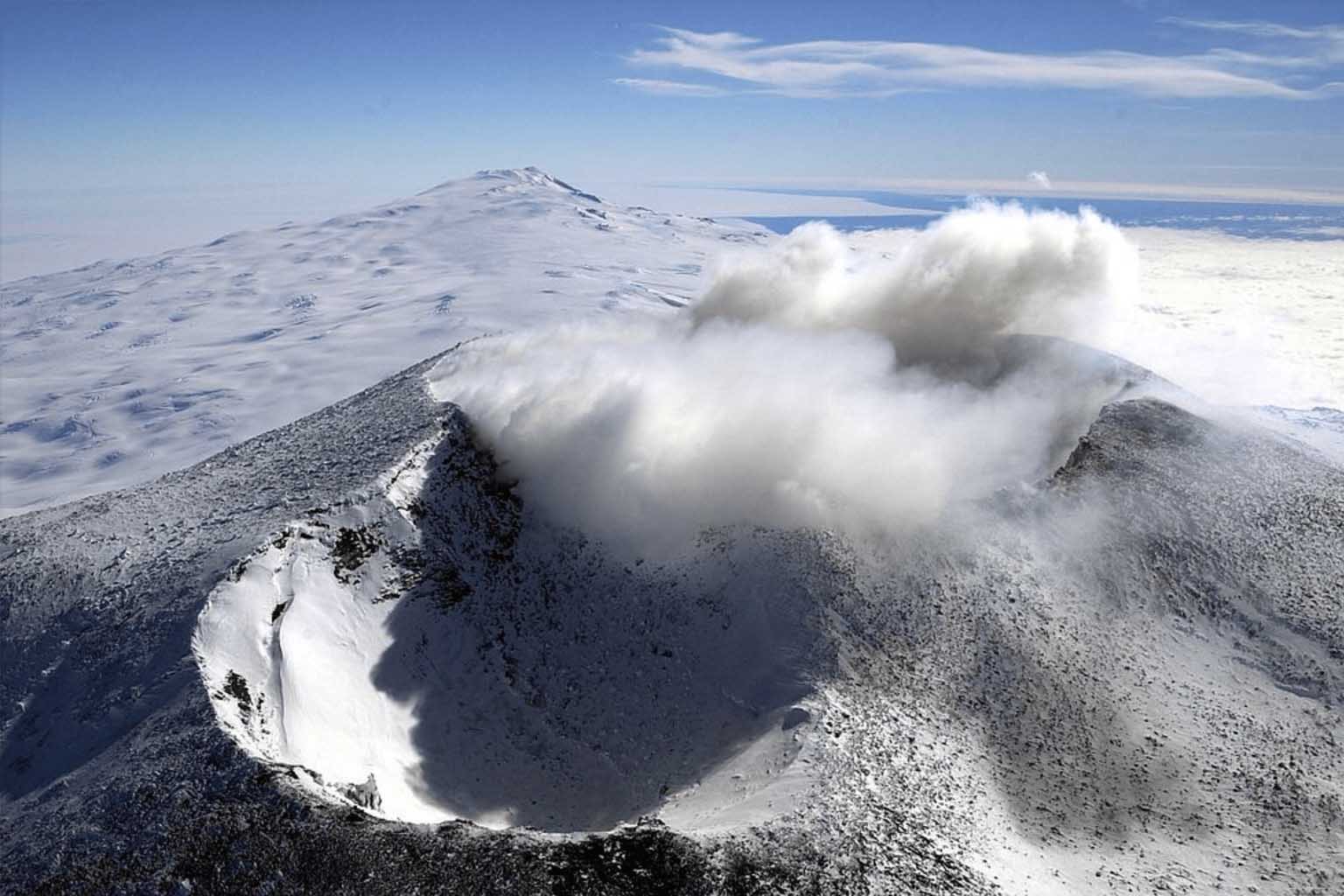
Deep beneath Antarctica’s frozen surface, where temperatures plummet to bone-crushing lows and sunlight never penetrates, something extraordinary is happening. Mount Erebus, the continent’s most active volcano, harbors a secret that challenges everything we thought we knew about life’s limits. Inside its volcanic ice caves, a thriving ecosystem exists in complete darkness, feeding off chemical reactions that would be toxic to most life forms.
This discovery isn’t just another scientific curiosity. As we push deeper into space exploration and search for life beyond Earth, these underground volcanic caves may hold the key to understanding how organisms could survive on distant worlds. Much like how LiDAR technology has revolutionized our ability to uncover hidden archaeological treasures, advanced scientific techniques are now revealing the microbes thriving in Erebus’s depths that don’t follow the rules we’ve come to expect from life on our planet.
A Volcanic Anomaly in Earth’s Frozen Desert
Mount Erebus stands as one of nature’s most paradoxical creations. Rising nearly 12,500 feet above Ross Island, this volcano maintains a permanent lava lake while surrounded by Antarctica’s brutal cold. The geothermal activity creates an intricate network of ice caves where temperatures can reach a balmy 77°F, even as surface conditions hover around -100°F.
These caves aren’t static formations. The constant interplay between volcanic heat and Antarctic ice creates a dynamic labyrinth where tunnels melt, freeze, and reform in an endless cycle. Towering ice chimneys stretch up to 30 feet high, venting volcanic gases that crystallize into alien-like formations. The environment resembles something from another planet more than anything recognizable on Earth’s surface.
Life Thrives Where It Shouldn’t Exist
The real revelation came when researchers began analyzing samples from these caves. They found not just traces of life, but thriving microbial communities that have adapted to conditions that would eliminate most known organisms. These aren’t struggling survivors clinging to existence—they’re flourishing populations that have carved out their own ecological niche.
What makes these microbes truly remarkable is their energy source. While surface life depends on photosynthesis to convert sunlight into usable energy, these cave dwellers have mastered chemosynthesis. They derive energy directly from chemical reactions with volcanic gases, particularly carbon monoxide and hydrogen that would be lethal to most life forms. Research published in PMC has shown that bacteria performing atmospheric chemosynthesis can function as prominent carbon processors within extreme ecosystems.
“Bacteria performing atmospheric chemosynthesis may function as a prominent carbon sink within desert ecosystems, demonstrating the crucial role of chemosynthetic organisms in extreme environments” – PMC Research
Research has revealed that many of these organisms use the Calvin-Benson-Bassham cycle to fix carbon, the same process plants use for photosynthesis, but powered entirely by volcanic emissions rather than solar energy. Some specimens show no close relatives anywhere else on Earth, suggesting they represent entirely new evolutionary branches. These discoveries parallel other remarkable underground ecosystems, such as the lost city beneath the ocean where unique microbial communities also thrive on chemical energy.
The Isolation Factor That Changes Everything
Warren Cave, one of the most studied locations within Erebus’s network, presents an ecosystem so isolated that it lacks Archaea—microbes typically found in extreme environments worldwide. This absence suggests something profound: these communities have evolved completely independently from other extreme-environment ecosystems on our planet.
The implications extend far beyond academic curiosity. If life can develop independently in such isolated conditions, using entirely different energy sources and metabolic pathways, it dramatically expands our understanding of where and how life might exist elsewhere in the universe. These aren’t adaptations of existing life forms—they appear to be fundamentally different approaches to survival. The complexity of these hidden ecosystems rivals that of other subterranean discoveries, including Nottingham’s underground network of caves, though the biological significance of Erebus’s caves far exceeds any archaeological find.
The Technological Testing Ground Nobody Expected
NASA’s interest in Erebus goes beyond biological curiosity. The agency has transformed these caves into a testing ground for space exploration technologies that could one day search for life on distant worlds. The conditions mirror what we might expect beneath the icy surfaces of Europa or Enceladus, Jupiter and Saturn’s moons respectively.
Scientists have deployed sophisticated equipment including PUFFER, an origami-inspired robot designed to navigate tight spaces, and ice-drilling rovers equipped with chemical sensors capable of detecting organic molecules. These technologies represent our best current approaches to exploring environments where traditional surface exploration would be impossible.
The success of these tests in Erebus’s caves provides crucial validation for similar missions to icy moons where subsurface oceans might harbor life. The volcanic activity that creates Erebus’s unique environment parallels the tidal heating that could generate similar conditions on distant worlds. Studies from Frontiers in Geochemistry have demonstrated that glaciovolcanic cave systems provide unique opportunities to understand these poorly studied ecosystems.
“Glaciovolcanic cave systems offer operationally simpler environments that can facilitate the study of these poorly understood ecosystems” – Frontiers in Geochemistry
The Rarely Discussed Implications for Evolutionary Biology
While media coverage often focuses on the astrobiology angle, the evolutionary implications of Erebus’s ecosystem deserve deeper consideration. These organisms challenge fundamental assumptions about life’s requirements and the pathways evolution can take when freed from conventional constraints.
The complete absence of photosynthetic life in these caves creates an ecosystem unlike any other on Earth. Every organism relies on chemosynthesis or feeds on those that do, creating food webs based entirely on volcanic chemistry. This represents a parallel evolutionary experiment that has been running for potentially thousands of years, isolated from surface life. The evolutionary significance of such isolated ecosystems extends our understanding of how life adapts over vast timescales, much like how ancient burial sites reveal the deep history of human cultural evolution.
The discovery also raises questions about early Earth conditions. If similar chemosynthetic communities could thrive in volcanic environments billions of years ago, they might have played a larger role in early evolution than previously understood. These modern caves might preserve metabolic strategies that predate photosynthesis itself.
As we continue exploring these hidden worlds beneath Antarctica’s ice, we’re not just discovering new forms of life—we’re uncovering alternative blueprints for how life itself might organize and thrive. The organisms living in Erebus’s depths may represent our best glimpse into the possibilities that await discovery beneath the frozen surfaces of distant worlds, or perhaps into the deep history of life on our own planet.