


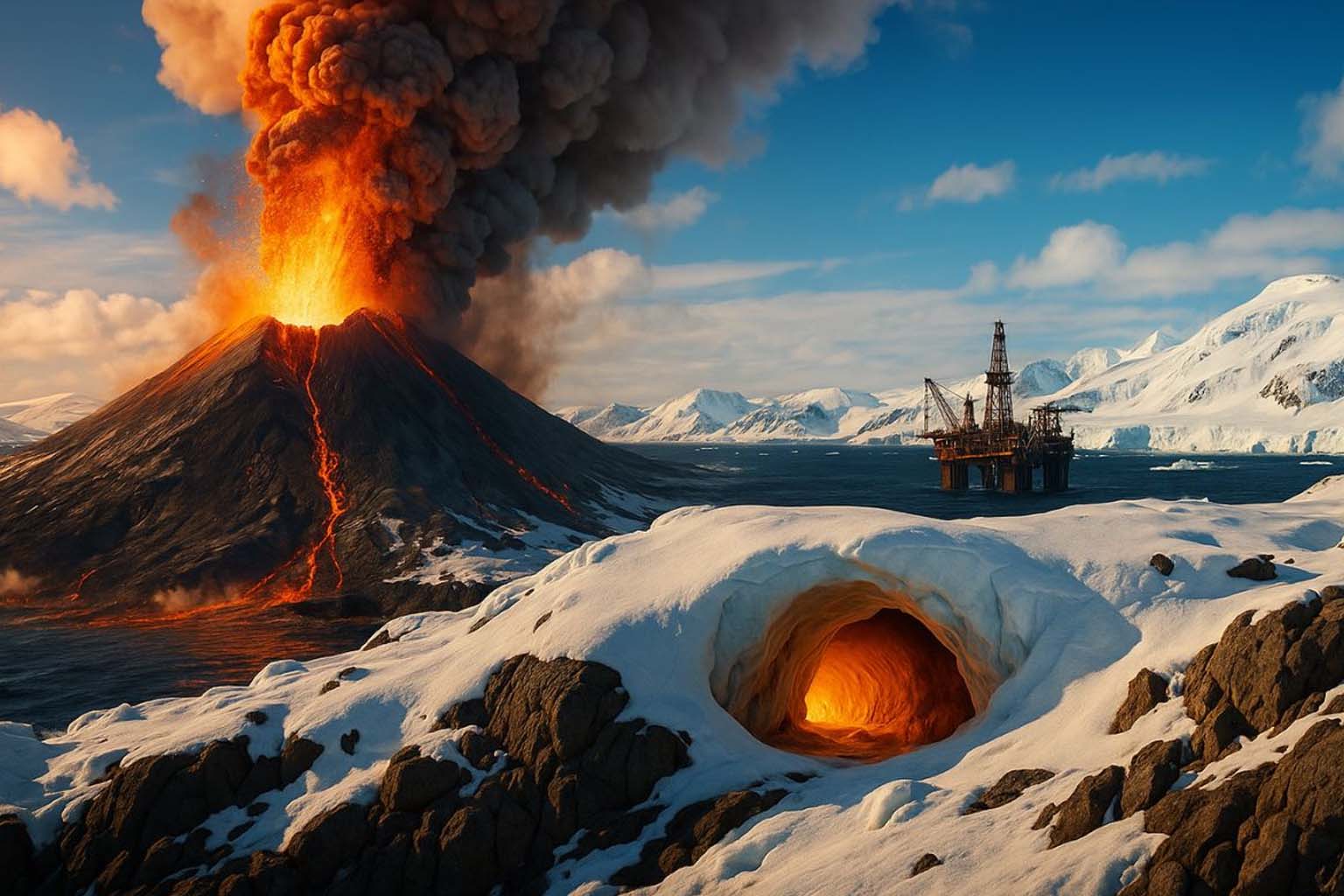
Deep beneath Antarctica’s frozen surface, where temperatures plummet to minus 100 degrees Fahrenheit, an unexpected discovery is challenging our understanding of life’s resilience. Mount Erebus, the continent’s most active volcano, harbors something extraordinary within its volcanic ice caves: thriving microbial communities that exist in complete darkness, sustained not by sunlight but by the mountain’s own volcanic emissions.
This revelation comes at a time when scientists are intensifying their search for life beyond Earth. The microbes dwelling in Erebus’s underground network represent more than just another example of extremophile organisms. They offer a window into how life might persist in the harsh environments of distant moons, where similar conditions of ice, volcanic activity, and perpetual darkness prevail.
The implications extend far beyond academic curiosity. As space agencies prepare for missions to Europa and Enceladus, understanding how these Antarctic microbes survive could fundamentally reshape our approach to detecting extraterrestrial life.
A Volcanic Laboratory in Earth’s Most Hostile Environment
Rising nearly 12,500 feet above Ross Island, Mount Erebus stands as Antarctica’s most remarkable geological feature. The volcano maintains a permanent lava lake and an intricate system of ice caves carved by geothermal heat. These caverns exist in constant flux, with tunnels melting and refreezing in an endless cycle that creates new passages while sealing others.
Within these caves, temperatures can reach a startling 77 degrees Fahrenheit, creating pockets of relative warmth in one of Earth’s most inhospitable regions. The environment features towering ice formations up to 30 feet tall, formed where volcanic gases escape and crystallize. Research published in Nature reveals that these conditions have fostered unique ecosystems completely isolated from the surface world.
“Erebus volcanic ice caves were reported to be dominated by extremophilic bacterial communities that thrive in calcium carbonate precipitating environments” – Nature Scientific Reports
Life Without Light: The Chemistry of Survival
The microorganisms discovered in Erebus’s caves have developed survival strategies that diverge dramatically from conventional biological processes. Rather than relying on photosynthesis, these bacteria and fungi employ chemosynthesis, extracting energy directly from chemical reactions involving volcanic gases like carbon monoxide and hydrogen.
Scientific analysis has identified organisms using the Calvin-Benson-Bassham cycle for carbon fixation, typically associated with plant photosynthesis, but powered entirely by volcanic emissions instead of sunlight. Some of these microbes show no close relationship to any known species, suggesting they represent entirely novel evolutionary pathways similar to discoveries made in other extreme environments, including ancient mysteries that reveal how life adapts over vast timescales.
Warren Cave, one of the most extensively studied locations, requires a 60-foot rappel to access but rewards researchers with insights into truly independent evolution. The absence of Archaea, microorganisms commonly found in other extreme environments, indicates these communities developed in complete isolation from Earth’s more familiar extremophile habitats.
NASA’s Planetary Laboratory: Testing Technologies for Alien Worlds
The space agency has transformed Erebus into a testing ground for future extraterrestrial missions. Engineers deploy origami-inspired robots called PUFFER to navigate the caves’ tight passages, while ice-drilling rovers equipped with chemical sensors practice detecting organic molecules in conditions that mirror what they might encounter on Jupiter’s Europa or Saturn’s Enceladus.
These technological trials serve a dual purpose: advancing robotic capabilities while validating theories about where life might exist beyond Earth. The success of these missions could determine how future space probes search for signs of life in the subsurface oceans of icy moons. Studies from Springer have shown that understanding glaciovolcanic environments like those found at Erebus provides crucial insights for extraterrestrial exploration strategies.
Advanced archaeological techniques, including LiDAR technology, are being adapted for use in these cave systems to map their complex three-dimensional structures without disturbing the delicate microbial ecosystems.
The Technical Challenges Nobody Mentions
While the discovery of life in Erebus’s caves captures scientific imagination, the practical difficulties of studying these organisms remain formidable. The caves’ dynamic nature means access routes constantly change, making consistent research locations nearly impossible to maintain. Equipment must function in conditions that swing from volcanic heat to Antarctic cold within meters of distance.
Sample collection presents unique preservation challenges. Microorganisms adapted to such specific chemical and thermal conditions often die rapidly when removed from their environment, limiting researchers’ ability to conduct comprehensive laboratory analysis. The remote location and extreme conditions mean that each research expedition requires months of planning and substantial resources, restricting the frequency and scope of studies.
Even more problematic is the question of contamination. Distinguishing between indigenous cave microbes and organisms introduced by human activity becomes crucial for accurate scientific conclusions, yet the harsh conditions make sterile sampling procedures exceptionally difficult to implement and verify. Unlike geothermal heat systems used in controlled environments, the unpredictable volcanic activity at Erebus creates additional safety and logistical complications.
“Geothermal ice cave environments present unique challenges for microbial sampling due to their dynamic thermal gradients and isolated ecosystem conditions” – Glaciovolcanic research studies
The discovery of thriving life in Mount Erebus’s volcanic caves forces us to reconsider the boundaries of habitability. As we prepare to search for life in the cosmos, these Antarctic microorganisms suggest that biology may be far more adaptable than we previously imagined. The question isn’t whether life could exist in such extreme conditions, but whether we’re equipped to recognize it when we find it among the stars.