


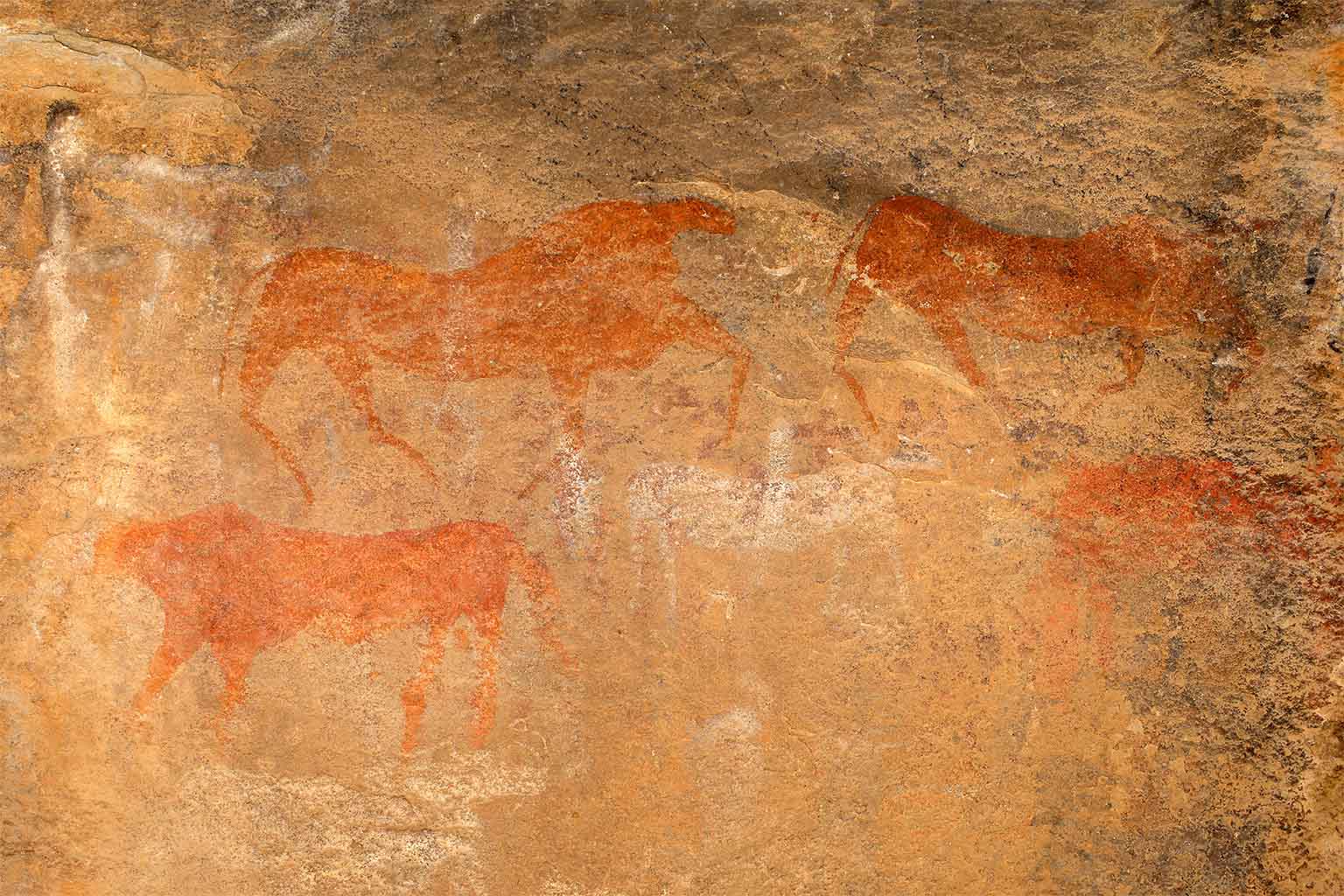
Imagine discovering a piece of art that captures an extinct creature, painted centuries ago—long before paleontologists even identified it. This is exactly what a recent find in South Africa’s Karoo region suggests: ancient cave art depicting a mysterious animal strikingly similar to the dicynodont, a plant-eating reptile that roamed Earth roughly 250 million years ago. This revelation invites us to rethink how indigenous peoples connected with and understood the prehistoric world around them.
A stunning discovery from South Africa’s Karoo region
The Karoo, spanning over 150,000 square miles, is not only a treasure trove of fossils but also home to the indigenous San people, whose rich cultural heritage includes remarkable rock paintings and cave art. These artworks, often overlooked as mere mythological renderings, now reveal a deeper layer of meaning.
Among the most fascinating is the so-called Horned Serpent Panel, painted between 1821 and 1835 on sandstone walls. This art shows a creature with a serpentine body and downward-curving tusks — features remarkably similar to the extinct dicynodont. Historically, researchers debated whether this was a symbolic rainforest spirit or something based on real fossils discovered by the San people. Closer analysis points towards the latter, suggesting these indigenous artists had detailed knowledge of prehistoric animals.
Art predates formal paleontology by over a decade
Julien Benoit, a researcher from the University of the Witwatersrand, analyzed the panel and explains, “The painting was made in 1835 at the latest, which means this dicynodont was depicted at least ten years before the western scientific discovery and naming of the first dicynodont by Richard Owen in 1845.” This challenges conventional history by showing that the San’s art provides one of the earliest visual records of an extinct species—predating Western science’s formal recognition.
This discovery not only redefines the role of indigenous knowledge in the history of paleontology but also highlights the observational skills and curiosity of the San people. Their art was not simply spiritual or abstract but an informed reflection of the environment and its ancient fossils.
Fossils and cultural heritage intertwined
The Karoo’s arid landscape naturally exposes ancient bones and fossils, making it likely that the San people encountered dicynodont remains regularly. Fossils may have been collected or revered within their spiritual and cultural practices, much like other natural wonders.
Benoit’s work supports the idea that “the first inhabitants of southern Africa, the San hunter-gatherers, discovered fossils, interpreted them, and integrated them into their rock art and belief system.” This integration offers us profound insight into how indigenous communities value and interpret natural history within their cultural worldview. It suggests a long-standing, intimate connection to land and its stories—transmitted through artistic expression.
“This discovery highlights indigenous knowledge systems as crucial contributors to our understanding of prehistoric life,” says Dr. Lisa Nguyen, a cultural anthropologist specializing in African indigenous traditions.
Why this matters today
This discovery underscores that the history of scientific knowledge is far more multidimensional than commonly believed. According to a 2024 study published by the National Academy of Sciences, indigenous knowledge often preserves ecological and historical information that predates and enriches modern scientific understanding.
Recognizing these cave paintings as legitimate scientific records helps correct the historical oversight of indigenous contributions to paleontology and natural history. It also invites current researchers to adopt a more inclusive approach in understanding past life and cultural heritage.
For anyone fascinated by prehistory, the Horned Serpent Panel is a powerful reminder that our ancestors left more than stories—they left clues. These artworks bridge the gap between scientific discovery and cultural memory, connecting the earliest known ecosystems and the people who witnessed their remnants up close.
To dive deeper, this short video brings the discovery to life :
How do you feel about the idea that ancient art could reshape scientific timelines? Share your thoughts, comments, or experiences with indigenous art and paleontology below. Let’s celebrate how culture and science together deepen our understanding of the past.