


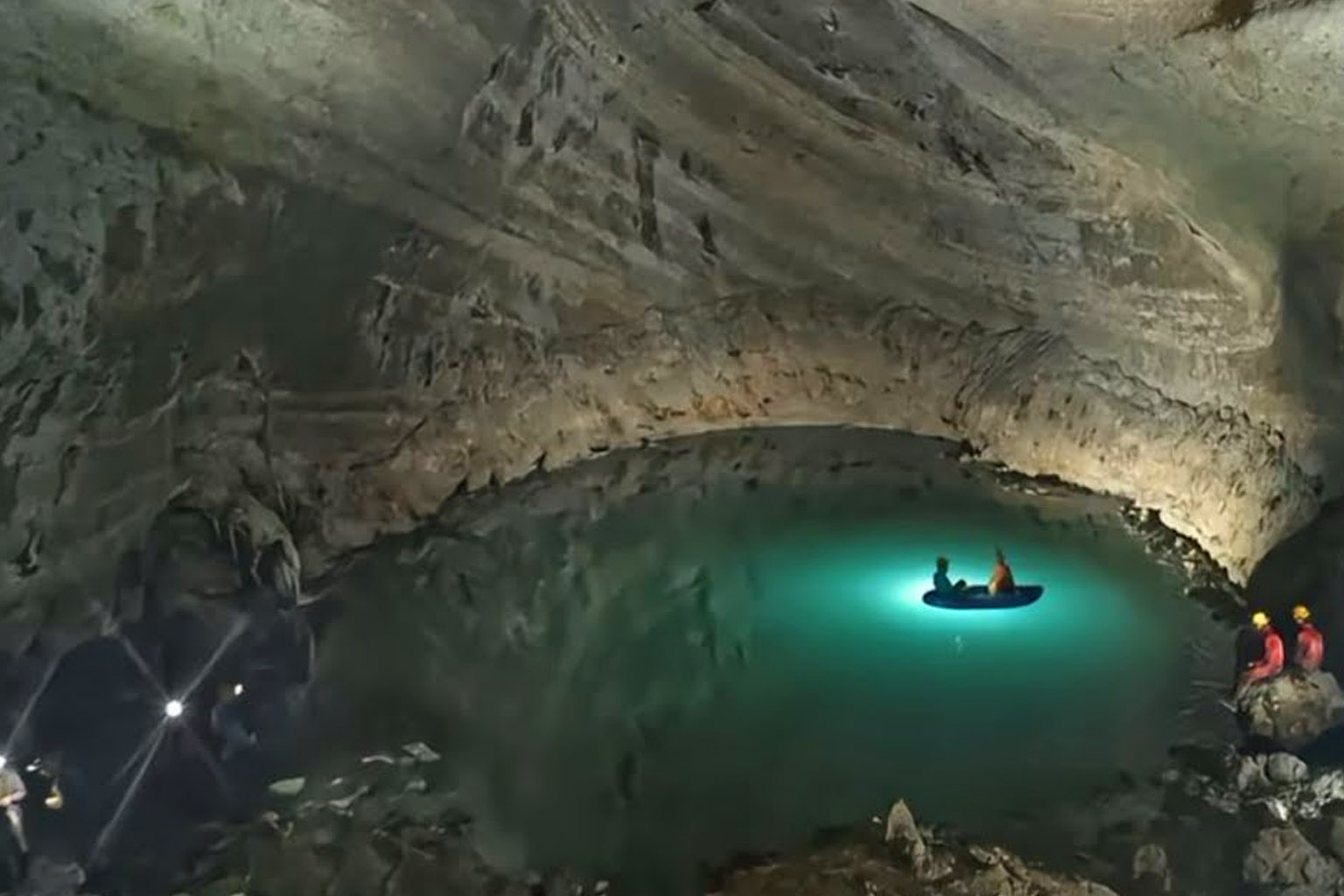
In the rugged mountains of southern Albania, where political tensions have long restricted scientific access, a column of steam rising mysteriously from the earth caught the attention of cave explorers in 2021. What began as curiosity about this natural phenomenon led to one of the most remarkable underground discoveries of recent decades. The steam, drifting upward like a signal from deep within the Earth’s crust, marked the location of something extraordinary hidden beneath the surface.
Three years later, armed with sophisticated 3D scanning technology and precise measurement tools, researchers have confirmed what their initial exploration had only hinted at. Deep within a 330-foot abyss, they found Lake Neuron—now officially recognized as the world’s largest underground thermal lake. This massive body of water, spanning 454 feet in length and containing enough water to fill 3.5 Olympic swimming pools, represents far more than a record-breaking discovery. The precision of these measurements was achieved using LiDAR technology, the same advanced mapping system that has revolutionized archaeological discoveries worldwide.
The implications extend well beyond simple measurements. This finding challenges our understanding of subterranean ecosystems and raises fundamental questions about the geological processes occurring beneath our feet. The lake’s thermal nature, heated by geothermal activity within the Earth’s crust, suggests connections to deep geological systems that scientists are only beginning to comprehend.
From Steam Signal to Scientific Breakthrough
The discovery began with veteran cave explorer Marek Audy and his team noticing an unusual steam plume in the remote Leskovik region. Following this natural beacon led them to a gaping abyss that descended over 100 meters into the mountain. Their initial descent revealed an extensive cave system with thermal springs and water channels, but the true prize lay deeper within.
Richard Bouda, expedition photographer, described the moment of realization: even with basic mapping equipment, the team understood they had encountered something unprecedented. The 2021 expedition provided enough evidence to secure funding from the Neuron Foundation, enabling a return visit in 2024 with the advanced technology necessary for precise documentation.
The three-year gap between discovery and confirmation illustrates the challenges inherent in underground exploration. Unlike surface discoveries that can be immediately verified, subterranean finds require specialized equipment and considerable resources to properly document and understand.
The Technology Behind the Measurement
The 2024 expedition employed lidar technology—a sophisticated laser-based remote sensing system—to create precise 3D maps of Lake Neuron and its surrounding cave network. This technological approach was crucial for establishing the lake’s record-breaking dimensions: 454 feet long, 138 feet wide, containing approximately 294,350 cubic feet of water.
These measurements officially surpassed the previous record holder, a thermal lake discovered in Budapest in 2008. The precision required for such documentation in underground environments presents unique challenges. Traditional surveying methods prove inadequate in the confined, humid conditions of thermal cave systems.
The lidar mapping revealed not just the lake’s size but also detailed information about the cave structure itself. This data provides crucial context for understanding how such massive underground water bodies form and maintain their thermal properties over potentially thousands of years. Similar mapping techniques have uncovered remarkable discoveries in cave systems worldwide, including 20,000-year-old 3D cave etchings that reveal ancient human understanding of underground environments.
Geothermal Origins and Geological Significance
Lake Neuron’s thermal nature distinguishes it from typical underground water bodies. While most subterranean lakes form from accumulated rainwater or groundwater, this lake derives its heat from geothermal processes within the Earth’s crust. According to research published in Geomorphology, thermal systems in karst environments often create complex underground formations through hypogenic processes that can sustain elevated temperatures over geological timescales.
“Thermal survey shows plumes of rising warm water within the underlying aquifer, indicating sustained geothermal activity that can maintain elevated temperatures in underground water systems” – Geomorphology research
The lake’s sustained thermal properties indicate a continuous heat source, likely linked to broader geological processes affecting the region. The border area between Albania and Greece sits within a geologically complex zone where tectonic forces have shaped the landscape over millions of years.
Understanding these connections could provide insights into regional geological stability and the presence of other thermal systems in the area. The discovery raises questions about whether Lake Neuron represents an isolated phenomenon or part of a larger network of thermal underground features.
The Biological Frontier Nobody Discusses
While the lake’s size captures headlines, the potential for discovering unique microbial life adapted to extreme thermal conditions represents perhaps the most scientifically significant aspect of this find. Underground thermal environments often harbor organisms that have evolved in complete isolation, developing survival mechanisms unlike anything found on the surface.
These potential microorganisms could provide crucial insights for astrobiology research, offering terrestrial analogs for life that might exist in extreme environments on other planets. The combination of high temperature, limited oxygen, and complete darkness creates conditions that push the boundaries of life as we understand it.
Research into extremophile organisms has already revolutionized our understanding of life’s limits and possibilities. Lake Neuron’s isolated environment, potentially unchanged for millennia, could harbor evolutionary adaptations that have developed nowhere else on Earth. The scientific implications extend beyond simple biological curiosity to fundamental questions about life’s adaptability and resilience. Such discoveries in underground environments parallel recent findings in other cave systems, including Nottingham’s largest network of caves, which continue to reveal new insights about subterranean ecosystems.
Unexplored Networks and Future Discoveries
The political sensitivity of the Albanian-Greek border region has historically limited scientific exploration, meaning vast cave systems remain uncharted. Lake Neuron’s discovery by chance raises compelling questions about what other underground features might exist in this geologically rich area.
Future research plans include detailed chemical analysis of the lake water, biological sampling for microbial life, and expanded exploration of the surrounding cave network. Studies from the National Speleological Society provide methodological frameworks for comprehensive cave system analysis, including protocols for thermal lake investigation and biological sampling in extreme environments.
Scientists hope to determine whether Lake Neuron connects to other thermal systems or represents a unique geological formation. The research team has committed to returning with even more advanced equipment, aiming to unlock every mystery this hidden world contains. Their work could establish this region as a focal point for understanding subterranean thermal systems and their role in broader geological processes. Such comprehensive underground investigations echo the methodical approaches used in studying ancient mysteries in cave environments worldwide.
The discovery of Lake Neuron reminds us that Earth continues to surprise us with hidden wonders, even in an age when we assume most of our planet has been explored. As researchers prepare for deeper investigations into this thermal underworld, we’re left wondering what other secrets lie beneath our feet, waiting for the right combination of curiosity, technology, and persistence to bring them to light.