


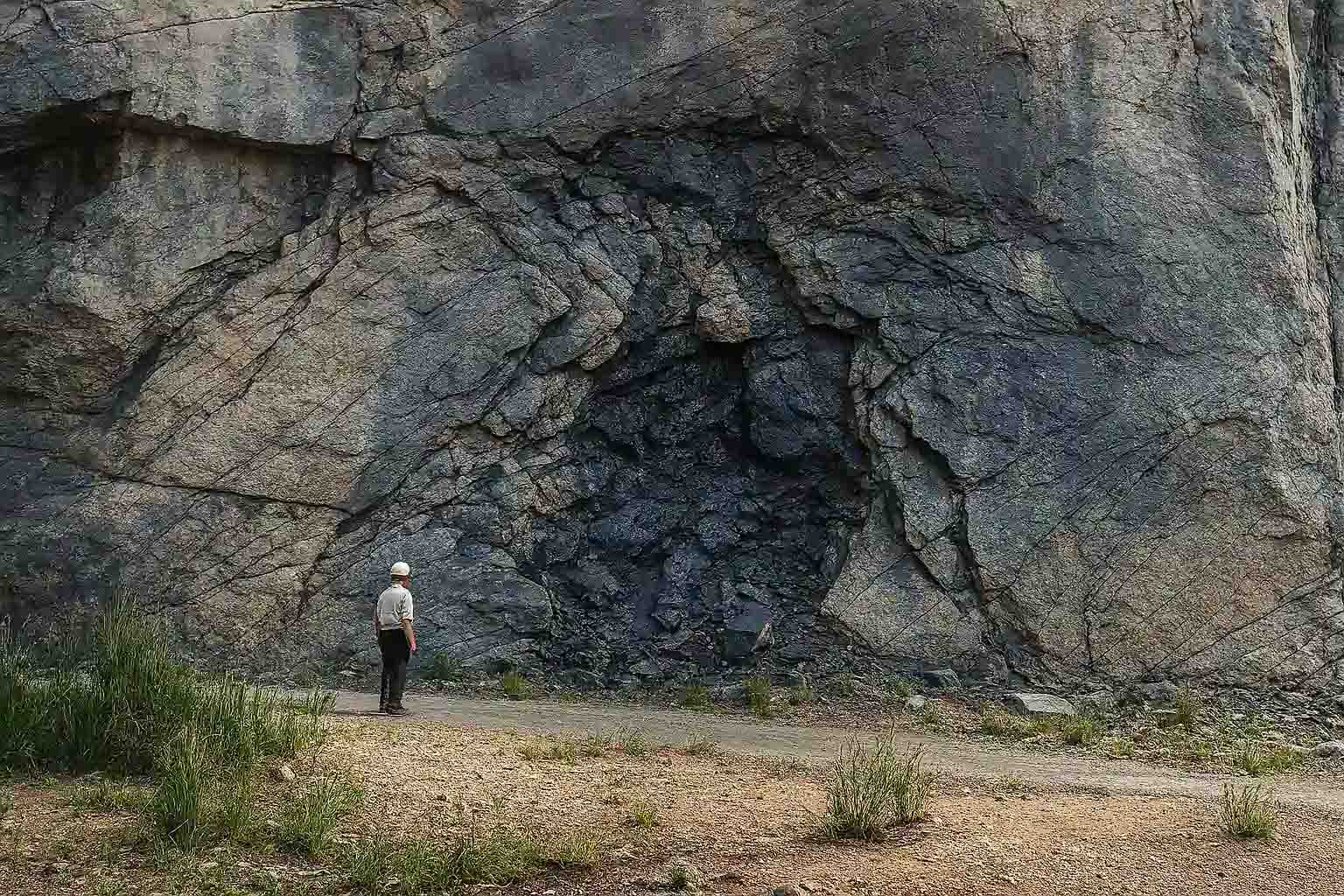
A hidden marvel lies beneath the soil of Gabon, Africa: a natural nuclear reactor that functioned two billion years ago, long before humans ever harnessed atomic energy. This extraordinary discovery challenges our understanding of nuclear science and offers a unique window into Earth’s deep past. Scientists were astonished when they unearthed the Oklo phenomenon, a prehistoric nuclear reaction site created entirely by nature.
The Ancient Nuclear Reactor Hidden in Gabon
Discovered in 1972, the Oklo mine exposed a puzzling anomaly in a sample of uranium ore: the proportion of uranium-235 was slightly lower than what is found in natural uranium anywhere else on earth. Normally, uranium-235 remains a constant 0.720%, but at Oklo, it measured at 0.717%. While this difference seems minuscule, it sparked intense scientific curiosity and further investigation.
French physicist Francis Perrin was initially responsible for the finding. The uranium was mined during the mid-20th century when Gabon was still a French colony, and its uranium was a key source of fuel for France’s growing nuclear reactors. It was only after analyzing the isotopic ratios that physicists realized they were looking at the residue of a natural reactor, active billions of years ago—long before humanity’s nuclear ambitions.
How Nature Created a Nuclear Chain Reaction
A nuclear chain reaction requires very specific conditions: enriched uranium, a neutron moderator like water, and an environment free from elements that absorb neutrons, such as boron or lithium. Remarkably, these conditions came together naturally at Oklo.
Back then, uranium-235 was much more abundant—approximately 3%, a concentration in line with modern nuclear reactors. Groundwater served as the moderator, slowing down neutrons and enabling sustained fission reactions. According to chemist Paul K. Kuroda’s 1956 prediction, such natural reactors could exist, provided the mineral deposits were large enough and free from neutron absorbers. His theory found irrefutable proof at Oklo.
When water percolated through the uranium-rich rock, it triggered the nuclear chain reaction. But as the water heated and evaporated, the reaction paused, resuming only when the groundwater returned. This on-off cycling continued for hundreds of thousands of years, making the Oklo reactor a natural marvel of geological and nuclear engineering.
Legacy and Scientific Revelations of Oklo
The total energy output of the Oklo reactor is estimated at about 15,000 megawatt-years—roughly the equivalent of a 1,500-megawatt nuclear plant operating for a decade. Importantly, the reactor’s operation was cyclical, governed by the ebb and flow of groundwater. The fission left behind distinctive isotopic signatures, particularly in xenon gas trapped within surrounding minerals.
Physicist Alex P. Meshik and his team studied these xenon isotopes, revealing rich insights into the reactor’s history and stability. The trapped xenon acted like a natural time capsule, confirming that the fission reactions were not only natural but also remarkably stable until uranium-235 was depleted below a critical threshold.
Why the Oklo Reactor Matters Today
The Oklo natural reactor is the only known instance of sustained nuclear fission occurring naturally. Its discovery in the 1970s shook the scientific community because it demonstrated that nuclear chain reactions are not solely the product of human invention.
Grave scientific discussions were held in Libreville, Gabon, in 1975, bringing together experts from around the world to explore the phenomenon. Today, samples from Oklo are preserved in institutions like the Natural History Museum in Vienna, where they continue to be studied.
Understanding Oklo enhances modern nuclear science by providing a real-world example of natural reactor dynamics—especially the way fission reactions can self-regulate over time. Moreover, research at Oklo contributes to insights in geology and isotope geochemistry, enriching our knowledge of Earth’s ancient conditions.
From the perspective of Dr. Ludovic Ferrière, a geologist who has worked extensively on Oklo samples: “The Oklo phenomenon represents not only a geologic curiosity but a natural laboratory for nuclear science, helping us understand both the Earth’s past and future energy potential.”
This discovery reminds us that nature’s ingenuity far precedes human technology and cautions us to study and respect the forces that shaped our planet’s evolution.
If you found this story about the 2-billion-year-old nuclear reactor as fascinating as we did, share your thoughts below or join the conversation on social media. How does knowing that nature cracked the nuclear code billions of years ago change your view of the atomic age?