


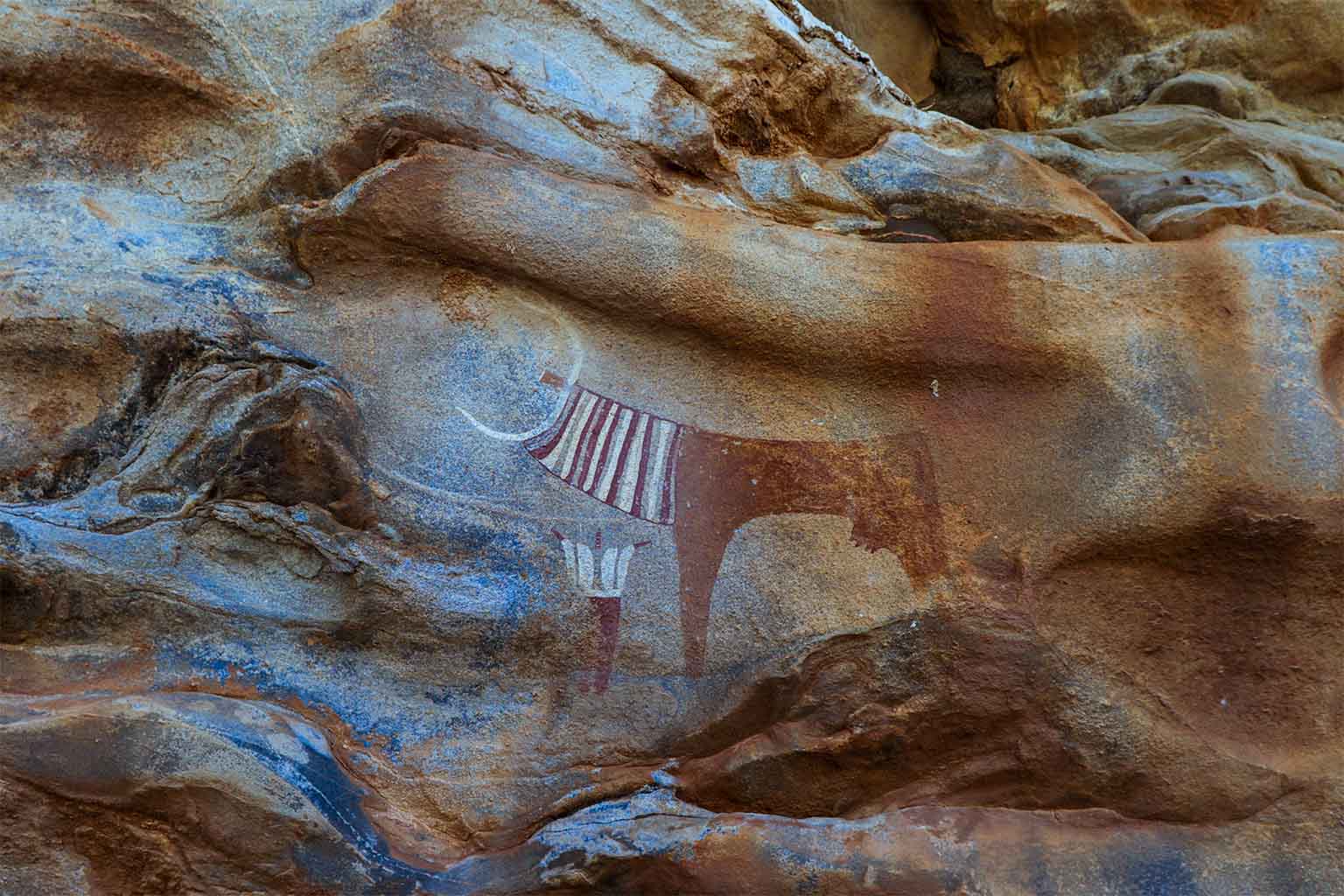
Imagine coming face to face with a 200-million-year-old mystery—captured not in a fossil, but in rock art. Deep within South Africa’s Karoo Basin, ancient San people painted an enigmatic creature adorned with downward-curving tusks, unlike anything alive today. This discovery is not just a remarkable glimpse into prehistoric life; it challenges what we know about Indigenous knowledge and its connection to Earth’s distant past.
The Enigmatic Horned Serpent Panel
This remarkable rock painting, called the Horned Serpent panel, emerges from the fertile fossil grounds of the Karoo Basin in southern Africa. Dating between 1821 and 1835 and crafted by the San people, the artwork features a strange, long-bodied animal with downward-turned tusks. It superficially resembles a walrus, yet walruses are marine mammals that inhabit northern seas, far from the African continent. The creature’s unique features fail to match any currently known species in the region.
Julien Benoit, a paleontological researcher at the Evolutionary Studies Institute at the University of the Witwatersrand, has proposed a fascinating explanation. He suggests the creature represents a dicynodont—an extinct herbivorous animal that roamed these lands during the Late Permian to Early Triassic periods, roughly 200 million years ago.
Benoit explains: “The Horned Serpent panel shows tusked animal traits remarkably similar to those of dicynodont fossils found in the region.”
This interpretation is supported by detailed comparisons of the painting with fossilized remains of Lystrosaurus, a well-known genus of dicynodonts, including skull and limb structures captured faithfully in the art.
Indigenous Paleontology: A Bridge Across Time
The idea that Indigenous communities like the San possessed some form of paleontological knowledge is gaining traction. Benoit highlights their intimate awareness of fossils in sites surrounding the Karoo Basin, suggesting they may have encountered and interpreted these ancient bones long before Western science documented them.
For example, the Bolahla rock shelter is a notable site where San people collected a dinosaur phalanx—likely the first dinosaur bone recorded by Indigenous people in that area. This evidence paints a compelling picture of cultural interactions with prehistoric life preserved through generations.
Such findings resonate with similar cases worldwide, where Indigenous groups have incorporated fossils and extinct species into their worldviews and myths, underscoring an often overlooked interaction between cultural knowledge and natural history.
Cultural Significance: The Rain-Making Connection
Benoit interprets the Horned Serpent panel within the San’s spiritual framework, particularly their traditional rain-making ceremonies. These rituals involve entering trance-like states to access the ‘realm of the dead,’ where participants capture rain-animals believed to have supernatural powers vital for restoring rainfall on Earth.
The depiction of a dicynodont—an extinct creature from the depths of prehistory—may have been no coincidence. Painting this powerful “dead” animal could have symbolized a potent bridge between this world and the world beyond, fulfilling a spiritual role as a rain-animal with amplified significance.
In Benoit’s words to IFLScience: “During rain-making ceremonies, the San enter a state of trance to catch rain-animals and bring the rain back to the world of the living. By selecting an extinct species like a dicynodont, they likely sought a rain-animal that held increased potency to bridge the two worlds.”
Scientific Context and Its Broader Implications
This research, published in the peer-reviewed journal PLOS ONE, adds a new layer of understanding to how Indigenous knowledge systems can preserve evidence of prehistoric life in unexpected ways. It reminds us that knowledge transmission does not always follow linear scientific paths but can also weave through oral tradition, ritual, and artistic expression.
This video highlights the unique biological traits of dicynodonts and their significance in evolutionary history—a useful complement for understanding the extinct species that may have inspired the Horned Serpent panel.
Julien Benoit’s research challenges us to rethink what ancient art can reveal—not only about the past but about the deep interconnectedness between human cultures and prehistoric life. It sparks new conversations about how Indigenous communities engaged with their environment, blending natural history with spiritual meaning.
What do you think about this astonishing blend of art, archaeology, and paleontology? Share your thoughts, questions, or reflections below, and let’s dive deeper into the mysteries these ancient paintings hold together.