


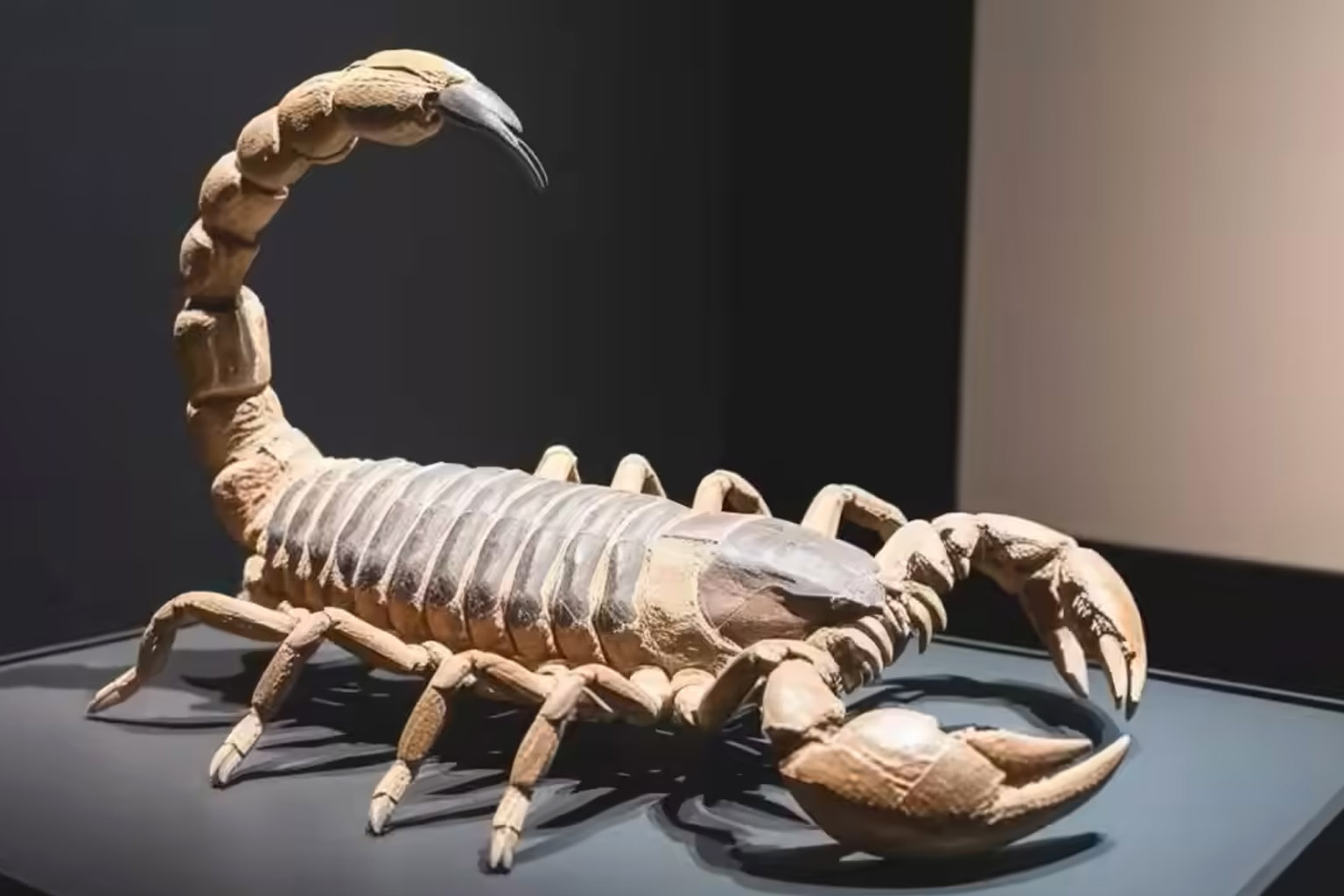
The discovery of ancient life forms often captures our imagination, but few finds are as remarkable as the recent unearthing of Jeholia longchengi, a giant venomous scorpion that prowled the Earth 125 million years ago. Found in China’s renowned Yixian Formation, this prehistoric predator represents far more than just another fossil in a museum display case.
At four inches long, this ancient arachnid was significantly larger than its contemporaries, occupying a crucial position in the complex food webs that existed alongside dinosaurs. What makes this discovery particularly significant is not just its size, but what it reveals about the intricate ecosystems that flourished during the Early Cretaceous period. This scorpion didn’t simply exist in isolation—it was an active participant in a world teeming with early mammals, primitive birds, and the iconic reptiles that dominated the era, much like other predator-prey interactions preserved from this remarkable time period.
The rarity of this find cannot be overstated. Scorpions may have existed for over 400 million years, but their fossils are extraordinarily scarce. This specimen represents only the fourth terrestrial scorpion fossil ever discovered in China and the first from the Mesozoic era, making it a window into a world we rarely get to examine in such detail.
An Ecosystem in Balance
The Jehol Biota, where researchers unearthed this remarkable specimen, functioned as one of the most diverse ecosystems of its time. This wasn’t simply a landscape dominated by massive dinosaurs, but rather a complex web of interconnected species where creatures like Jeholia longchengi played essential roles.
Evidence suggests this prehistoric scorpion occupied what ecologists call a mesopredator niche—hunting insects, small reptiles, and possibly tiny mammals while remaining vulnerable to larger vertebrates. Research indicates that such positioning was crucial for maintaining ecological balance, preventing smaller prey species from overwhelming their environments while providing sustenance for apex predators.
The scorpion’s distinctive anatomy tells us much about its hunting strategies. Unlike modern species, Jeholia longchengi possessed elongated legs and slender pincers, adaptations that likely made it an agile pursuer rather than an ambush predator. Its rounded spiracles show evolutionary connections to certain Asian scorpion families that exist today, suggesting some anatomical features have remained remarkably stable across geological time.
Preservation Against All Odds
The exceptional preservation of this fossil highlights just how unlikely such discoveries truly are. Most scorpions from this period that we know about come from amber preservation, where tree resin trapped the creatures in perfect detail. Finding one preserved in sedimentary rock represents an entirely different set of circumstances, similar to how researchers have discovered other remarkable specimens like a tiny dinosaur preserved in amber from roughly the same era.
Scorpions typically inhabit environments that work against fossilization—they burrow underground, hide beneath rocks, and live in conditions where rapid burial by sediment rarely occurs. For Jeholia longchengi to have been preserved in the Yixian Formation’s fine-grained rocks, a specific sequence of environmental conditions had to align perfectly.
This preservation method offers advantages that amber cannot provide. While amber captures incredible detail, sedimentary preservation can reveal information about the scorpion’s immediate environment and the conditions that led to its death. Researchers can analyze surrounding rock layers to understand seasonal changes, water levels, and other environmental factors that shaped this creature’s world, much like how scientists have studied ancient geological events preserved in amber from the same time period.
Evolutionary Insights from Ancient Anatomy
The anatomical features of Jeholia longchengi provide fascinating insights into scorpion evolution and adaptation strategies. Studies by researchers at the Nanjing Institute of Geology and Palaeontology reveal that this species possessed characteristics that set it apart from both its contemporaries and modern descendants.
The creature’s pedipalps lacked certain spurs found in related species, suggesting a unique approach to prey capture and handling. This adaptation likely influenced its hunting success and may have determined which prey species it could effectively target. Such morphological variations demonstrate how ancient ecosystems drove specialized evolutionary responses.
Scientific analysis indicates that if Jeholia longchengi existed today, it would likely dominate as a predator of insects, amphibians, and even juvenile vertebrates. This projection helps researchers understand how body size and hunting adaptations translated into ecological success during the Cretaceous period.
The Broader Context Few Consider
While the discovery of Jeholia longchengi captures headlines for its impressive size and age, the broader implications extend far beyond paleontological curiosity. This find represents a critical piece in understanding how terrestrial ecosystems recovered and diversified following major extinction events that preceded the Cretaceous period.
The scorpion’s presence in the Jehol Biota suggests that arthropod communities had achieved remarkable complexity by 125 million years ago. This complexity required stable food sources, predictable environmental conditions, and intricate predator-prey relationships that could support specialized hunters like Jeholia longchengi. Such sophisticated ecological networks demonstrate the same level of complex strategies that would later emerge in human civilizations.
Climate research indicates that the Early Cretaceous period experienced significant environmental fluctuations, yet ecosystems like the Jehol Biota maintained their diversity. Understanding how species like this scorpion adapted to changing conditions provides valuable context for modern conservation efforts and ecosystem management strategies.
The fossil now resides at the Fossil Valley Museum in Chaoyang, where ongoing research continues to unlock secrets about life in the age of dinosaurs. Each analysis reveals new details about how these ancient communities functioned, adapted, and ultimately gave rise to the modern world we inhabit today. What other secrets lie buried in similar formations, waiting to reshape our understanding of prehistoric life?