


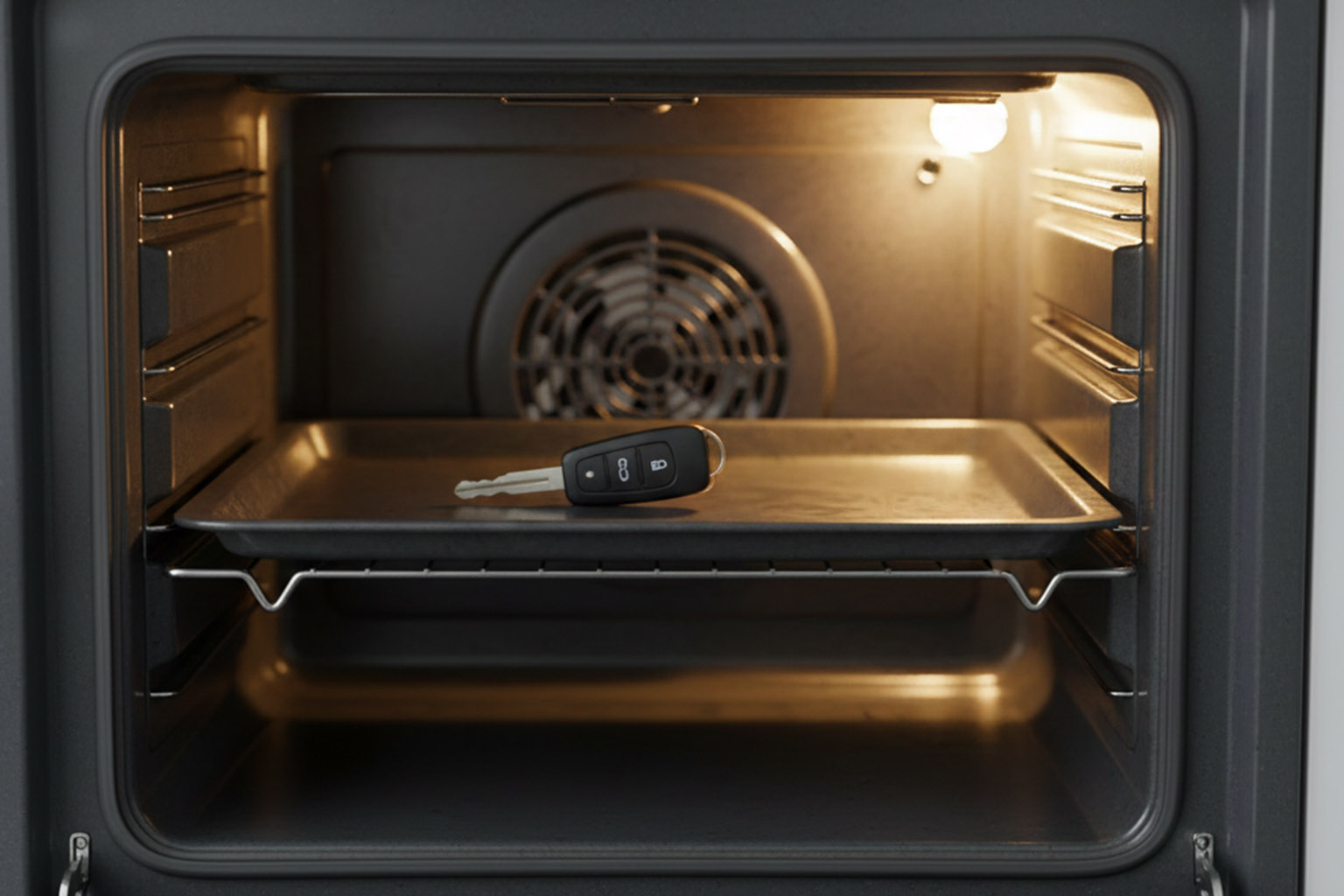
Prepare to be both intrigued and slightly bewildered: So, drivers are now putting their car keys in the microwave each night. Not for warming up — that’d be risky — but to ward off savvy car thieves. It sounds peculiar, doesn’t it? Yet it’s happening because of ruthless exploitation of wireless security gaps. That kitchen staple, the metal microwave, turns out to be an unexpected hero in this modern tale.
A hallway’s motion sensor light flickers faintly, an elevator pings quietly somewhere, and a curious thought invades: Is your key fob’s signal safe from those nocturnal hackers when you leave it in the foyer? Let’s be honest, we all hit that moment of doubt, questioning if our everyday habits might betray us.
A woman’s tale in the building stirred the community. Imagine this: strangers extending the reach of her keyless fob with a simple device. A sleek, almost undetectable maneuver taking less time than a coffee break. The local police reports are now littered with similar accounts, cars disappearing in electronic feats rather than brute force. And yes, it led me to eye my microwave with newfound appreciation.
The invisible peril and the quaint microwave rescue
Living with keyless entry offers this seamless, almost magical access — like an inviting, invisible door. The car listens intently, the fob responds, and meanwhile, somewhere in the nefarious electromagnetic space, someone capitalizes on this very convenience. This relay theft extends your fob’s radio waves from the comfort of your home to the car waiting outside — no smashed glass, no blaring alarms. Rather abruptly, that cute bowl near your entryway seems more like a welcome mat for would-be hustlers, adjusted nicely by**daily routine**.
Imagine a night on a Hamburg street; a SUB “awakes” two times, its mirrors flickering like a strobe. A local resident shared this odd occurrence, later explained by police as possible experiments with radio repeaters. Insurers, like Germany’s GDV, are raising alarms about the rise in such cases, targeting cars equipped with this modern convenience — not an uncontrollable frenzy, but a stealthy uptick that worsens by the night.
The logic is surprisingly simple. The fob broadcasts modestly, the thief amplifies it significantly. Break the chain by blocking the signal, and you escape the pattern. Your humble microwave acts as a makeshift Faraday cage — a metal enclosure, complete with that perforated door screen keeping radio waves where they belong — inside. It’s not that microwaves are flawless barriers; car fobs transmit at 433 MHz or 868 MHz, while microwaves target 2.45 GHz. Yet, the signal attenuation they offer, it’s enough to disrupt that nightly villainy.
Executing the microwave trick — guilt-free
It’s all in the ritual: fob goes into metal at dusk, free again by dawn. When employing the microwave, unplug it first — just to be safe. Then, pop the keys in, close the door. A quick, half-awake test at the car door: touch the handle. Car doesn’t unlock? Perfect. Admitedly, it smacks of a DIY solution but proves its mettle again and again.
And yes, mistakes crawl in, where routine reigns supreme: Someone accidentally hits “Start,” aiming to heat a cup of milk. A roomie shuffles for space, unwittingly turns a knob. Let’s admit it, nobody nails it every day. Oddly effective is a simple handwritten note on the microwave door: “Keys Inside — Do Not Use.” Don’t love the idea? A solid metal tea canister or a**Faraday bag** on the go is your friendly alternative. Even an oven shields well, as long as it stays unheated.
There’s no wizardry here, just pragmatic blocking of signals to fend off intrusions. It might not metamorphose your world — just your nights.
“A silenced fob discourages keyless attacks. Criminals value speed. Every obstacle means more time and frustration for them.”
Micro-steps to make it work
Turn off the power or unplug the device. Conduct a range test: handle stays locked? Good to go. Alternatively, go for a tight-lidded metal box. Leave a note by the door: “Keys Inside — Do Not Use.” On the move, pack a small shielding pouch in your backpack.
What this little habit says about our times
Ultimately, this quiet counter is an **insurgent act** against our app-driven, always-on existence: a snug cocoon encasing a helpful, yet vulnerable signal. This is less a heroic act, more a modern grounding ritual — one reminiscent of locking your front door, now with an added deliberation, even in our digital age. Perhaps this is soon to become the hottest topic in building lobbies, more so than any impending software update.
People embracing this approach aren’t just thinking about their cars, but also craving a bit of peace of mind in daily life. Less tossing and turning at night, less skepticism at a sudden doorbell — less chance of anxiety. This invites consideration for tiny safeties to flourish: in households, within families, among friends. Share it with just a nod — a peek at the metal box, a soft door click, and done.
If you’re ready, join the conversation. Share this little-known hack with your friends and neighbors, and enjoy a sound, uninterrupted sleep tonight.