


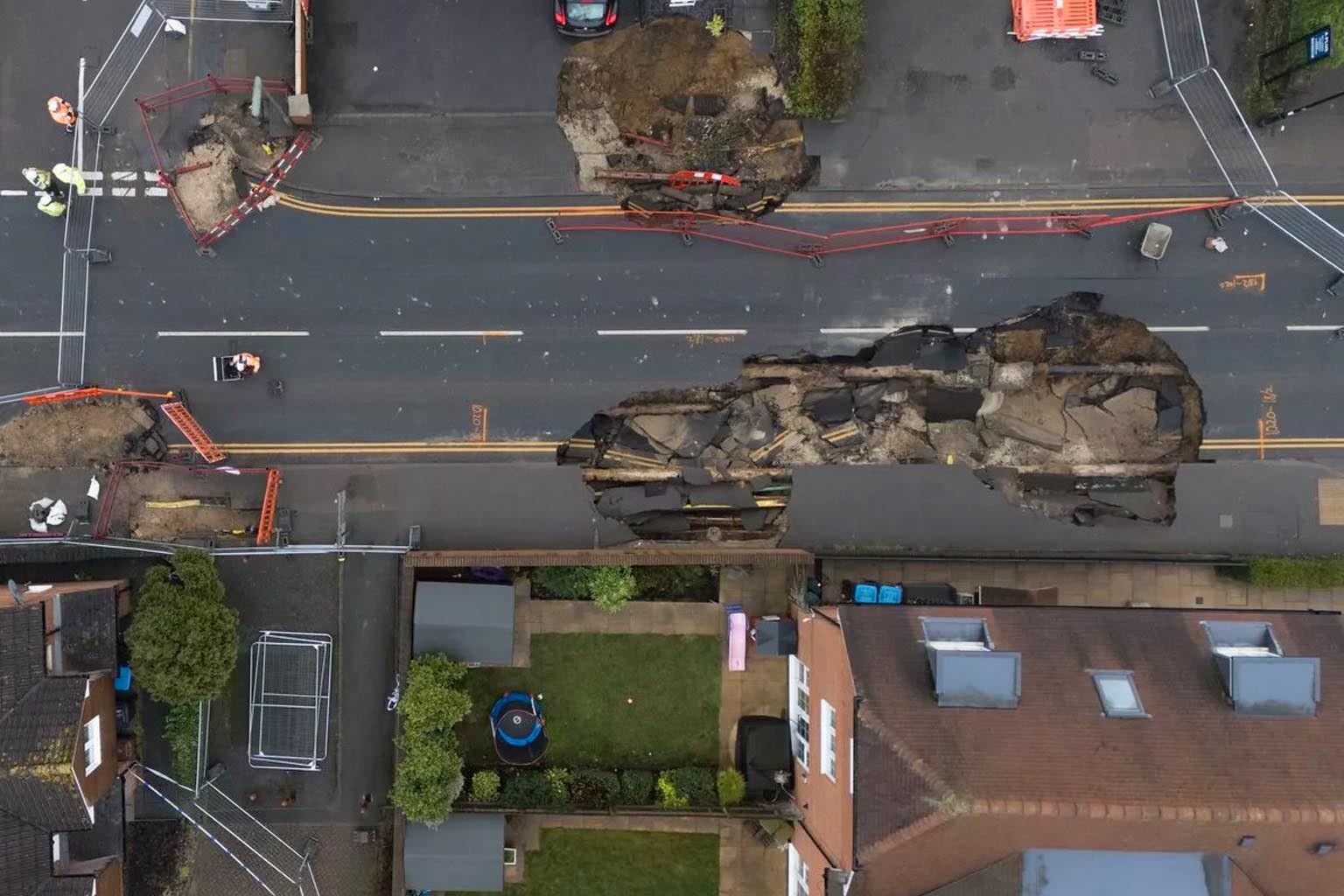
The ground beneath our feet holds secrets we rarely consider until they dramatically reveal themselves. In Godstone, a quiet Surrey village, residents experienced this reality firsthand when a massive sinkhole suddenly opened, swallowing part of their road and forcing immediate evacuations. What initially appeared to be a geological mishap has unveiled something far more intriguing: a forgotten network of underground tunnels and quarries that speaks to England’s industrial past.
This discovery highlights a troubling reality facing many historic communities across Britain. Beneath seemingly stable ground lies a hidden world of unmapped Victorian-era excavations, created during an age when industrial expansion took precedence over documentation. The Godstone collapse serves as a stark reminder that our understanding of what lies beneath modern developments remains dangerously incomplete, much like the largest network of caves discovered beneath Nottingham that revealed centuries of hidden history.
The implications extend beyond mere archaeological curiosity. These forgotten spaces represent potential hazards that could emerge anywhere, at any time, in communities built over centuries of human activity.
The Industrial Legacy Hidden Underground
The tunnels beneath Godstone weren’t created for shelter or transportation, but for commerce. During the Victorian era, the area’s exceptionally pure silver sand made it invaluable for glassmaking and industrial production. Workers excavated extensive underground networks to extract this precious resource, creating a subterranean maze that would later be abandoned and forgotten.
Peter Burgess from the Wealden Cave and Mining Society has spent years documenting these forgotten spaces. His research reveals a pattern that extends far beyond Godstone: industrial excavations from the 1800s were rarely recorded with the precision we’d expect today. When operations ceased and entrances were sealed, institutional memory faded within a generation.
The scale of these operations was substantial. Evidence suggests the network stretches throughout the village, though its exact boundaries remain unknown. This uncertainty creates a particularly modern problem: how do you plan urban development around infrastructure that exists but cannot be mapped?
The Challenge of Forgotten Infrastructure
Godstone’s situation illustrates a broader challenge facing historic communities throughout England. Unlike nearby Reigate, which has systematically preserved and documented its underground passages, Godstone’s tunnels became casualties of poor record-keeping and changing priorities.
The consequences manifest unpredictably. Residents have reported gardens suddenly caving in, revealing hidden entrances to tunnels no one knew existed. These discoveries often come without warning, turning routine landscaping into archaeological expeditions. The randomness of these collapses creates ongoing anxiety for homeowners who cannot know whether their property sits above solid ground or forgotten caverns.
Local authorities now face the complex task of assessing risks without comprehensive historical records. Traditional surveying methods prove inadequate when the very existence of underground spaces remains uncertain. This gap between historical activity and contemporary knowledge creates a unique form of urban vulnerability.
Predicting the Unpredictable
The Godstone sinkhole raises uncomfortable questions about predictive capabilities in areas with undocumented underground activity. Current geological surveys rely heavily on existing records and visible surface indicators. When both are absent, communities operate with incomplete information about the stability of their foundations.
According to research published by the U.S. Geological Survey, subsidence mechanisms over soluble rocks and artificial cavities follow complex patterns that challenge conventional prediction methods. Modern technology offers some solutions. Ground-penetrating radar and other non-invasive techniques can identify subsurface voids, but systematic deployment across entire communities requires significant investment and coordination. The challenge lies in determining priorities: which areas warrant immediate investigation, and which can wait?
“Subsidence mechanisms over artificial cavities and soluble rocks create unpredictable failure patterns that require specialized assessment techniques” – U.S. Geological Survey research
The randomness of collapses complicates risk assessment. Unlike predictable geological processes, these human-made voids fail according to factors like structural deterioration, water infiltration, and surface loading that weren’t considered during their original construction. This unpredictability makes conventional hazard mapping inadequate for addressing the risks.
The Psychological Impact on Communities
Beyond the immediate safety concerns, the Godstone discovery has created a persistent sense of unease among residents. The knowledge that extensive tunnels lie beneath their homes transforms their relationship with their environment. What once felt solid and dependable now seems uncertain and potentially treacherous.
This psychological dimension rarely receives adequate attention in discussions of geological hazards. The fear isn’t simply about potential property damage or physical safety, but about the fundamental reliability of one’s surroundings. When the ground beneath your feet becomes questionable, it affects daily life in subtle but significant ways.
The broader implications extend to property values, insurance considerations, and long-term community planning. Potential buyers must now consider not just the visible attributes of properties, but the possibility of hidden underground risks. This uncertainty creates lasting economic and social effects that persist long after immediate safety concerns are addressed. Similar discoveries, like the 1,700-year-old altar found at the Tikal archaeological site, demonstrate how hidden structures can fundamentally alter our understanding of historical landscapes.
The Rarely Discussed Engineering Implications
The Godstone situation reveals critical gaps in how we approach subsurface engineering assessments for historic areas. Traditional geotechnical surveys assume natural soil conditions, but the presence of artificial voids fundamentally changes structural calculations and foundation requirements.
Building codes and construction standards weren’t designed to address scenarios where extensive but unmapped cavities might exist beneath proposed developments. This creates liability questions for engineers, planners, and developers who must work with incomplete subsurface information. The professional standards that guide construction assume a level of geological predictability that simply doesn’t exist in areas with significant historical excavation. Ancient civilizations faced similar challenges, as evidenced by discoveries showing how Egyptians used hidden water systems to build the pyramids, demonstrating sophisticated understanding of subsurface engineering.
Insurance companies face similar challenges. How do you assess risk and set premiums for properties where the very existence of underlying hazards remains unknown? The discovery of the Godstone network likely triggers reviews of coverage policies and risk models across similar historic communities throughout England.
The incident forces a broader reconsideration of how we balance historical preservation with contemporary safety requirements. Studies published in sedimentology research have shown that karst sinkholes function as complex sediment sinks with unpredictable stratigraphic patterns. This understanding becomes crucial when assessing risks in areas with both natural and artificial subsurface features.
As more communities discover their own forgotten underground legacies, the need for systematic approaches to subsurface risk assessment becomes increasingly urgent. The dedication of individuals like the retired engineer who discovered the Pictish ring at Burghead shows how volunteer efforts can uncover crucial historical information that impacts modern safety considerations. The question isn’t whether more collapses will occur, but how we prepare for the inevitable revelations that await beneath other seemingly stable communities.