


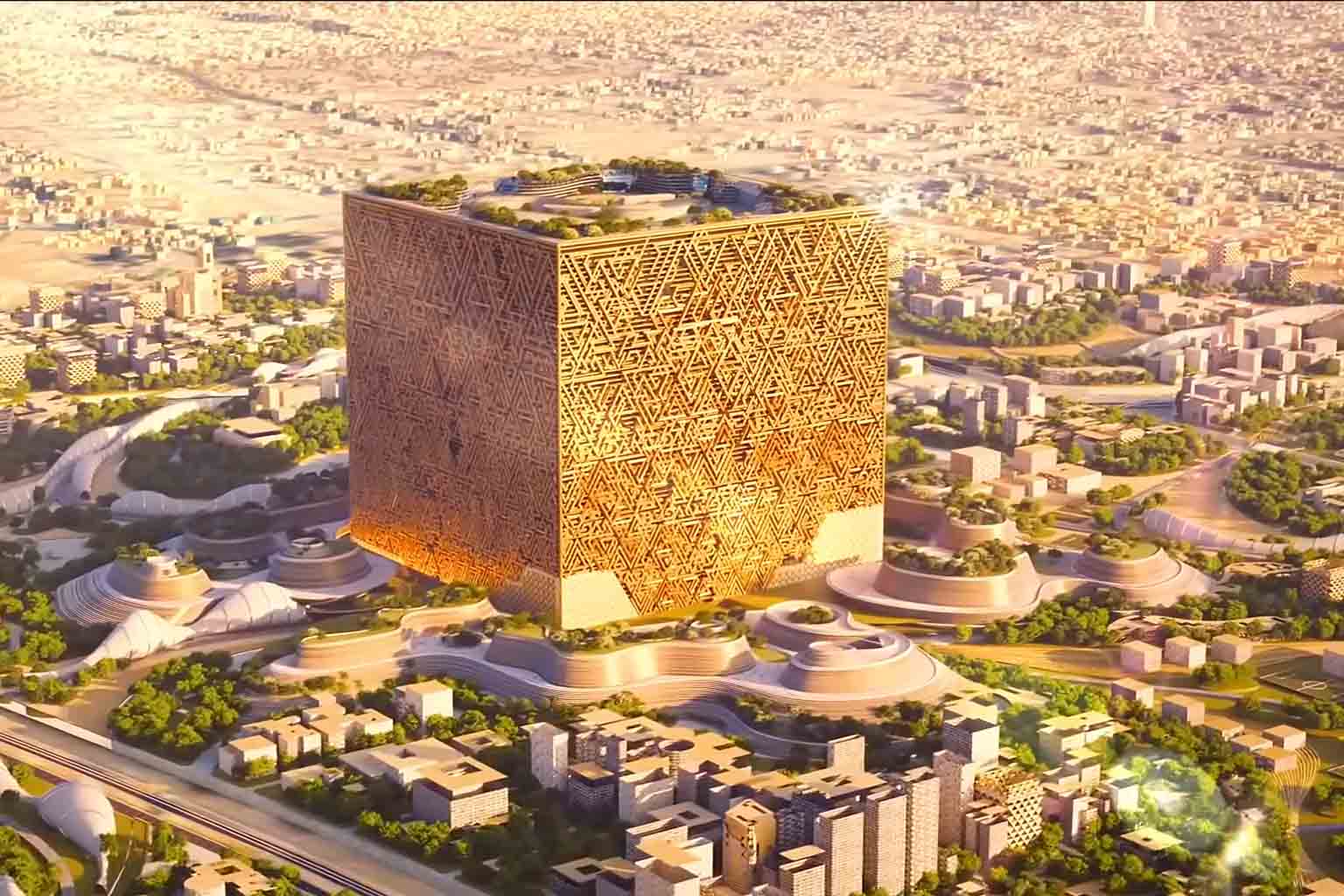
In the vast expanse of the Saudi desert, construction crews are laying the foundation for what could become humanity’s most audacious architectural experiment. The Mukaab, a perfect 400-meter cube rising in Riyadh’s heart, promises to house 400,000 residents within its geometric confines. This isn’t merely about breaking construction records—it represents a fundamental reimagining of how we might live, work, and coexist in an increasingly urbanized world.
The project emerges at a time when traditional urban planning faces mounting pressures. Cities worldwide struggle with sprawl, infrastructure decay, and environmental degradation. Saudi Arabia’s answer is characteristically bold: compress an entire city into a single structure, equipped with holographic projections and advanced climate systems. Yet the gap between vision and reality has never felt wider, especially as similar megaprojects face delays and budget overruns. Other ambitious urban projects have attempted to revolutionize city living through technology, though none at this unprecedented scale.
The Mukaab’s success or failure will likely influence urban development strategies for decades. The question isn’t just whether Saudi Arabia can build this monumental cube, but whether humanity is ready for such a dramatic departure from conventional city living.
The Engineering Challenge of Vertical Cities
Building a 400-meter cube presents engineering challenges that dwarf those of traditional skyscrapers. While towers like the Burj Khalifa concentrate structural stress along a relatively narrow footprint, the Mukaab must distribute enormous loads across massive horizontal spans. The structural requirements alone demand innovations in materials science and construction techniques that currently exist only in theoretical form.
The project’s architects envision seamless integration of residential, commercial, and recreational spaces within the cube’s interior. This means creating multiple climate zones, transportation networks, and utility systems that function independently yet harmoniously. The complexity multiplies when considering that holographic environments will replace traditional windows and outdoor spaces, requiring sophisticated projection systems and backup power infrastructure.
Water management becomes particularly critical in desert conditions. The structure must collect, recycle, and distribute water for hundreds of thousands of residents while maintaining the artificial landscapes and climate control systems. Research in closed-loop urban systems suggests these challenges are solvable, but never at this scale.
Social Dynamics in Enclosed Communities
The psychological implications of life within the Mukaab extend far beyond architectural novelty. Research on urban living environments consistently shows that access to natural light and open spaces significantly impacts mental health and social cohesion. The cube’s design attempts to address this through holographic environments, but questions remain about whether artificial nature can substitute for genuine outdoor experiences.
“High-density urban environments with limited access to natural spaces show significant correlations with increased stress levels and reduced psychological well-being” – Environmental health research
Population density within the structure will approach levels typically seen only in the world’s most crowded cities. Yet unlike traditional dense urban areas, residents cannot simply walk outside to escape the crowd. This creates unique social pressures that urban planners have limited experience addressing. The success of mixed-use developments suggests that vertical communities can thrive, but those examples typically involve thousands, not hundreds of thousands, of residents.
Cultural integration presents another layer of complexity. The Mukaab aims to attract international residents and businesses, creating a multicultural environment within Saudi Arabia’s conservative social framework. Managing these dynamics within an enclosed space requires careful consideration of public areas, privacy zones, and cultural accommodation.
Economic Viability and Market Forces
The Vision 2030 initiative positions the Mukaab as a catalyst for Saudi Arabia’s economic diversification, but the project’s financial fundamentals remain unclear. Construction costs for the cube likely exceed those of entire city centers in other countries. The return on investment depends entirely on the structure’s ability to attract residents, businesses, and tourists at unprecedented levels.
Real estate markets typically reward scarcity and location advantages. The Mukaab creates artificial scarcity through its limited space, but its desert location lacks the organic economic activity that drives property values in established cities. The project essentially bets that technological amenities and engineered convenience can substitute for natural urban advantages like proximity to ports, rivers, or existing business clusters.
Maintenance costs present another economic challenge. The cube’s advanced systems—climate control, holographic displays, water recycling—require constant upkeep and eventual replacement. These ongoing expenses must be balanced against revenue from residents and businesses who may not be willing to pay premium prices indefinitely for the novelty of cube living. Interestingly, economic opportunities from electronic waste could potentially offset some maintenance costs through advanced recycling systems within the structure.
The ecological paradox of desert megastructures
Environmental impact assessments for desert construction typically focus on water usage and energy consumption, but the Mukaab’s enclosed design creates unique ecological considerations. The structure essentially creates an artificial ecosystem that must be maintained indefinitely through technological intervention. This represents a fundamental departure from sustainable urban design principles that emphasize integration with natural systems.
Energy demands for the cube will be enormous. Climate control for 400,000 residents in desert conditions, combined with holographic systems and vertical transportation, creates power requirements equivalent to small cities. While Saudi Arabia has abundant solar potential, the environmental cost of manufacturing and installing such extensive renewable infrastructure raises questions about the project’s true carbon footprint.
The psychological relationship between residents and the natural environment also carries ecological implications. Studies on density and mental wellbeing suggest that disconnection from natural systems affects not only individual well-being but also environmental consciousness and conservation behaviors. If the Mukaab’s artificial environments successfully substitute for nature, residents may lose the intrinsic motivation to protect ecosystems beyond their cube. This contrasts sharply with how ancient European societies developed sustainable relationships with their natural environments over millennia.
“Prolonged exposure to high-density living environments without adequate natural elements correlates with decreased pro-environmental behaviors and reduced ecological awareness” – Behavioral psychology research
Whether the Mukaab ultimately rises as envisioned or joins the catalog of abandoned megaprojects, it forces us to confront fundamental questions about urban futures. The cube represents humanity’s growing confidence in technological solutions to spatial and social challenges, yet it also highlights our persistent uncertainty about what makes communities truly livable. As construction continues in the Saudi desert, the world watches to see whether architectural ambition can indeed reshape the urban experience, or whether some aspects of human settlement resist even the most determined engineering efforts.