


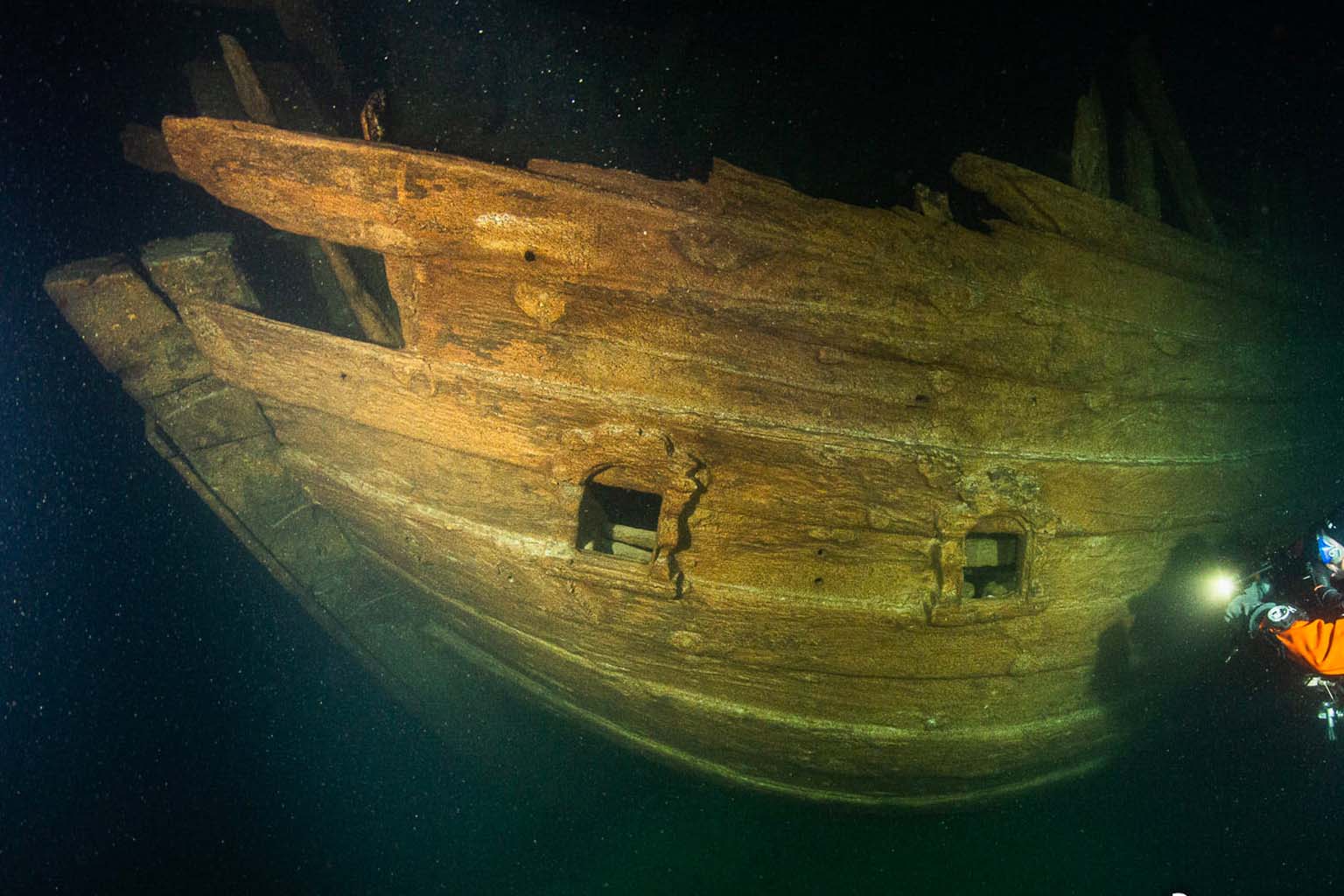
The Baltic Sea has yielded many secrets over the centuries, but few discoveries carry the weight of Wreck 5, a 500-year-old shipwreck recently uncovered in Swedish waters. Found in Landfjärden, south of Stockholm, this vessel represents far more than another archaeological find. It may fundamentally alter our understanding of when and how Scandinavian shipbuilders embraced revolutionary construction techniques that would reshape naval warfare and maritime trade.
What makes this discovery particularly compelling is its carvel construction—a building method that was still relatively new to northern Europe in the late 1400s. While most Scandinavian ships of this era relied on traditional clinker-built designs with overlapping planks, this vessel demonstrates that Swedish shipwrights were experimenting with more advanced techniques much earlier than previously believed. This find adds to the growing body of knowledge about northern European maritime heritage revealed through recent archaeological discoveries.
The implications extend beyond maritime archaeology. This ship offers a window into a pivotal moment when medieval Europe was transitioning toward the age of exploration and cannon-armed warfare, fundamentally changing how nations projected power across the seas.
The Revolutionary Design That Changed Everything
Measuring an estimated 35 meters long and 10 meters wide, Wreck 5 represents a dramatic departure from typical Scandinavian vessels of its time. The carvel construction method, which places planks edge-to-edge rather than overlapping them, created a smooth, rigid hull capable of withstanding the stress of heavy cargo and artillery.
This wasn’t simply an aesthetic choice. The structural advantages of carvel construction were revolutionary for naval capabilities. Ships built using this method could carry cannons without compromising hull integrity, while the smooth exterior reduced drag and improved speed. For a nation like Sweden, positioned at the crossroads of Baltic trade routes, such technological advancement represented a significant strategic advantage.
Dendrochronological analysis reveals that the timber was felled in either Möre or eastern Blekinge, confirming this was a Swedish-built vessel rather than a foreign import. This detail suggests that Swedish shipwrights weren’t merely copying foreign designs but were actively developing their own interpretations of carvel construction techniques.
Preservation in the Baltic’s Embrace
The ship’s remarkable state of preservation offers researchers an unprecedented opportunity to study medieval construction techniques. The sternpost and rudder remain upright, while the ship’s frame still rises prominently above the seabed after more than five centuries underwater.
This exceptional preservation is largely thanks to the Baltic Sea’s unique conditions. According to research published in Scientific Reports, the cold, low-salinity water and limited oxygen create an environment hostile to the wood-boring organisms that typically destroy shipwrecks in other marine environments. These conditions have turned the Baltic into what maritime archaeologists often describe as a time capsule, preserving organic materials that would have long since disappeared elsewhere.
“The Baltic Sea’s unique environmental conditions create exceptional preservation for wooden archaeological materials, allowing detailed analysis of construction techniques centuries after submersion” – Scientific Reports research
The quality of preservation means researchers can examine construction details that are rarely available in other medieval wrecks. Joint techniques, tool marks, and even the sequence of construction may still be discernible, providing invaluable insights into 15th-century shipbuilding practices. Similar preservation conditions have allowed detailed study of other medieval vessels across Europe.
A Fleet in Transition
The Landfjärden site has revealed five shipwrecks spanning several centuries, initially thought to be Viking vessels but now understood to represent different periods of maritime development. Three of the other large wrecks date to the 1600s and 1700s, making Wreck 5 not only the oldest but potentially the most historically significant.
This discovery raises intriguing questions about Sweden’s naval development strategy. The timing of this vessel, dating to the 1460s or 1480s, coincides with a period of intense political and military evolution in northern Europe. Sweden was emerging as a regional power, and naval technology was becoming increasingly important for both defense and trade.
Research indicates that carvel construction spread northward from Mediterranean shipyards, but the process wasn’t uniform. Some regions adopted the technique gradually, while others, apparently including Sweden, made more decisive transitions. The existence of Wreck 5 suggests Swedish maritime authorities recognized the strategic importance of advanced hull construction earlier than many neighboring regions. This pattern of technological adoption mirrors discoveries of ancient shipwrecks that reveal how maritime trade influenced technological development across different civilizations.
The technological leap rarely discussed by historians
Most accounts of medieval naval development focus on famous battles or prominent vessels, but they often overlook the profound psychological and economic shifts that accompanied new shipbuilding technologies. The transition from clinker to carvel construction represented more than a technical upgrade—it fundamentally altered how maritime communities understood their relationship with the sea.
Clinker-built ships, with their flexible, overlapping planks, were designed to work with ocean forces, bending and adapting to waves. Carvel construction, by contrast, created vessels that could resist these forces through rigid strength. This philosophical shift from accommodation to dominance over natural elements paralleled broader changes in European thinking about technology and nature.
The economic implications were equally profound but rarely examined in detail. Carvel construction required different skills, tools, and materials than traditional methods. Shipyards had to retrain workers, invest in new equipment, and establish supply chains for different types of timber and hardware. The decision to build vessels like Wreck 5 represented significant financial and social commitments that extended far beyond the shipyard itself. Such technological transitions required the same kind of systematic adaptation seen in other archaeological discoveries that reveal how ancient communities embraced new technologies.
As researchers continue studying Wreck 5, they’re not just uncovering details about medieval shipbuilding—they’re revealing how entire societies adapted to technological change. The ship resting in Landfjärden represents a moment when Sweden chose to embrace an uncertain future rather than maintain comfortable traditions, a decision whose consequences would ripple through centuries of maritime history.