


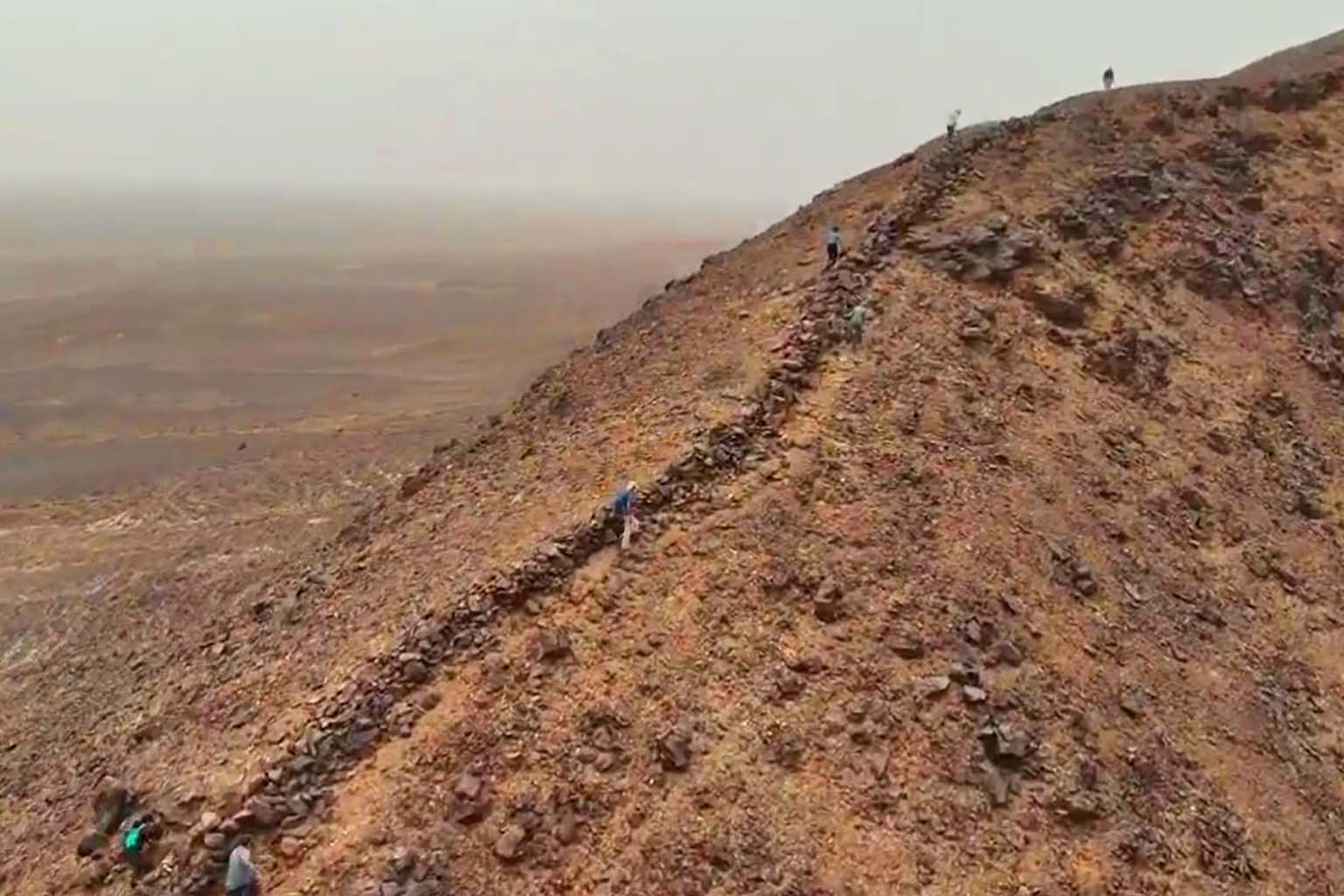
A colossal wall stretching 200 miles across the remote Gobi Desert has emerged from the sands, turning centuries-old ideas about medieval empires upside down. This astounding discovery sheds new light on the complex strategies of empire builders who crafted vast frontier systems, blending defense, governance, and resource management.
Archaeologists led by Professor Gideon Shelach-Lavi from Hebrew University have unveiled this striking 321-kilometer (200-mile) segment of the so-called Gobi Wall, a largely unknown but critical piece of a sprawling ancient border network. Their groundbreaking research, recently published in the journal Land, provides compelling evidence that this Medieval wall was far more than a simple barrier—it was a sophisticated administrative mechanism shaping trade, movement, and territorial control across East Asia’s inhospitable highlands.
The Vast Medieval Wall System of East Asia
Spanning roughly 2,500 miles across northern China, Mongolia, and into Siberia, the Medieval Wall System represents one of the grandest and most enigmatic construction projects in human history. Built primarily between the 10th and 13th centuries CE under various imperial dynasties, this wall network was a dynamic frontier infrastructure rather than a mere military defense.
Professor Shelach-Lavi comments, “The Medieval Wall System is one of East Asia’s most extensive yet understudied architectural feats, showcasing the complex geopolitical climate of the Xi Xia Dynasty and others.” By studying multiple sections of this wall, researchers have detected varying construction techniques reflecting diverse local environments and functions, from rugged mountains to desert plains.
Despite decades of research, the segment in Mongolia’s Ömnögovi province—now named the Gobi Wall—remained shrouded in mystery until this study. Its remote location and lack of extensive archaeological investigation left a significant gap in understanding how empires managed their desert frontiers.
Rediscovering the Gobi Wall: Architecture Meets Desert Survival
The Gobi Wall’s construction is a marvel of adaptive engineering. Made of rammed earth and reinforced with stone and wood, it exploited local materials to withstand the extremes of the Gobi Desert climate. Its layout hugs natural landforms like mountain passes and sand dunes, enhancing both its defensive and administrative functionality.
Forts and garrison complexes are strategically placed at critical points along this 200-mile-long fortification, revealing a complex military and bureaucratic presence. Archaeological evidence dates the primary phase of construction to the Xi Xia Dynasty (1038–1227 CE), a time of intense political maneuvering and expansion in Inner Asia.
Yet the Gobi Wall’s historical footprint extends well beyond this era. Artifact layers suggest intermittent occupation and use from as early as 200 BCE through the 1800s CE. This timeline underscores the region’s longstanding importance as a strategic node controlling movement and resources across a challenging landscape.
Beyond Defense: The Wall as a Dynamic Frontier Mechanism
Perhaps the most striking revelation from this study challenges the conventional view of medieval walls as purely military barricades. The Gobi Wall appears to have operated as a multifunctional border system managing not only defense but also trade, resource distribution, and population movement.
The research team explains, “Our findings show the Gobi Wall served as a complex bureaucratic instrument, integrating defensive needs with environmental management.” The wall’s precise positioning allowed imperial authorities to regulate access to scarce resources like water and timber while controlling vital caravan routes crossing the desert.
This approach aligns with recent academic perspectives that reimagine frontier walls as living infrastructures balancing multiple socio-political roles. This synthesis of ecological, administrative, and military functions enabled the Xi Xia state to sustain its territorial ambitions in a volatile region.
Expert Insights and Historical Significance
Experts in Mongolian and Chinese medieval history have hailed the discovery as a game-changer. Dr. Emma Hughes, a historian specializing in Inner Asian empires, explains, “This study compels us to rethink medieval imperial borders as integrated systems of power and survival, not just walls built to keep enemies out.”
Furthermore, a 2023 report from the Institute for East Asian Archaeology highlights how frontier fortifications like the Gobi Wall contributed to state resilience by promoting economic stability and regional governance (IEAA Report).
To further illustrate the scale and importance of the Gobi Wall, here is a detailed video that explores this remarkable structure and the wider Medieval Wall System.
This research, led by specialists in landscape archaeology and frontier history, adds rich context to how ancient empires engineered their environments and controlled vast territories. Their findings bolster the growing consensus that medieval fortifications were multifaceted instruments blending military, economic, and ecological strategies.
If this deep dive into the Gobi Wall’s mysteries inspires you, share your thoughts or questions below. How do you think this discovery changes our understanding of medieval history? Your comments help us uncover more layers of the past!