


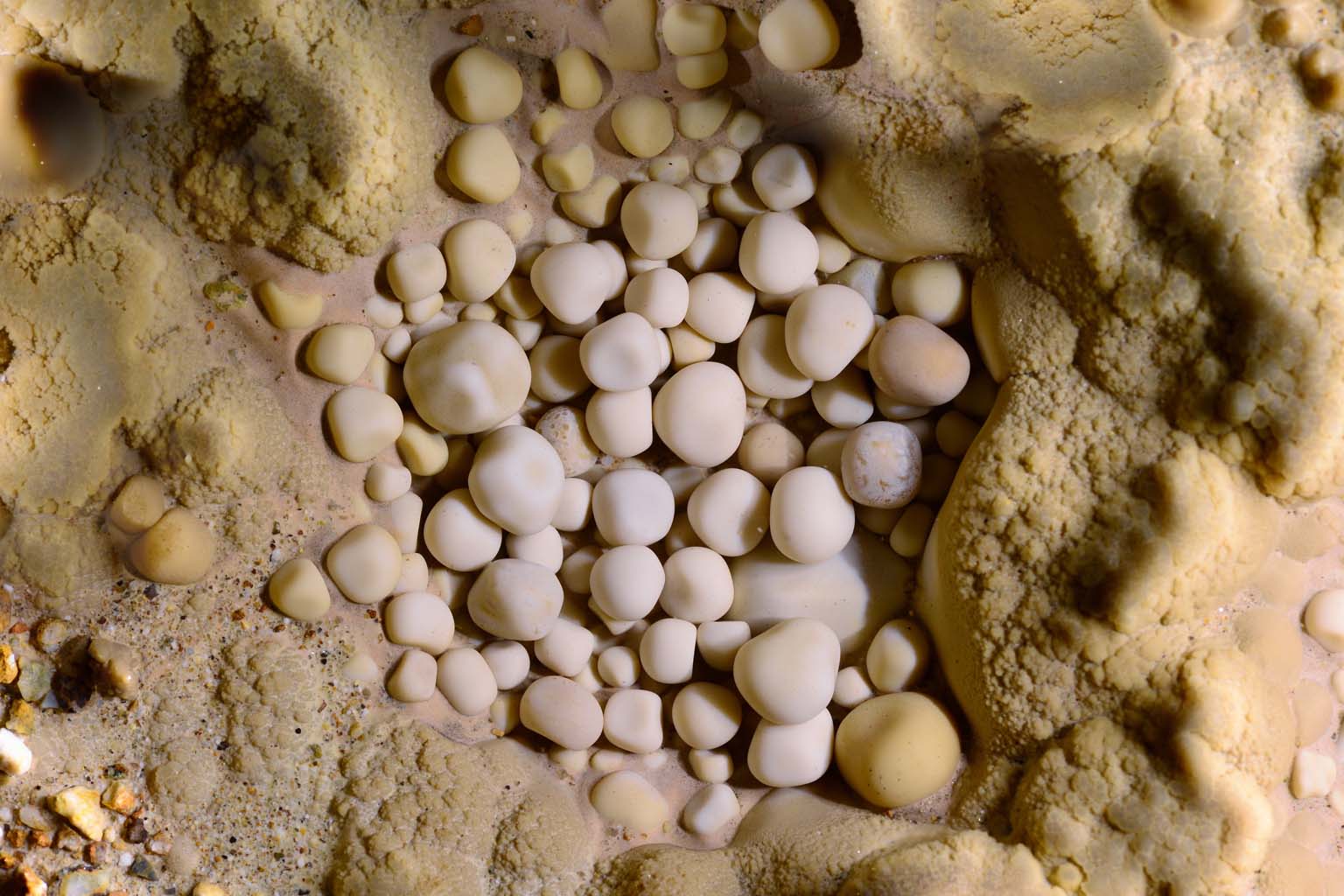
Beneath Jerusalem’s ancient streets, archaeologists have stumbled upon what might be one of the most unusual preservation methods in archaeological history. Deep within the Joweizeh spring tunnel, a 232-meter underground passage dating back over two millennia, researchers discovered something that challenges our understanding of both natural cave formations and artifact preservation.
The find centers on cave pearls—rare mineral formations that typically develop when water droplets accumulate minerals around a small nucleus over time. What makes this discovery extraordinary is that these cave pearls formed around human-made objects, essentially creating natural time capsules that have preserved pottery fragments and plaster pieces for hundreds of years. Similar unexpected preservation of ancient artifacts has been documented in other archaeological contexts, though never through such unique geological processes.
This phenomenon represents the first documented case of cave pearls incorporating archaeological artifacts into their structure. The implications extend far beyond simple preservation, offering insights into ancient engineering practices, trade networks, and the continuous human occupation of one of history’s most contested cities.
A Natural Archive Hidden in Stone
Dr. Azriel Yechezkel’s team from Hebrew University initially entered the tunnel system expecting a standard archaeological survey. Instead, they encountered 50 cave pearls, with 16 containing tangible remnants of ancient civilizations. According to research on cave formation mechanisms, unlike the millennia required for stalactite formation, cave pearls can develop within centuries under specific hydrological conditions—making them remarkably efficient natural preservers.
“Cave pearls form through rapid mineral precipitation around nuclei under specific hydrological conditions, creating unique preservation environments” – Cave formation research
The embedded pottery fragments span an impressive temporal range, from potentially the Middle Bronze Age II (17th century BCE) through the Byzantine period (330-636 CE). This chronological breadth suggests the tunnel maintained active use across multiple civilizations, each leaving traces that became incorporated into the cave’s natural processes.
Among the most intriguing discoveries were pottery fragments coated with cobalt, a luxury material typically associated with imported ceramics from Cyprus and Ephesus. The presence of such expensive items in what was essentially a utilitarian water extraction system raises questions about the social dynamics of ancient infrastructure projects.
Engineering Hierarchies in Ancient Jerusalem
The cobalt-coated pottery fragments provide unexpected insight into the organization of ancient construction projects. These luxury items, likely parts of imported oil lamps, suggest that skilled engineers oversaw the tunnel’s construction and maintenance, while manual laborers performed the excavation work. This sophisticated approach to ancient engineering mirrors techniques used in other monumental construction projects of the period.
This hierarchical structure mirrors patterns found in other ancient tunnel systems across the Levant, where evidence points to sophisticated project management involving both local workers and specialized technical expertise. The presence of expensive imported goods in a working environment indicates that these projects attracted professionals of considerable status and resources.
The tunnel’s continuous use from the Iron Age II through the Byzantine period demonstrates remarkable engineering longevity. Each period of renovation and maintenance contributed new artifacts to the cave environment, creating an inadvertent archaeological record preserved within the cave pearls’ mineral layers. This discovery adds to our understanding of Jerusalem’s underground infrastructure, complementing recent finds like the 3,000-year-old fortress that reveal the city’s complex defensive and utility systems.
A Window Into Ancient Urban Water Management
The Joweizeh spring tunnel represents sophisticated hydrological engineering that sustained Jerusalem through various political transitions. Its construction during the 8th-7th centuries BCE coincided with a period of urban expansion and infrastructural development that would define the city’s resilience for centuries.
Evidence suggests the tunnel underwent significant renovations during the Hellenistic period, as indicated by the embedded plaster and pottery fragments. This renovation pattern reflects the practical necessity of maintaining water access regardless of changing political control—a priority that transcended individual civilizations.
The tunnel’s abandonment after the Byzantine period marks the end of nearly 1,400 years of continuous operation. This longevity speaks to both the quality of initial construction and the consistent value placed on maintaining urban water infrastructure across dramatically different political and cultural contexts.
The Preservation Paradox Nobody Expected
Cave pearl formation around archaeological artifacts presents a preservation mechanism that operates on entirely different principles than traditional archaeological contexts. Unlike typical stratigraphic layers that preserve objects through burial, these formations actively incorporated artifacts into their mineral structure during the formation process. Studies on cave calcite formation have shown that specific environmental conditions can create unique preservation scenarios previously unknown to archaeologists.
This preservation method raises questions about how many similar formations might exist in other cave systems connected to archaeological sites. The specific hydrological conditions required for cave pearl formation are relatively rare, but their potential for artifact preservation has been completely overlooked in previous research. Such unexpected archaeological discoveries parallel findings at sites like the Tikal archaeological site, where conventional excavation methods continue to reveal surprising preservation contexts.
The discovery also highlights the unintended consequences of ancient human activity in cave environments. What began as practical engineering created conditions for a natural preservation system that operated long after the original builders had any awareness of the process. The cave pearls essentially became accidental archival systems, maintaining records of human presence through purely geological means.
This find forces us to reconsider the relationship between natural processes and archaeological preservation. While we typically think of environmental factors as threats to artifact integrity, the Jerusalem cave pearls demonstrate how specific conditions can create preservation opportunities that extend far beyond human planning or intention. The implications for understanding long-term human-environment interaction in archaeological contexts remain largely unexplored.