


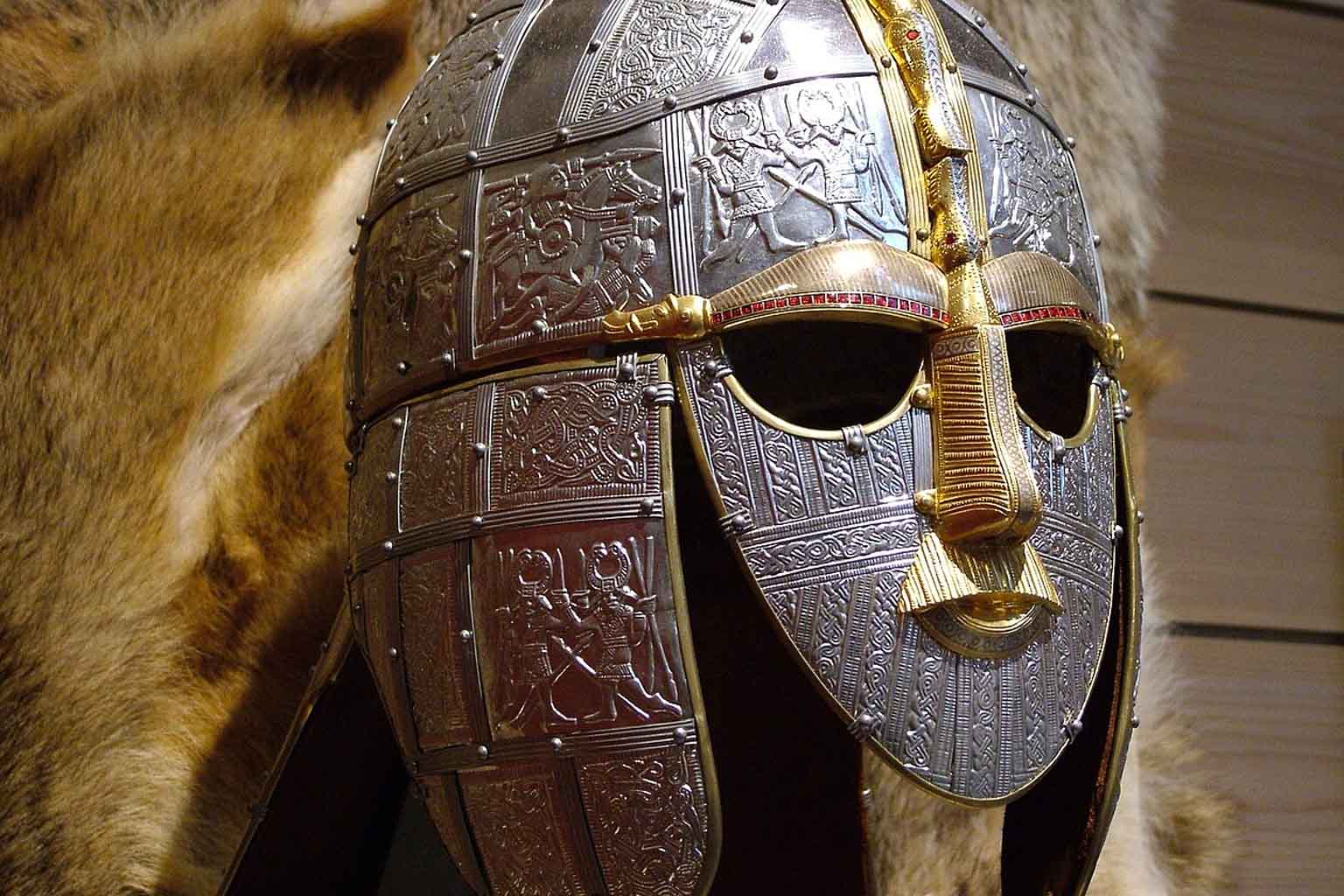
The Sutton Hoo helmet, an Anglo-Saxon masterpiece, has held art historians and archaeologists spellbound for decades. Just when we thought we knew its story, an unexpected discovery might reshape everything. Imagine that the emblem of Anglo-Saxon heritage was not crafted in England or Sweden as previously believed, but in Denmark. It’s the kind of revelation that sends ripples across the pond of history.
Caught off guard, you ask: how did this come to light? A quiet hero, Danish hobbyist Jan Hjort, armed with nothing more than a metal detector and a penchant for discovery, stumbled upon a small yet striking copper-alloy stamp—or “patrice”—on the island of Tåsinge in Denmark. Its dimensions are unassuming, just 5-by-4 centimeters, but its story is anything but ordinary.
Could the Sutton Hoo Helmet Be Danish?
The Sutton Hoo helmet, often referred to as “Britain’s Tutankhamun” because of its rich symbolism and historical importance, might now have a Danish twist to its tale. Why the sudden shift in perspective, you ask? The motifs on Hjort’s patrice bear an uncanny resemblance to those etched onto the helmet itself. According to a detailed report by Archaeology Mag, these similarities aren’t just coincidental; they suggest the Sutton Hoo helmet might have Danish, rather than Swedish, origins.
Imagine the scene — it’s a quiet day in the Southern Funen archipelago, Hjort is out on one of his routine detection walks, when the metal detector emits a curious beep. Digging down, he uncovers this small stamp, recognized as a tool for embossing metal sheets. This too could sculpt the narrative of European craftsmanship and trade routes, unraveling a tale of shared techniques and potentially centralizing Denmark in a historical context few had considered.
A Detectorist’s Lucky Find
Luck, as they say, favors the prepared. Hjort’s discovery may be one for the books. The stamp features a motif of a mounted warrior, echoing the warrior engraved on the Sutton Hoo helmet, right down to the delicate details of the horse’s harness, the warrior’s cuff, and the swaying mane.
This isn’t just artistry, it’s a signature — one that transcends borders and potentially rewrites history. To delve deeper into the implications, researchers like Peter Pentz, a curator at the National Museum of Denmark, have thrown caution to the wind, embracing this thrilling mystery. Pentz hypothesizes a shared origin, perhaps the helmet and the stamp hail from the same workshop, and just maybe… crafted by the same hands.
Denmark’s New Role in 7th-Century Geopolitics
Should authentication proceed favorably, this could flip the script on 7th-century geopolitics. Denmark, traditionally overshadowed by its Scandinavian neighbors, might emerge as a central power far earlier than suspected. By Pentz’s account, “The Sutton Hoo helmet is iconic worldwide… It would be sensational if this helmet… was made in Tåsinge.”
Suddenly, the quiet island of Tåsinge finds itself holding the shards of a narrative long believed set in stone. A knight’s helmet, buried with someone of importance — possibly a king. Could the craftsmen of Tåsinge have been creating artifacts for the mighty elite of the time?
The implications are comprehensive, nudging us to reconsider the alliances, conflicts, and migratory habits of Northern Europe’s past at large. It’s a puzzle with many missing pieces, but each discovery urges us closer to a clearer picture.
Challenging Historical Narratives
Peter Pentz goes further, teasing the potential for a much earlier political unity within Denmark than recorded history suggests. Traditionally attributed to Harald Bluetooth in the 10th century, this on-site find could mean Denmark wielded influence as early as 600 CE. It’s a leap, sure, but one that stirs a pot long since simmering over.
The National Museum of Denmark, along with its intricate network of experts, is tuning in closely. The artifacts found in such locations hold secrets—often whispered through the ages—to decode and redefine what we believe we know about cultural exchanges and ancient diplomacy.
It’s a process unfolding, and though conclusions are tentative, the evidence builds excitement nonetheless. Who would have thought that a small island in the Baltic Sea might tell such grand tales? The discovery challenges previous theories, sparking debates and inviting curiosity in the heart of archaeologists and history aficionados alike.
For those eager to dive deeper into this unfolding mystery, a recent YouTube video captures further insights into the helmet’s story and its implications for our understanding of Northern European history.
So here we are, standing on the precipice of a historical rewrite. What remains uncertain today might tomorrow become a new chapter in our tapestry of the past. Curiosity never stops, and the trails of discovery often lead to places few expected. As we wait for more revelations, why not explore this story further and connect the dots yourself? After all, history isn’t just carved in stone; it’s etched in the whispers of chance discoveries, like Hjort’s little copper stamp. Do you feel the pull of history yet?