


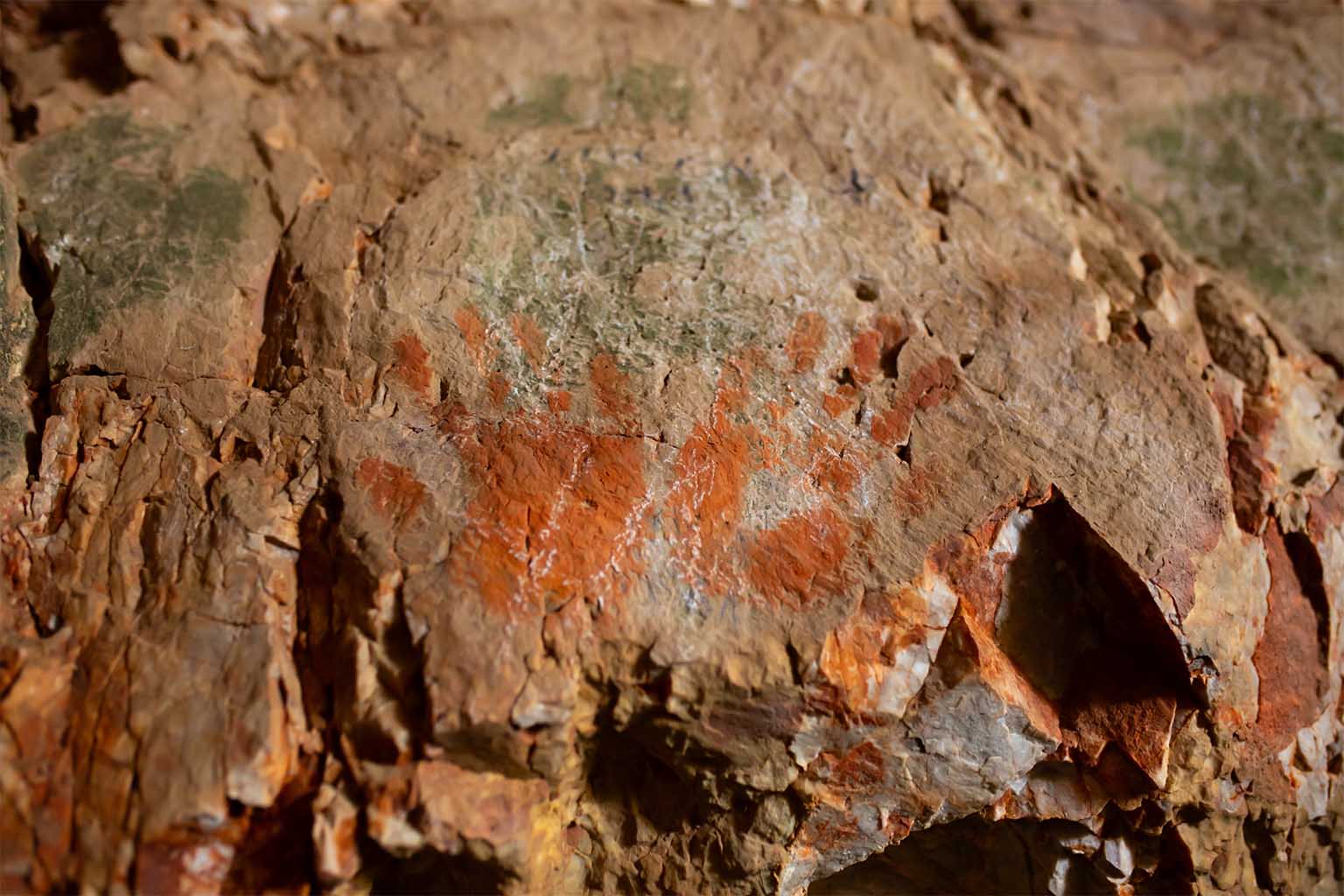
Archaeologists have stumbled upon a discovery that’s shaking the foundations of human history—a tiny granite pebble with a mysterious red dot that could be the world’s oldest fingerprint. This artifact isn’t just a curious fossil; it could rewrite what we know about the origins of art and the creative minds behind it.
A Pebble That Speaks Volumes About Our Past
In the summer of 2022, a team of Spanish archaeologists led by David Álvarez Alonso from Complutense University in Madrid uncovered an unusual 20-centimeter granite pebble inside the San Lázaro rock shelter near Segovia. What caught their attention was an oddly shaped, face-like formation on the stone, marked deliberately with a bright red ochre dot where the nose would be. This wasn’t just a random stain—it was placed with intention.
The red mark has been dated to roughly 43,000 years ago, making it potentially the earliest example of portable art ever documented. The artifact likely predates even the oldest known Homo sapiens art pieces, suggesting that Neanderthals, our close evolutionary cousins, might have been the first artists.
Science Unveils a Human Fingerprint in Ochre
Skeptical about the red dot’s origin, the archaeologists collaborated with forensic experts from the Spanish Scientific Police to analyze whether it was indeed a human fingerprint. The forensic analysis confirmed that the delicate ochre mark was made by a human fingertip, most likely belonging to an adult male.
“This was not a careless smear,” said Álvarez Alonso. “It was a deliberate act, an imprint placed on a stone carefully selected for its face-like shape.” This print is arguably the oldest full fingerprint ever found, making it a groundbreaking forensic and archaeological find.
This discovery suggests a moment of symbolic thinking—what scientists call pareidolia, the innate human tendency to recognize faces in random objects. This indicates cognitive complexity in Neanderthals that was once thought exclusive to modern humans.
Neanderthal Cognition Under the Microscope
Why bring a pebble from a riverbed into a cave? Why mark it with pigment sourced from miles away? These questions hint at profound mental capabilities. The ochre pigment itself, composed of iron oxides and clay minerals, was absent from the immediate cave environment, indicating that Neanderthals sourced it deliberately and carried it to the site.
This suggests forward planning and an ability to abstract meaning—traits that scientists typically associate with Homo sapiens. “This artifact shows intentional communication, symbolic thought, and the capacity to attribute meaning to objects,” explains Álvarez Alonso.
According to a 2024 report from the Max Planck Institute for Evolutionary Anthropology, recent discoveries increasingly support the notion that Neanderthals had cognitive abilities once thought unique to modern humans, including symbolic behavior and tool use. This find adds a valuable piece to that growing body of evidence.
Rethinking the First Artists and Human Symbolism
If the San Lázaro pebble’s significance holds, it challenges the long-held stereotype of Neanderthals as primitive, uncreative beings. The stone’s carefully applied red dot and its face-like shape embody the three pillars necessary for artistic creation: image conception, deliberate communication, and meaning attribution.
Dr. Pascal Picq, a renowned paleoanthropologist, has stated that such artifacts force us to reconsider the cognitive evolution timeline. “Artistic expression is the visible sign of symbolic thinking, which fundamentally shapes what it means to be human,” he said in a 2023 interview.
This pebble could be one of the earliest known abstractions of the human face, making Neanderthals pioneers of artistic expression. It offers a glimpse into how they may have seen the world—full of meaning, symbolism, and creativity, much like we do today.
Implications for Our Understanding of Humanity
The San Lázaro find is more than an archaeological curiosity; it’s a cultural revelation. It forces scientists and the public alike to reconsider what it means to be truly “human.” Neanderthals made art, expressed abstract ideas, and engaged in symbolic thought tens of thousands of years ago.
As Álvarez Alonso reflected, “Why would a Neanderthal have looked at this stone any differently than we do? They were human, too.” This discovery echoes a paradigm shift in paleoanthropology, urging us to expand our definitions of creativity and symbolic behavior beyond modern humans.
For those fascinated by the dawn of artistic expression and human cognition, this pebble offers an unprecedented window into a past where the lines between species blur, and creativity transcends time.
What do you think about Neanderthal creativity? Share your thoughts or questions below, and let’s explore together how these ancient fingerprints continue to shape our understanding of human history.