


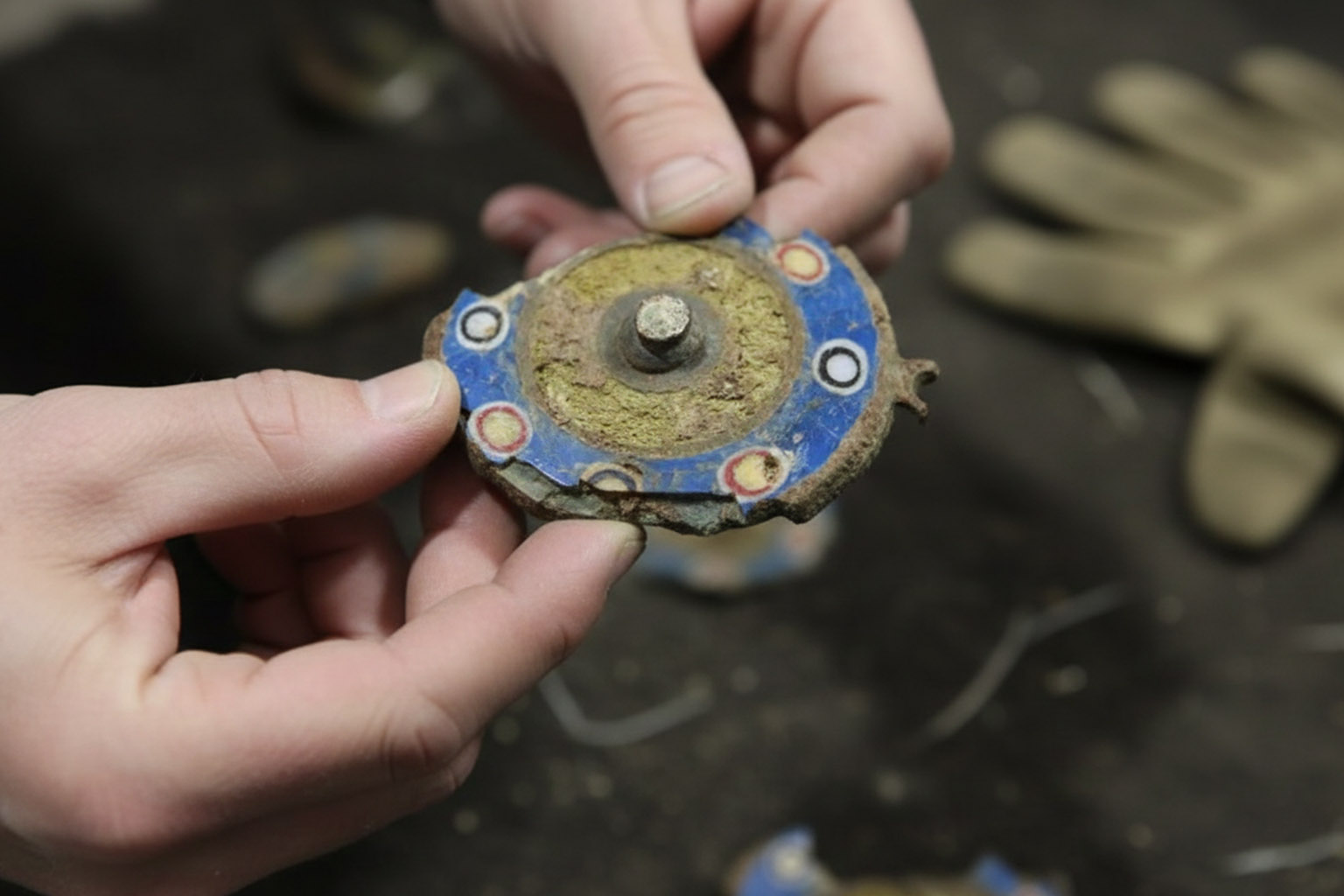
A single bronze brooch, barely larger than a modern-day clasp, has opened a window into one of history’s most complex frontiers. Discovered in 2020 beneath a Scottish distillery, this 2,000-year-old Roman artifact tells a story that archaeologists are still trying to piece together. Found buried in the foundations of an Iron Age roundhouse in Ayrshire, the enamelled bronze brooch raises uncomfortable questions about how Roman influence penetrated far beyond the empire’s established borders. Like other remarkable discoveries such as the 20,000-year-old cave etchings that reveal ancient cultural narratives, this brooch provides insights into complex prehistoric relationships.
The mystery deepens when we consider the context. This wasn’t a Roman settlement or trading post. The brooch emerged from a fortified Iron Age dwelling built by local Britons who had every reason to view Roman soldiers as enemies. Yet here it was, carefully placed in the foundation trench of their home, suggesting a significance that went far beyond mere possession of foreign goods.
A Fortress Built for Defense Against Rome
The site at Curragh reveals the defensive mindset of its inhabitants. Perched on a rocky plateau with steep northern slopes and surrounded by a wooden palisade, this roundhouse was built for protection. Archaeological evidence suggests the dwelling was constructed during the second century AD, precisely when Roman military pressure in southern Scotland was intensifying.
What makes the brooch discovery particularly striking is its isolation. Jordan Barbour from Guard Archaeology notes that if regular trade relationships existed between these inhabitants and Roman Britain, we would expect to find multiple Roman artifacts scattered throughout the site. Instead, this single brooch stands alone among otherwise typical Iron Age materials, suggesting its acquisition was anything but routine.
The brooch design itself was common among Roman military personnel, particularly those stationed in frontier regions. Similar examples have been found throughout Central Europe, the Rhineland, and Switzerland, marking it as standard military equipment rather than a luxury trade item.
The Trophy Theory
The most compelling explanation for the brooch’s presence involves conflict rather than commerce. During the second century, Roman forces regularly operated north of Hadrian’s Wall, conducting raids and establishing temporary camps. Archaeological evidence confirms a Roman marching camp existed near the Curragh site, indicating direct military contact between the occupying forces and local populations.
If the brooch was indeed taken from a Roman soldier during battle, it would represent more than simple looting. For Iron Age Britons, possessing an enemy’s personal effects carried deep symbolic meaning. The act of stripping gear from defeated opponents served as both practical gain and spiritual victory, transferring the perceived power of the conquered to the victor. Similar to discoveries like the Roman war horses burial site in Germany, these artifacts reveal the profound significance of military possessions in ancient cultures.
This interpretation gains weight when considering the broader military context. According to research on Roman frontiers, the Antonine Wall, Rome’s northernmost frontier, had been abandoned by this period, but Roman military activity continued through patrol operations and punitive expeditions. Local Britons would have had multiple opportunities to encounter Roman soldiers in hostile circumstances.
“Roman frontiers represented complex zones of interaction where indigenous populations developed sophisticated strategies for dealing with imperial military presence” – Theoretical Roman Archaeology Journal
Ritual Burial and Sacred Protection
The brooch’s placement within the foundation trench suggests deliberate ritual purpose rather than casual discard. Foundation sacrifices were common across ancient cultures, with objects buried during construction to invoke divine protection for the dwelling and its inhabitants. The careful positioning of this Roman artifact indicates the Iron Age builders attributed special significance to it.
Research into Celtic religious practices shows that captured enemy objects were often repurposed for spiritual protection. By burying a Roman military brooch in their home’s foundation, the inhabitants may have been symbolically capturing and containing Roman power, turning it to their own defensive advantage. This practice would have been particularly meaningful for a people living under constant threat of Roman raids.
The timing of the burial also supports this interpretation. As Roman forces consolidated south of Hadrian’s Wall during the mid-second century, frontier communities faced increased uncertainty about future raids and territorial expansion. A ritual offering for household protection would have provided psychological comfort during these turbulent times.
The Overlooked Economic Implications
While debates focus on warfare and ritual, the brooch also reveals sophisticated economic networks that historians often underestimate. Even if obtained through conflict, the decision to preserve rather than destroy this Roman artifact suggests these Iron Age communities understood its broader value. Bronze was a precious material, and the brooch’s enamelled decoration demonstrated advanced metalworking techniques that local craftsmen could study and potentially replicate.
The artifact’s preservation also indicates these communities maintained complex relationships with Roman material culture despite political hostilities. Rather than simply rejecting all Roman influence, they selectively incorporated foreign objects that served their practical or spiritual needs. This nuanced approach challenges simplistic narratives about Roman-British relations that emphasize only conflict or submission.
Economic evidence from other Scottish sites shows that Roman goods continued circulating through informal networks long after official trade relationships ended. Coins, pottery fragments, and metalwork appear regularly in Iron Age contexts, suggesting persistent economic connections that operated independently of political control. Much like the ancient artifacts discovered at Somló Hill in Hungary, these finds demonstrate the complex trade networks that existed across prehistoric Europe.
The discovery of individual artifacts continues to reshape our understanding of ancient economies. Just as the rare Roman coin found after years of searching revealed unexpected circulation patterns, the Curragh brooch ultimately represents something more complex than a simple archaeological find. Whether trophy, trade good, or sacred offering, it embodies the messy reality of cultural contact along Rome’s northern frontier, where military conflict, economic opportunity, and spiritual belief intersected in ways that continue to challenge our understanding of ancient Scotland’s relationship with the expanding empire.