


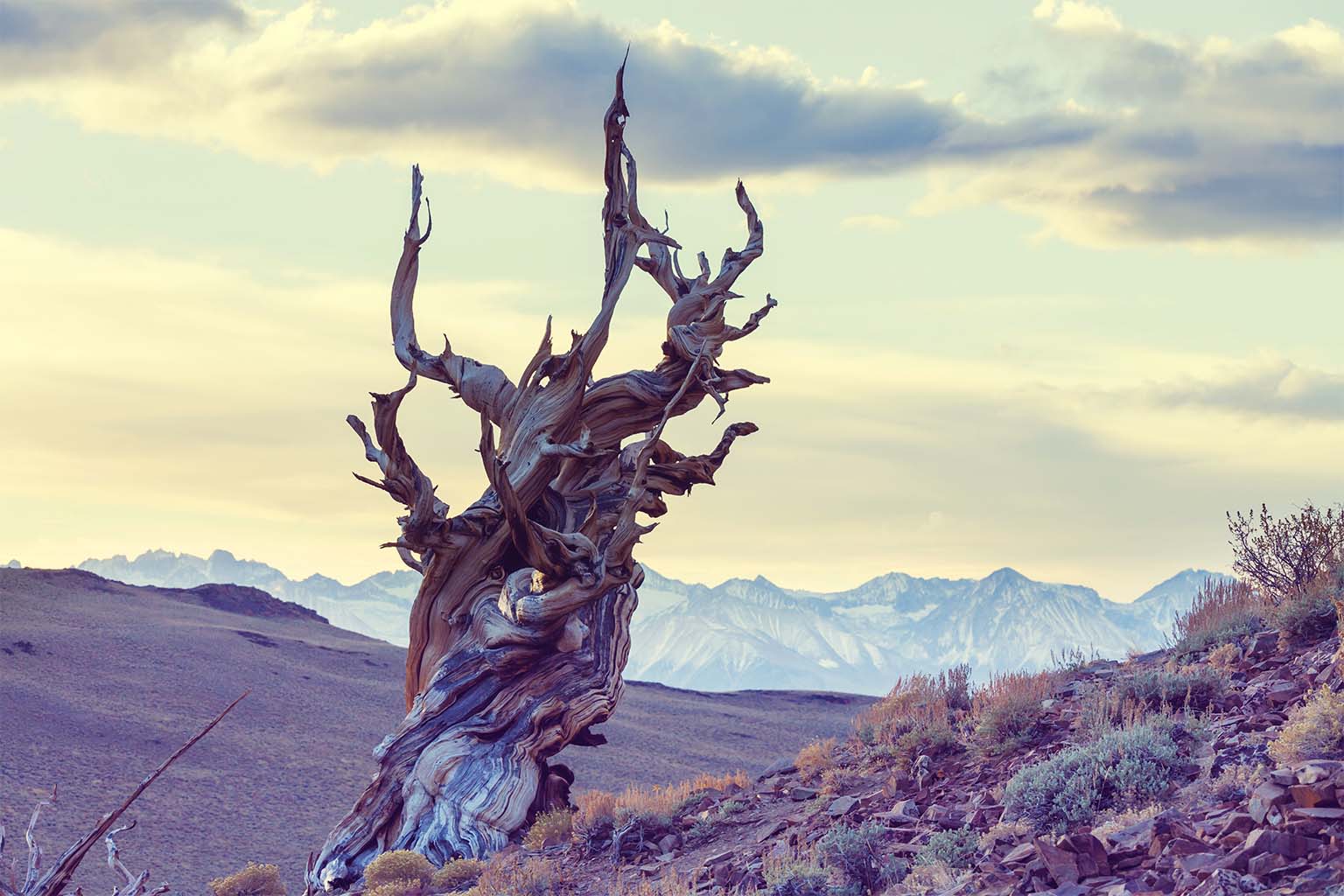
In a quiet corner of California’s White Mountains, a tree stands as a living testament to the passage of time. This isn’t just any tree—it’s Methuselah, an ancient bristlecone pine that has thrived for nearly 4,800 years, long before the Egyptian pyramids rose from the sands. Its story beckons us to explore the mysteries of longevity, resilience, and nature’s quiet endurance.
The astonishing discovery of Methuselah
Back in 1953, Edmund Schulman, a dedicated dendrochronologist, set out on a mission to find the oldest living trees. Armed with an increment borer, Schulman and his team ventured into an isolated grove in the White Mountains, a harsh, arid environment where few trees survive. When Schulman extracted a core sample from a lone bristlecone pine, the tightly packed growth rings told a story that stunned the scientific community—the tree was more than 4,800 years old.
This revelation was nothing short of breathtaking. According to the U.S. Forest Service, Methuselah holds the title of the oldest known non-clonal tree on Earth, a single living organism whose roots reach back millennia without cloning itself. The forest service wisely chose to keep the tree’s exact location secret, protecting it from vandalism and the curious hikers who might harm this ancient natural wonder.
The delicate balance of secrecy and public fascination
For decades, Methuselah’s precise whereabouts remained a secret, wrapped in an aura of mystery. Hikers could wander the Methuselah Trail, named in its honor, but no one could pinpoint the exact tree. This secrecy contributed to a mythic status, adding to the tree’s legend without exposing it to immediate harm.
The veil was partially lifted in 2021 when photos leaked online, showing the tree’s unmistakable twisted and weather-beaten form. This triggered renewed public interest and admiration for one of the planet’s oldest living organisms. Still, experts emphasize the importance of respecting the tree’s environment and avoiding interference with its fragile habitat.
Other contenders for the title of oldest tree
While Methuselah currently holds the backed-by-science crown, it does have challengers. In Chile, a Fitzroya cupressoides named Gran Abuelo (“Great-Grandfather”) captures attention for its potential to be even older. Climate scientist Jonathan Barichivich estimates, based on partial core sampling and modeling, that Gran Abuelo could be more than 5,400 years old. However, the inability to take a full core sample due to the tree’s decaying heart means this age can’t be *officially* verified through dendrochronology yet.
Another poignant story comes from 1964, when a tree called Prometheus—an ancient bristlecone pine in Nevada—was cut down for research purposes. Scientists later discovered it had lived at least 4,862 years, potentially outliving Methuselah. This accidental loss shocked the scientific community and became a pivotal moment for the protection of ancient trees, highlighting the need to balance research with conservation.
Lessons from ancient trees: science meets preservation
Studying such ancient organisms is a tricky business. While the desire to understand these trees—and by extension, centuries of ecological history—is strong, researchers must proceed cautiously. Modern approaches now favor non-invasive methods, like advanced ring modeling or satellite ecological monitoring, to avoid damaging these precious living artifacts.
This video captures not just the tree’s majesty but also the delicate ecosystem it supports. It’s a reminder that these ancient sentinels are part of a complex environmental web that deserves our respect.
Trees like Methuselah invite us to pause and marvel—not just at their age, but at their resilience in the harshest conditions. Their stories underscore the importance of stewardship over our natural world, preserving these living legacies for generations to come.
If you’ve been moved by Methuselah’s incredible lifespan or have your own thoughts on ancient trees and conservation, share your reflections below. How do we, as a society, balance scientific curiosity with protecting timeless natural wonders? Your voice matters.