


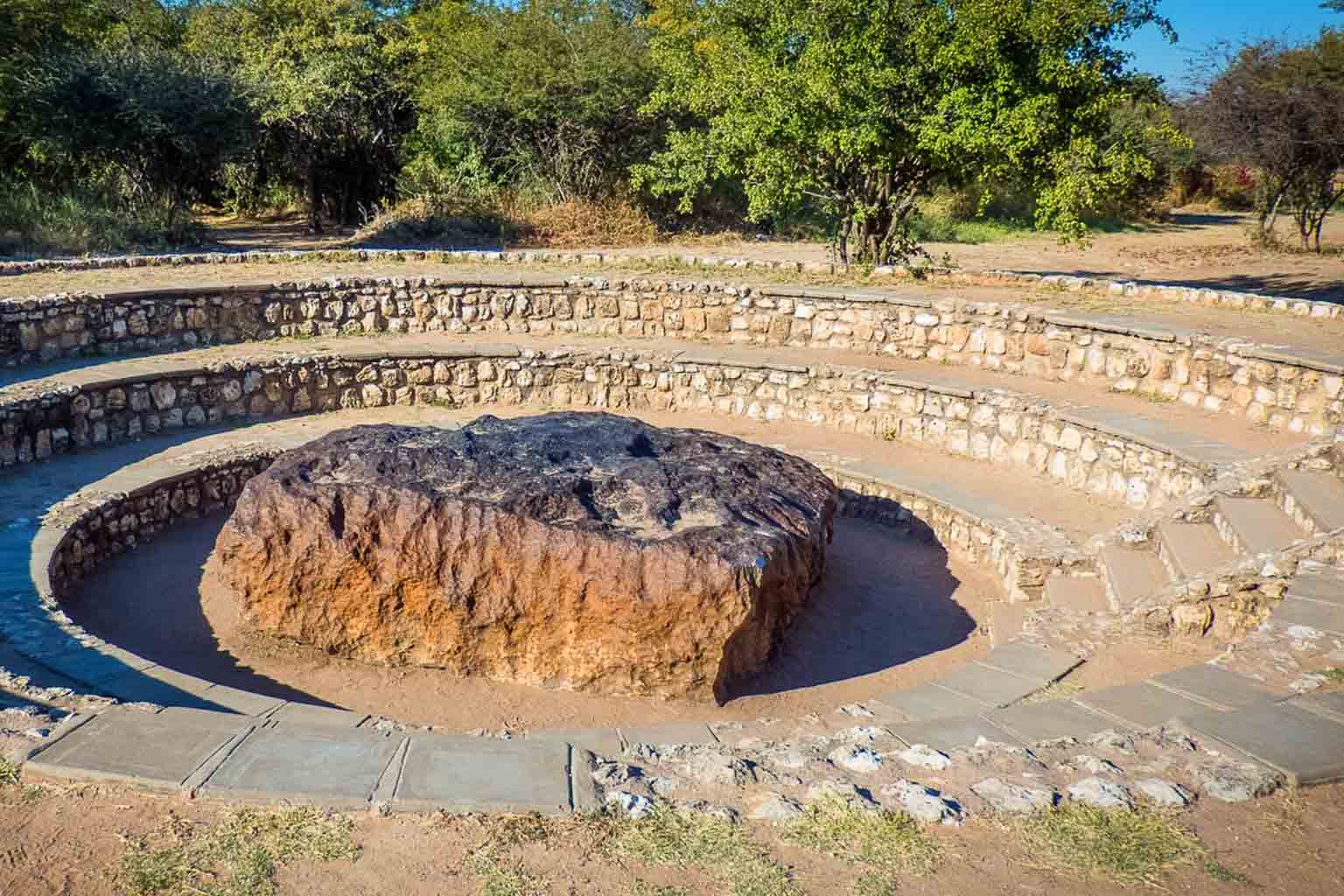
In the remote Grootfontein region of Namibia lies one of space science’s most perplexing riddles. The Hoba meteorite, discovered in 1920, weighs an astounding 60 tons and holds the distinction of being Earth’s largest known meteorite. Yet this cosmic giant defies every expectation we have about how celestial objects should behave when they crash into our planet.
What makes Hoba truly extraordinary isn’t just its massive size—it’s what didn’t happen when it arrived. No crater marks the spot where this enormous iron mass came to rest. No historical records document its fiery descent through our atmosphere. The meteorite simply exists, as if it had always been there, challenging our understanding of cosmic impacts and leaving researchers with more questions than answers about its gentle arrival on Earth. Like other remarkable archaeological discoveries that challenge our understanding of the past, such as the 3,000-year-old village unearthed beneath France, Hoba forces us to reconsider what we think we know about historical events and their physical evidence.
The Physics of an Impossible Landing
Most meteorites, regardless of size, leave unmistakable calling cards when they strike Earth. Craters, scorched earth, displaced soil—these are the typical signatures of objects traveling at cosmic velocities through space before slamming into our planet’s surface. The Hoba meteorite, however, appears to have landed with all the violence of a feather touching down.
Research published in Meteoritics and Planetary Science confirms that the meteorite likely entered Earth’s atmosphere at an unusually shallow angle, dramatically altering the physics of its descent. This trajectory would have allowed atmospheric friction to gradually reduce its velocity over a much longer path than typical meteorite falls. By the time Hoba reached the ground, much of its forward momentum had dissipated, causing it to impact vertically with significantly reduced force.
“At 60 tons, the IVB Hoba represents the largest individual meteorite specimen ever recovered, demonstrating unique preservation characteristics that distinguish it from typical impact events” – Meteoritics and Planetary Science research
The meteorite’s remarkably intact structure supports this theory. Unlike meteorites that show extensive fracturing and fragmentation from violent impacts, Hoba displays minimal signs of structural damage. This preservation suggests it experienced a far gentler landing than its massive size would typically produce.
A Weathered Giant’s Silent History
Scientific analysis reveals that Hoba has been resting in its current location for less than 80,000 years—a relatively recent arrival in geological terms, yet ancient enough to erase any human memory of its fall. This timeframe ensures that no written records or oral traditions will ever emerge to document the meteorite’s dramatic journey from space to Earth. The absence of historical documentation parallels other archaeological mysteries, such as the 3,000-year-old fortress discovered beneath Jerusalem’s streets, where physical evidence exists without contemporary written accounts.
Over these millennia, the meteorite has undergone significant surface alterations. Contact with the underlying Kalahari limestone has created a thick iron-shale base extending 20 to 30 centimeters into the rock. This chemical weathering process has gradually transformed the meteorite’s lower surface, creating a natural cement that anchors it firmly in place.
The extensive weathering raises intriguing possibilities about the meteorite’s impact history. Natural erosion processes—wind, water, and chemical reactions—may have gradually obscured or eliminated whatever crater initially marked Hoba’s arrival. Decades of exposure to Namibian weather patterns could have slowly filled in and smoothed over the impact site, leaving behind only the meteorite itself as evidence of its cosmic origins.
Fragment or Whole: Unraveling Hoba’s True Nature
One of the most compelling theories suggests that Hoba may not represent a complete meteorite at all, but rather the largest surviving fragment of a much larger parent body that broke apart during atmospheric entry. If true, this would mean additional fragments could be scattered across a wide area, potentially buried or weathered beyond recognition. This fragmentation pattern mirrors discoveries in ancient civilizations, where researchers studying sites like the 1,700-year-old altar at Tikal must piece together scattered evidence to understand larger cultural narratives.
Studies of Hoba’s composition and structure indicate it could be part of a broader strewn field—a pattern of debris created when large meteoroids disintegrate during their atmospheric passage. The shallow entry angle that likely characterized Hoba’s descent would have provided optimal conditions for such fragmentation, with pieces scattered across considerable distances depending on their size and aerodynamic properties.
This fragmentation hypothesis offers another explanation for the missing crater. If Hoba separated from its parent body at high altitude, it would have continued falling as an individual object with its own trajectory and velocity characteristics, potentially landing with much less force than the original intact meteoroid would have generated.
The Geological Implications Often Overlooked
Beyond the spectacle of a crater-less meteorite lies a more subtle but equally important scientific puzzle: what Hoba’s unusual preservation tells us about long-term weathering processes in southern Africa’s climate. The meteorite serves as an unintentional geological experiment, demonstrating how extraterrestrial materials interact with terrestrial environments over tens of thousands of years.
The formation of Hoba’s iron-shale base represents a unique case study in chemical alteration processes. This weathering pattern provides insights into groundwater chemistry, limestone dissolution rates, and iron oxide formation under semi-arid conditions. Such data proves invaluable for understanding similar processes affecting other meteorites worldwide and helps calibrate models used to estimate terrestrial ages of cosmic materials.
The meteorite’s exceptional preservation also offers researchers a rare opportunity to study how cosmic radiation exposure affects iron meteorites over extended periods. Most meteorites undergo significant terrestrial alteration that obscures their space-weathering history, but Hoba’s size and composition have protected its interior from complete chemical transformation, preserving crucial evidence about its pre-Earth existence.
Unanswered Questions and Future Investigations
Despite decades of study, fundamental questions about Hoba remain unresolved. Advanced ground-penetrating radar surveys have yet to definitively rule out the presence of a buried or heavily eroded crater beneath the meteorite’s current position. Such investigations could potentially reveal subtle geological disturbances that might have been overlooked by earlier, less sophisticated detection methods. Modern archaeological techniques, similar to those used to analyze 20,000-year-old cave etchings in France, continue to reveal hidden details about ancient events.
The possibility of discovering additional fragments continues to intrigue researchers. If Hoba is indeed part of a larger strewn field, systematic searches using modern detection equipment might locate other pieces of this cosmic visitor. Such discoveries would dramatically expand our understanding of the original meteoroid’s size, composition, and breakup dynamics during atmospheric entry.
Perhaps most intriguingly, Hoba challenges our assumptions about what constitutes a “typical” meteorite impact. As detection methods improve and more meteorites are discovered worldwide, researchers may find that gentle, crater-less landings are more common than previously thought—suggesting that our planet has been quietly collecting cosmic visitors in ways we’re only beginning to appreciate.