


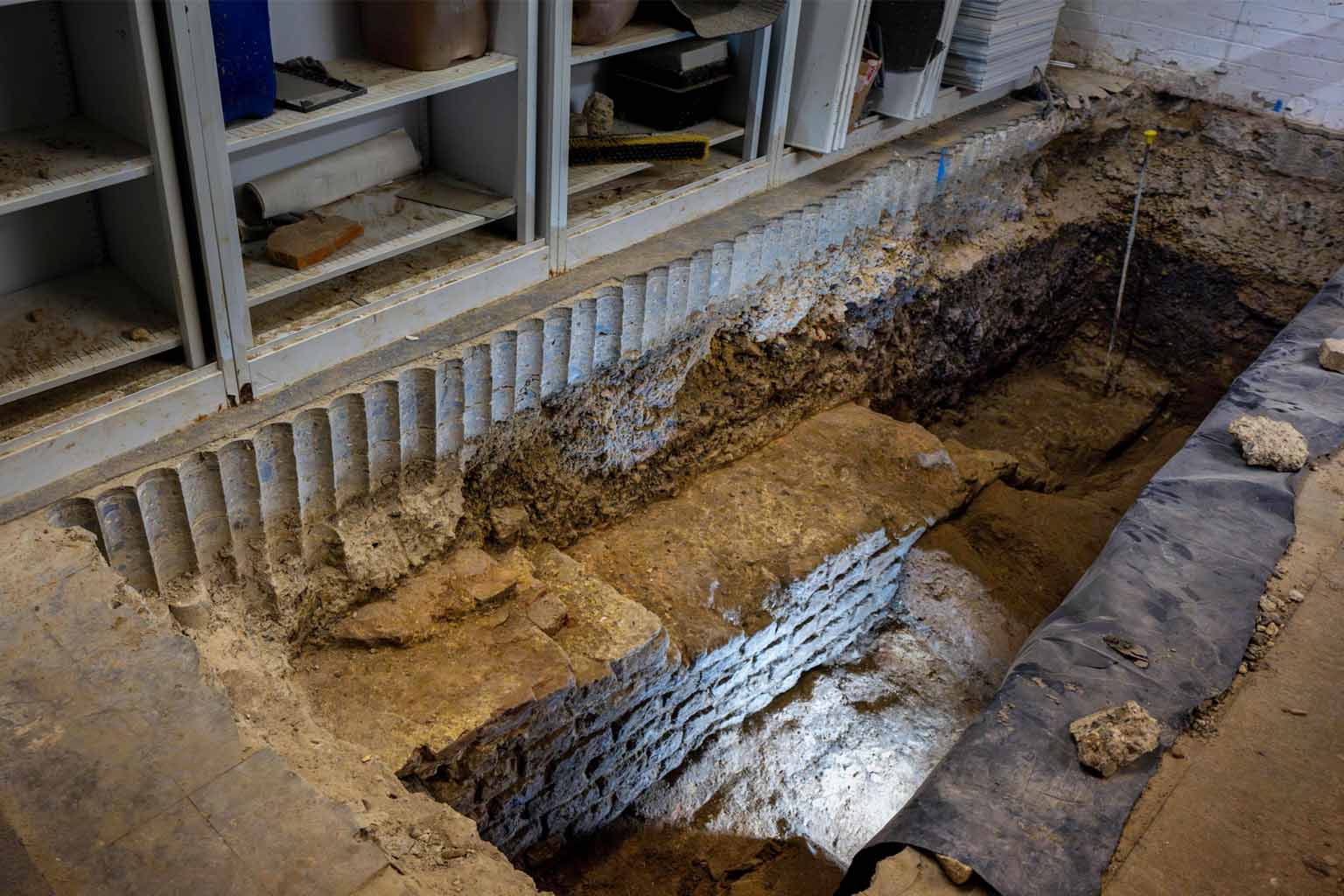
Beneath the bustling streets of modern London, where office workers rush past ancient stones without a second thought, archaeologists have pulled back the curtain on one of Britain’s most significant Roman discoveries. The first known Roman basilica in London has emerged from beneath an office block in the City, its nearly 2,000-year-old foundations intact and surprisingly well-preserved. This isn’t just another archaeological find gathering dust in museum storage, but rather a discovery that joins other remarkable finds like the 5,000-year-old fortification revealed by LiDAR in Romania, demonstrating how modern technology continues to unlock ancient secrets.
The basilica once stood as the beating heart of Roman London’s forum, a place where laws were debated, commerce flourished, and the administrative machinery of empire turned its gears. Found during redevelopment work at 85 Gracechurch Street, near Leadenhall Market, this discovery offers something rare in urban archaeology: a complete picture of how Romans organized their newest provincial capital. The structure represents more than ancient architecture; it’s a window into the moment when London began its transformation from a frontier settlement into an imperial city.
What makes this discovery particularly compelling is its location. The basilica wasn’t tucked away in some forgotten corner but occupied prime real estate in the forum’s elevated center, roughly the size of a modern football pitch. Here, surrounded by shops and administrative buildings, Roman officials made decisions that would echo through centuries of British history.
The Architectural Marvel Hidden in Plain Sight
The physical remains tell a story of Roman ambition and engineering prowess. Walls stretching more than 10 meters long, 1 meter wide, and 4 meters deep in places showcase the Romans’ commitment to permanence. Built from flint, ragstone, and Roman tile, these foundations were designed to support a structure meant to last generations. The level of preservation has exceeded all archaeological expectations, with key structural elements remaining intact despite centuries of London’s relentless urban development above.
Sophie Jackson from the Museum of London Archaeology draws a telling comparison: discovering this basilica is like finding the speaker’s chair of the House of Commons 2,000 years in the future. The analogy captures something crucial about Roman civic life. This wasn’t merely a building but the physical embodiment of Roman political culture, transplanted wholesale to British soil. The raised platform, or dais, where officials conducted business remains visible, offering tangible evidence of where empire met local governance.
The discovery’s timing proves fortunate. Found during commercial redevelopment, the basilica’s remains have prompted developers to revise their plans entirely. Rather than building over this piece of history, Hertshten Properties will incorporate the findings into a public exhibition space. This represents a significant shift in how modern London approaches its layered past, treating archaeology not as an obstacle to development but as an asset worth preserving.
Reconstructing Daily Life in Roman Londinium
The basilica’s role extended far beyond ceremonial functions. Research suggests these structures served as multipurpose civic centers where Romans conducted the complex business of governing a diverse population. Legal proceedings, commercial disputes, tax collection, and administrative meetings all took place within these walls. The forum surrounding the basilica buzzed with activity as merchants hawked goods, citizens sought official services, and news from across the empire circulated through informal networks.
Evidence from similar Roman sites across Europe indicates that basilicas like London’s hosted a fascinating mix of official and unofficial activities. While magistrates handled legal cases on the dais, the surrounding spaces accommodated everything from marriage ceremonies to business negotiations. The structure essentially functioned as Roman London’s town hall, courthouse, and social center rolled into one imposing building. Such discoveries of ancient ceremonial centers echo findings from other civilizations, including the 1,700-year-old altar at Tikal that revealed complex ritual practices in ancient Mesoamerica.
The basilica’s construction timeline reveals Roman confidence in their British venture. Built just decades after the initial invasion, this wasn’t a temporary military structure but a permanent civic building designed for centuries of use. The Romans clearly viewed London as more than a strategic outpost; they saw it as a future provincial capital worthy of monumental architecture.
Connecting Ancient Foundations to Modern Identity
The discovery forces a reconsideration of London’s earliest urban development. Archaeological evidence suggests the Romans didn’t simply build on empty land but created a carefully planned urban environment with designated spaces for different civic functions. The forum and basilica anchored a broader network of streets, buildings, and public spaces that would influence London’s layout for centuries to come. This pattern of ancient ceremonial architecture shaping urban development mirrors discoveries elsewhere, such as the 5,000-year-old fire altar in Peru’s Supe Valley that revealed sophisticated urban planning in the Americas.
Modern Londoners walking through the City unknowingly follow paths first laid down by Roman surveyors. Many contemporary street patterns echo ancient Roman routes, while the concentration of financial and legal institutions in the City continues a tradition of centralized civic authority that began with structures like this basilica. The discovery provides physical proof that London’s role as a center of governance and commerce has nearly 2,000 years of continuity.
Historic England’s recognition of the find as “something special” reflects more than archaeological enthusiasm. In an era when development pressure constantly threatens historical sites, the decision to preserve and display the basilica represents a commitment to maintaining London’s connection to its foundational period. The planned public exhibition will allow visitors to literally stand where Roman officials once debated laws and policies that shaped early British society.
The Untold Story of Imperial Integration
What conventional analyses of Roman Britain often miss is the basilica’s role as a tool of cultural integration rather than mere conquest. These structures weren’t imposed on unwilling populations but offered local elites opportunities to participate in imperial governance. The London basilica likely hosted a mix of Roman officials and cooperative British leaders, creating a hybrid administrative system that gradually transformed local political culture.
The basilica’s prominent location and impressive scale sent unmistakable messages about Roman intentions. Unlike military fortifications designed to intimidate, civic buildings like this one projected stability and permanence. They suggested that Roman rule offered benefits beyond military protection: access to imperial trade networks, standardized legal systems, and participation in a broader Mediterranean world. The significance of such Roman artifacts continues to captivate modern treasure hunters and archaeologists alike, as demonstrated by discoveries like the rare Roman coin found after years of searching on an English farm.
Research into similar Roman structures across Britain reveals fascinating variations in how imperial architecture adapted to local conditions. The London basilica appears to follow standard Roman design principles while incorporating materials and construction techniques suited to British conditions. This architectural flexibility reflects a broader Roman approach to governance that balanced imperial consistency with provincial adaptation.
As excavations continue and new discoveries emerge from beneath London’s modern surface, each find adds complexity to our understanding of how ancient and contemporary cities intersect. The basilica beneath Gracechurch Street represents just one layer in London’s archaeological palimpsest, but it’s a layer that fundamentally shaped everything built above it. Whether future discoveries will reveal more about the daily lives of ordinary Romans or the grand strategies of imperial planners remains an open question, one that keeps archaeologists returning to London’s ancient foundations with renewed curiosity.