


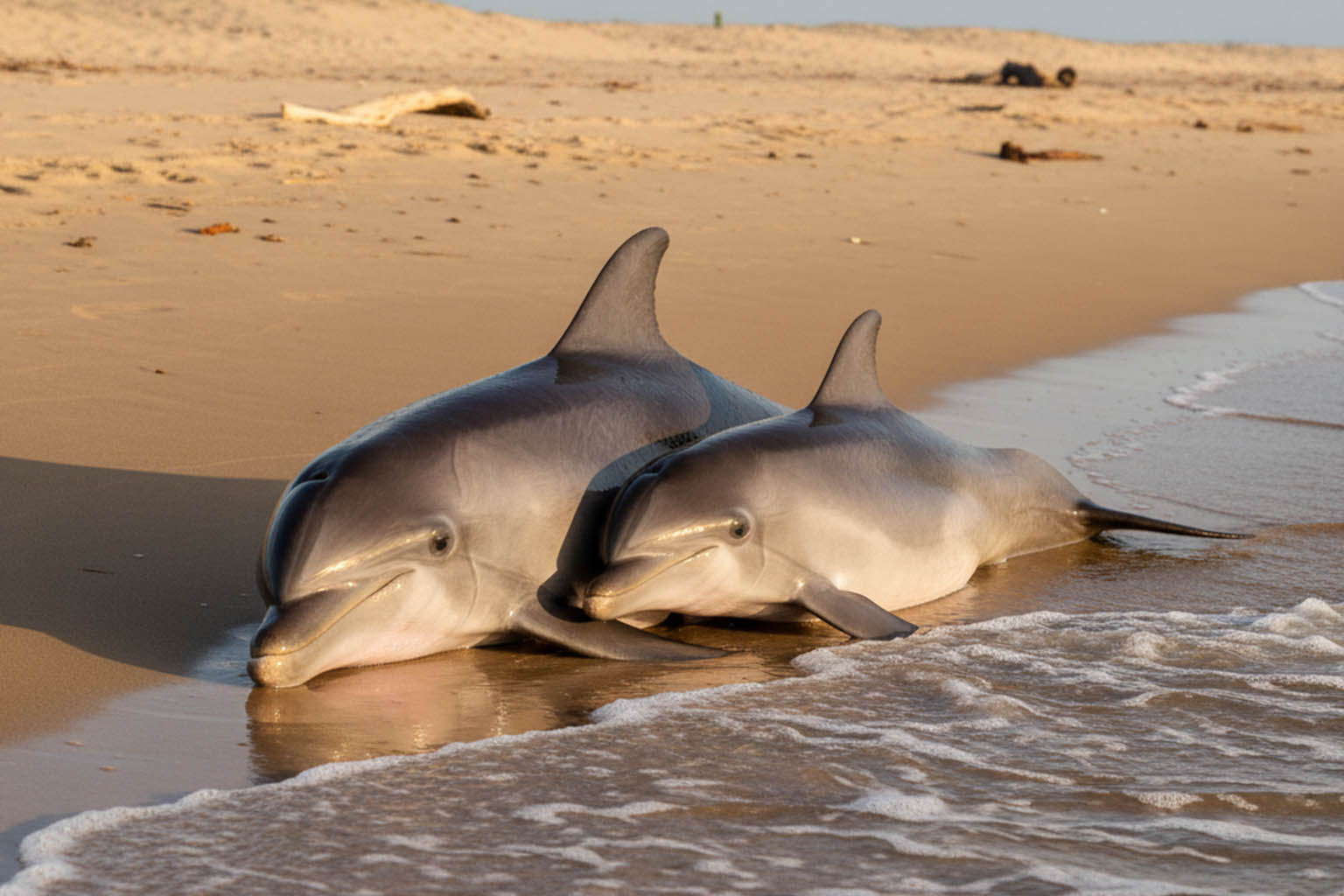
The pristine coastline of Tasmania’s northwest region became the scene of another marine tragedy when 90 dolphins and 157 false killer whales found themselves helplessly stranded near Arthur River. What began as a routine rescue operation quickly transformed into an impossible battle against geography, weather, and the relentless forces of nature that leave marine biologists grappling with one of the ocean’s most enduring mysteries.
The isolated location presented challenges that even the most experienced rescue teams couldn’t overcome. With only a treacherous single-lane road providing access to the remote beach, transporting heavy rescue equipment proved nearly impossible. As hours turned into days, the dolphins’ condition deteriorated under the scorching sun, leaving veterinarians with no choice but to make the heartbreaking decision to euthanize the remaining animals.
This incident underscores the harsh reality facing marine rescue operations in Australia’s most remote regions. Despite advances in marine biology and rescue techniques, some locations remain beyond human reach when nature’s clock starts ticking against stranded marine mammals. Just as LiDAR technology has revolutionized our ability to uncover hidden archaeological sites, modern rescue technology still faces insurmountable challenges when confronted with Tasmania’s rugged terrain.
The Geographic Trap That Sealed Their Fate
Arthur River’s location, roughly 300 kilometers from Launceston, represents one of Tasmania’s most challenging rescue environments. The steep terrain and rough coastal conditions create a perfect storm of obstacles that transform routine marine rescues into logistical nightmares.
Local resident Jocelyn Flint witnessed the devastating scene after her son spotted the struggling animals while shark fishing. Her description captures the emotional weight of watching intelligent creatures trapped by circumstances beyond anyone’s control. The dolphins’ open eyes and apparent awareness of their predicament added a deeply human dimension to an already tragic situation.
The inability to transport the massive animals safely from such terrain highlights a critical gap in Australia’s marine rescue capabilities. While coastal cities have sophisticated rescue protocols, remote strandings expose the limitations of current emergency response systems when geography becomes the enemy.
The Fifty-Year Mystery Returns
False killer whales hadn’t been involved in a Tasmanian mass stranding for over half a century, making this event particularly significant for marine biologists. These dolphins, despite their name, represent one of the largest dolphin species and display complex social behaviors that may contribute to their stranding patterns. Interestingly, these marine mammals share genetic similarities with the rare wholphin hybrid that has fascinated researchers with its unique characteristics.
The species’ strong family bonds create a double-edged survival mechanism. While these social connections help them thrive in open ocean environments, they become deadly liabilities during strandings. Entire family groups refuse to abandon distressed members, leading to cascading strandings that can affect entire pods.
According to research published in CSIRO Marine Research, Tasmania accounts for more than 80% of Australia’s whale strandings, with the west coast bearing the heaviest burden. The 2020 Macquarie Harbour incident saw 470 pilot whales stranded, while 200 more suffered the same fate two years later in the identical location. These recurring patterns suggest environmental factors specific to Tasmanian waters play a crucial role in these tragedies.
“Cetacean strandings in the Australian region have been systematically recorded since 1825 in Tasmania, revealing periodic variability linked to large-scale environmental factors” – CSIRO Marine Research
When Rescue Becomes Impossible
Marine biologist Kris Carlyon described this stranding as the most challenging he’d encountered in 16 years of rescue operations. The combination of animal size, terrain difficulty, and weather conditions created an unprecedented set of obstacles that defeated even the most determined rescue efforts.
The dolphins repeatedly returned to shore despite attempts to guide them back to deeper waters. This behavior, common in mass strandings, suggests the animals’ navigation systems had been fundamentally compromised. Studies from Nova Southeastern University indicate that multiple biological and abiotic factors influence cetacean mass stranding events, with the phenomenon puzzling researchers since ancient times.
The decision to euthanize reflects the brutal calculus of marine rescue work. Allowing the animals to suffer for days under harsh conditions while attempting increasingly desperate rescue measures serves neither the animals’ welfare nor conservation goals. Sometimes the most humane choice requires abandoning hope for individual animals to prevent prolonged suffering.
The Cultural Complexity of Marine Tragedy
Beyond the immediate rescue challenges lies a deeper complexity involving Tasmania’s Aboriginal communities, for whom the stranding site holds significant cultural value. This dimension adds layers of consideration to decisions about carcass removal and site restoration that rarely feature in mainstream coverage of marine strandings. Much like how the discovery of ancient Mesoamerica requires careful consideration of cultural significance, marine stranding sites demand similar sensitivity.
The choice to potentially allow natural decomposition rather than mechanical removal reflects growing recognition that marine strandings intersect with cultural heritage in ways that require sensitive handling. These considerations influence everything from cleanup timelines to memorial protocols.
Research into mass strandings continues to yield more questions than answers, despite decades of study. Scientists have identified potential triggers ranging from solar activity affecting magnetic navigation to shipping noise disrupting echolocation systems. Yet each new stranding event reveals how little we truly understand about these marine mammals’ complex relationship with their environment. Archaeological discoveries, such as the 3,000-year-old village recently unearthed in France, remind us that understanding complex systems—whether ancient human settlements or marine mammal behavior—requires patience and continued investigation.
The Arthur River stranding serves as a stark reminder that our capacity to help marine life remains constrained by forces beyond our control. As ocean environments continue changing due to human activity and climate shifts, these tragic events may become more frequent, testing our ability to balance intervention with acceptance of nature’s harsh realities. The dolphins’ story raises uncomfortable questions about the limits of human compassion when faced with the unforgiving mathematics of marine rescue in an increasingly unpredictable world.