


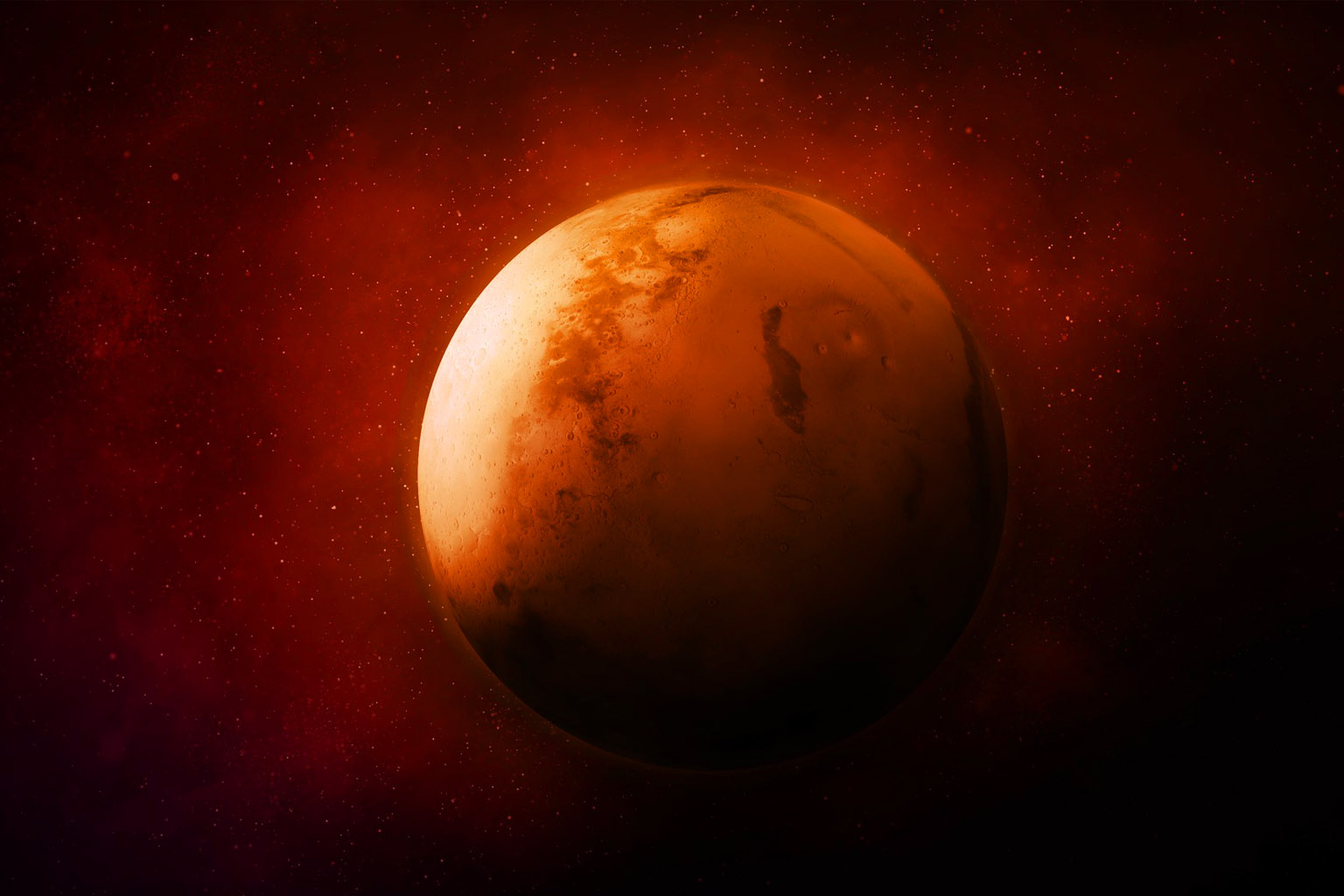
For over a century, Mars has earned its nickname as the Red Planet through its unmistakable rusty appearance visible even to the naked eye. The scientific consensus has long attributed this distinctive coloration to iron oxidation—essentially rust formation similar to what we observe on Earth when iron meets oxygen and moisture. This explanation seemed straightforward enough, fitting neatly into our understanding of planetary geology and atmospheric chemistry.
Recent laboratory research has disrupted this comfortable certainty. A team led by Adomas Valantinas at Brown University has discovered that Mars’ red dust contains ferrihydrite, a water-rich mineral that forms only in cool, water-abundant environments. This finding, published through analysis of data from the European Space Agency’s Trace Gas Orbiter, suggests that Mars underwent oxidation much earlier in its history than previously believed—at a time when liquid water still flowed across its surface.
The implications extend far beyond academic curiosity. If Mars rusted when water was plentiful, this fundamentally alters our timeline of the planet’s habitability and raises new questions about when and how long conditions might have supported life. Similar to how researchers have discovered microbial communities thriving in Earth’s extreme underwater environments, Mars’ early water-rich conditions may have provided suitable habitats for ancient life forms.
Laboratory Recreation Reveals Hidden Complexity
The breakthrough came through meticulous laboratory work designed to replicate Martian conditions. Researchers used advanced grinding equipment to process various iron oxide minerals into particles matching the fine, windblown dust that characterizes Mars’ surface layer. They then subjected these samples to the same analytical techniques employed by orbiting spacecraft and surface rovers.
This direct comparison between laboratory-created samples and actual Martian data from NASA’s Mars Reconnaissance Orbiter and Curiosity rover revealed the presence of ferrihydrite. According to research from the Planetary Science Research Discoveries, iron oxide formations on Mars show complex geological patterns that suggest varied formation processes. Colin Wilson, project scientist for both the Trace Gas Orbiter and Mars Express missions, emphasized that this discovery emerged from combining datasets across multiple international Mars exploration missions.
“The geologic setting and origin of iron oxide deposits in Terra Meridiani reveal complex formation processes that occurred under specific environmental conditions” – Planetary Science Research Discoveries
The mineral’s identification required sophisticated spectroscopic analysis. Unlike simple iron oxides, ferrihydrite produces distinct spectral signatures that had previously been overlooked or misinterpreted in Martian dust samples. The mineral’s presence explains certain anomalies in Mars’ spectral data that had puzzled researchers for years.
Early Oxidation Rewrites Martian History
The discovery fundamentally shifts our understanding of when Mars transitioned from potentially habitable to its current arid state. Traditional models suggested that Mars rusted gradually over billions of years as its atmosphere thinned and water disappeared. The presence of ferrihydrite indicates that significant oxidation occurred while the planet still maintained substantial surface water.
This timeline has profound implications for Mars’ ancient climate. Ferrihydrite formation requires not just water, but relatively stable hydrological conditions over extended periods. The mineral typically develops in lake beds, river deltas, and other environments where water persists long enough for complex chemical processes to occur. Understanding these geological transitions is as complex as studying geological history that shapes species distribution patterns on Earth.
Evidence suggests that ferrihydrite remains chemically stable under current Martian conditions, meaning the dust we observe today preserves a chemical record of the planet’s wetter past. This stability offers scientists an unprecedented opportunity to study ancient Martian environments through analysis of contemporary surface materials.
Sample Return Missions Hold the Key
The research has heightened anticipation for upcoming sample return missions that could provide definitive answers about Mars’ oxidation history. NASA’s Perseverance rover has already collected Martian dust samples that await return to Earth through the joint NASA-ESA Mars Sample Return mission. These samples could allow scientists to measure ferrihydrite concentrations precisely and determine their distribution across different Martian terrains.
Laboratory analysis of returned samples will enable researchers to conduct experiments impossible with remote sensing alone. Scientists plan to subject Martian dust to detailed mineralogical analysis, isotopic studies, and chemical dating techniques that could reveal exactly when and under what conditions ferrihydrite formed. Studies published in Earth and Planetary Science Letters have shown that iron isotopic tracing can reveal the chemical pathways of iron oxide formation under different environmental conditions.
The European Space Agency’s Rosalind Franklin rover, equipped with drilling capabilities, will provide additional data about subsurface mineral composition. This mission could reveal whether ferrihydrite concentrations vary with depth, potentially indicating different periods of water availability in Mars’ geological history. Such detailed scientific research missions echo the methodical approach used in scientific research conducted in Earth’s most challenging environments.
The Chemical Archaeology of Ancient Habitability
Beyond confirming Mars’ early water abundance, ferrihydrite’s presence raises intriguing questions about the planet’s potential for supporting life during its formative period. The mineral forms in environments that, on Earth, often harbor microbial communities. Its chemical structure can preserve organic compounds and other biosignatures that might indicate past biological activity.
Research indicates that ferrihydrite can act as both an energy source and preservation medium for certain types of microorganisms. On Earth, some bacteria derive energy from iron mineral transformations, suggesting that similar processes might have occurred on ancient Mars. The mineral’s ability to protect organic molecules from radiation and oxidation means that any preserved biological signatures could remain intact over geological timescales.
“Iron isotopic analysis reveals that basalt alteration and hematite formation follow specific chemical pathways that depend on environmental conditions during formation” – Earth and Planetary Science Letters research
The discovery also influences how scientists interpret other Martian geological features. Ancient lake beds and river channels that previously seemed too brief to support complex chemistry may have hosted more sophisticated processes than initially believed. Ferrihydrite formation requires sustained chemical activity that indicates stable, long-lasting aqueous environments rather than brief flooding events. This understanding of mineral formation processes parallels discoveries about how plants can naturally concentrate rare earth minerals through biological processes.
This research transforms our understanding of Mars from a planet that slowly dried out to one that experienced complex, water-rich chemistry early in its history. As future missions bring Martian samples back to Earth, we may discover that the Red Planet’s distinctive color tells a far more compelling story about ancient habitability than anyone previously imagined. The rust that defines Mars’ appearance might ultimately prove to be our best evidence for when and how long the planet could have supported life.