


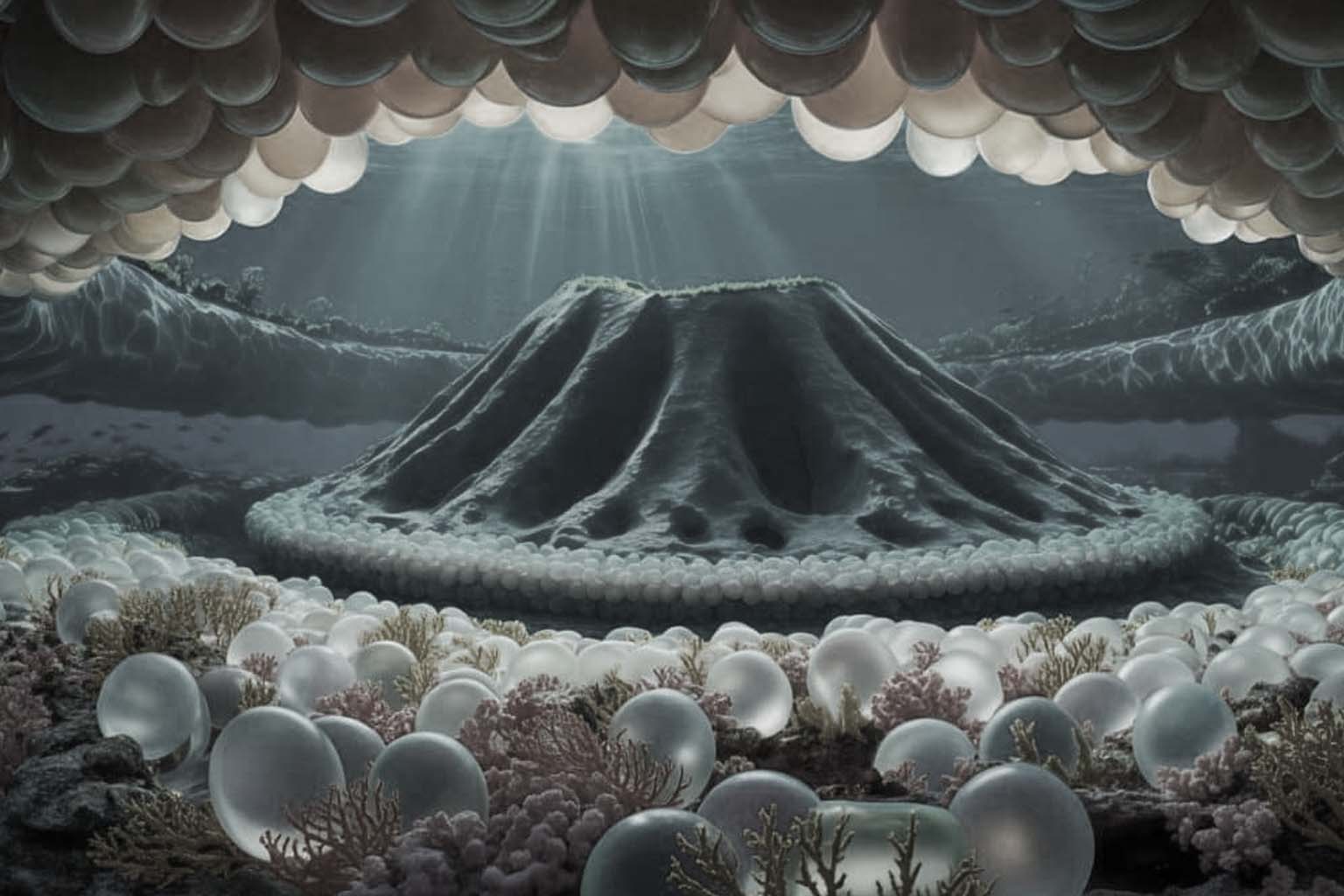
Deep beneath the Pacific Ocean, where sunlight has never penetrated and temperatures hover just above freezing, scientists have uncovered something that challenges our fundamental understanding of deep-sea ecosystems. An ancient underwater volcano, previously classified as extinct and forgotten, has revealed itself to be not only alive but nurturing one of the most extraordinary nurseries ever documented in marine science.
The discovery occurred during a routine expedition off the Pacific coast of Canada, nearly a mile below the surface. What researchers expected to find was a cold, barren seamount—a submerged mountain rising 3,600 feet above the seafloor. Instead, they encountered hot hydrothermal fluids still flowing from the volcano’s summit, and scattered across this geologically active landscape were up to a million giant eggs belonging to Pacific white skates, deep-dwelling relatives of sharks and rays.
This revelation forces us to reconsider how many other supposedly dormant underwater volcanoes might be secretly shaping marine ecosystems in ways we’ve never imagined. The implications extend far beyond this single discovery, suggesting that our maps of deep-sea geological activity may be woefully incomplete—much like how recent archaeological discoveries have revealed hidden complexities beneath familiar landscapes, such as the 3,000-year-old village unearthed beneath France.
When Extinct Volcanoes Refuse to Die
The seamount’s continued activity came as a complete shock to the research team. Cherisse Du Preez, the deep-sea marine biologist leading the expedition, described finding warm, mineral-rich water seeping from cracks in the volcanic rock—evidence of ongoing geological processes that should have ceased long ago.
Using advanced submersibles and remotely operated vehicles, researchers documented hydrothermal flows creating an oasis of warmth in an otherwise hostile environment. According to research from the Smithsonian Institution, these thermal vents don’t just represent geological curiosities; they fundamentally alter the chemistry and biology of the surrounding water, creating conditions that can support life in regions that would otherwise remain barren.
“At certain spots on the ocean floor where tectonic plates meet, unique ecosystems teem with unusual animal species, supported by mineral-laden fluid emissions” – Smithsonian Ocean Research
The discovery raises unsettling questions about our geological surveys of the ocean floor. If this volcano remained undetected in its active state, how many others are we missing? Recent advances in deep-sea exploration technology suggest we may need to reassess entire regions of the seafloor previously written off as geologically inactive.
The Ravioli-Shaped Mystery
The eggs themselves present a biological puzzle that marine scientists are still working to solve. These rectangular, ravioli-shaped structures, known colloquially as “mermaid purses,” belong to Bathyraja spinosissima, one of the most elusive species in the deep ocean. Found at depths between 2,600 and 9,500 feet, these skates represent an evolutionary lineage that has adapted to some of Earth’s most extreme environments.
What makes this discovery particularly significant is the sheer scale of the nursery. Du Preez’s estimates range from hundreds of thousands to potentially over a million eggs concentrated on the volcano’s summit—a density of reproductive activity that suggests this site plays a crucial role in the species’ survival strategy. This kind of hidden complexity in seemingly barren environments mirrors discoveries like the 20,000-year-old cave etchings that revealed sophisticated ancient mapping techniques.
The eggs require an extraordinary four-year incubation period before hatching, making them vulnerable to temperature fluctuations and predation throughout their extended development. This lengthy gestation period, unusual even among deep-sea species, makes the discovery of their association with volcanic heat sources all the more intriguing.
Volcanic Heat as an Evolutionary Advantage
The strategic use of geothermal energy by deep-sea skates represents a remarkable example of evolutionary adaptation. In the frigid depths where temperatures barely rise above freezing, even a few degrees of additional warmth can dramatically accelerate embryonic development and improve survival rates.
Research from similar discoveries near the Galápagos Islands in 2018 supports the theory that volcanic nurseries provide crucial advantages for deep-sea reproduction. The warm water doesn’t just speed up egg development; it creates a more hospitable environment for newly hatched juveniles before they venture into the broader deep-sea ecosystem.
This relationship between geological activity and biological reproduction suggests a level of ecosystem integration that scientists are only beginning to understand. The skates appear to have evolved not just to tolerate extreme deep-sea conditions, but to actively exploit geological features for reproductive success.
The Overlooked Ecological Implications
What conventional analyses of this discovery often miss is the broader ecological web that such volcanic nurseries support. The concentration of skate eggs creates a unique food web dynamic that extends far beyond the immediate vicinity of the seamount.
The mineral-rich hydrothermal flows support communities of specialized bacteria and other microorganisms, which in turn feed small invertebrates. These form the base of a food chain that ultimately supports not just the developing skates, but potentially influences fish populations across much wider areas of the deep Pacific. Studies by NOAA have shown that deep ocean hydrothermal vent ecosystems, first discovered in 1977, continue to broaden our understanding of life on Earth.
“Deep ocean hydrothermal vent ecosystems were discovered in 1977, broadening our understanding of life on Earth beyond previously known limits” – NOAA Ocean Research
The long-term stability of these nurseries also raises questions about deep-sea conservation that marine biologists are only beginning to address. If critical reproductive sites for deep-sea species depend on specific geological conditions, changes in volcanic activity could have cascading effects on marine ecosystems that take decades to become apparent. Understanding these deep-sea environments is as crucial as exploring other hidden ecosystems, whether they’re Mediterranean deep trenches or terrestrial archaeological sites.
The complexity of these discoveries continues to surprise researchers, much like how excavations reveal unexpected structures such as the 3,000-year-old biblical fortress beneath Jerusalem’s streets. This discovery reminds us that the deep ocean remains largely unexplored territory, where the intersection of geology and biology continues to surprise even seasoned researchers. As we develop new technologies for deep-sea exploration, how many other hidden ecosystems are waiting to reshape our understanding of life in Earth’s most remote environments?