


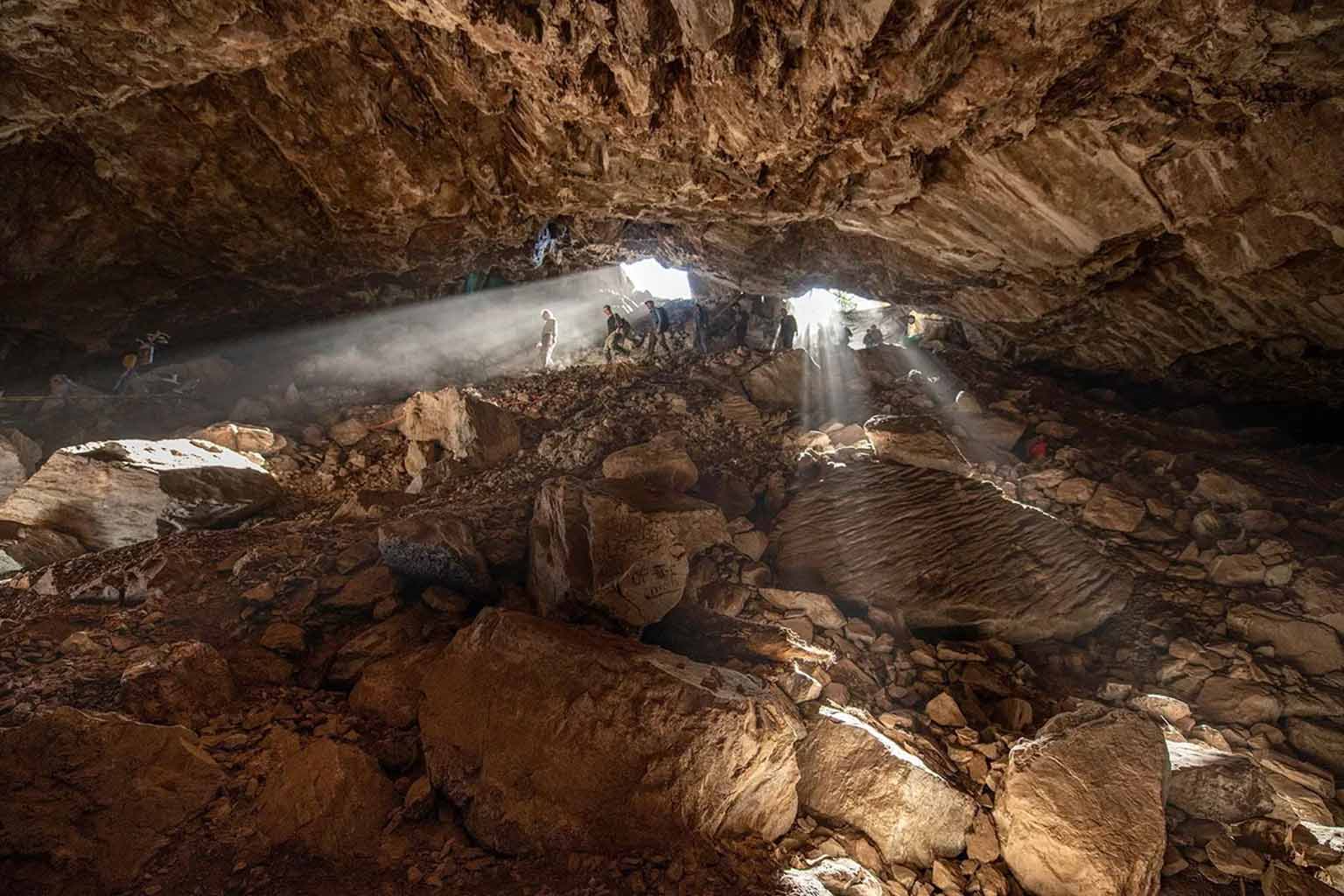
It’s an extraordinary testament to the complexity of early human life—the unearthing of a **100,000-year-old burial site** in Israel. This discovery, both mesmerizing and thought-provoking, offers a glimpse into the symbolic traditions of our ancestors and highlights a fascinating interaction between Homo sapiens and Neanderthals that complicates the story of our evolution. Imagine stumbling upon a hidden chapter of human history, tucked away in the dark confines of Tinshemet Cave. That’s precisely what archaeologists have achieved near Tel Aviv, and the revelations from this site are reshaping our understanding of early human culture.
A Lost Cemetery Hidden in Time
Tinshemet Cave, east of bustling Tel Aviv, harbors an archaic burial ground where at least two complete skeletons, three skulls, and several other human bones were meticulously arranged in a fetal position. This arrangement—reminiscent of other historical sites like Qafzeh and Skhul Caves—points to a trend; one where early humans had begun practicing **symbolic behavior** much earlier than we had previously thought. It’s easy to picture these ancient people, carefully decorating the deceased with red ochre—a pigment potent with ritual significance. But this discovery isn’t just about awe and wonder; it’s a critical clue in the puzzle of human history.
Archaeologists unearthed not just bones, but also grave goods—deer antlers, boar jaws, and shells. These items suggest that early humans weren’t just discarding their dead aimlessly; they were engaged in profound and complex funerary rituals. As Chris Stringer, a paleontologist from the Natural History Museum in London, put it, the Tinshemet Cave finds are “probably the most **important discoveries in the region** in the last 50 years.” That’s saying something in a region as history-rich as the Levant!
A Cultural Bridge Between Homo Sapiens and Neanderthals
Just a stone’s throw away from Tinshemet, at Nesher Ramla, scientists recently uncovered fossils with a mix of Neanderthal and archaic human features. This nearness isn’t just geographic; it’s cultural. The artifacts and burial practices at Tinshemet and nearby sites are strikingly similar—nudging us toward the idea of a **shared cultural network** in prehistoric times. It’s intriguing, isn’t it? The notion that Homo sapiens and Neanderthals—often pictured as fierce competitors—were likely sharing thoughts, technologies, and perhaps even social norms.
Prof. Israel Hershkovitz from Tel Aviv University offers an insightful perspective: “The overlap of the two populations is now visible not only on the genetic level but also on the social and cultural level.” This suggests a rich tapestry of interactions rather than an evolutionary battle royale. The technological craftsmanship, hunting techniques, and symbolic behaviors observed at these ancient sites reflect not isolation, but rather cooperation and cultural **exchange over millennia**.
The Role of Symbolic Thinking in Early Human Society
The discovery of **red ochre at Tinshemet** is not merely an archaeological footnote; it symbolizes something profound. This pigment, often associated with symbolic and ritual practices, hints at early spiritual or social traditions. Across the globe, from ancient times to today, ochre has been linked with **identity and status**. But what did it truly mean to these early humans?
Prof. Yossi Zaidner, heading the excavation, posits that the burials at Tinshemet served a dual purpose: ritualistic and social. “Humans needed to cope with a bunch of new social pressures,” he explains, suggesting that burial rituals may have helped define group identities and social boundaries. Perhaps the decorated bodies were a way for these early humans to declare, “This land is tied to me and my ancestors.” The ceremonial use of decorations didn’t just honor the dead; it forged communal ties, strengthened kinship, and ensured cultural continuity—like anchors dropped into the turbulent sea of **early human society**.
Hunting, Tools, and Rituals: A Unified Tradition
But the echoes of prehistoric life resonate beyond these ethereal rituals. The excavation brought to light a stash of stone tools forged with the Levallois technique—a testament to the **cognitive sophistication** of these early tenants of the Earth. This complex tool-making method spread across the Levant during the Middle Paleolithic and whispers of a shared bulwark of knowledge and innovation.
Archaeologists have determined that Tinshemet’s inhabitants were adept hunters, tracking large game like deer, wild cattle, and horses. Interestingly, these hunting patterns mirror those at other ancient sites across Israel. What does this tell us? These weren’t isolated communities but rather a connected web of human groups, united by **shared survival strategies and symbolic customs**.
The ongoing discoveries at Tinshemet Cave paint a picture of early humans not as solitary nomads but as members of a cooperative community—drawn together by shared rituals, technologies, and aspirations. It’s a perspective that deepens our understanding of human nature, encouraging us to reconsider what it means to be part of a community.
For the curious and the contemplative among us, these revelations hold something akin to magic. It serves as a reminder that in our quest for understanding, we are forever standing on the shoulders of those who came before us. If this piques your interest, why not explore further? Dive into the fascinating world of archaeology, where mysteries lie just beneath our feet, waiting to be uncovered. And as always, keep questioning, keep exploring, and perhaps you’ll uncover the past, one story at a time.