


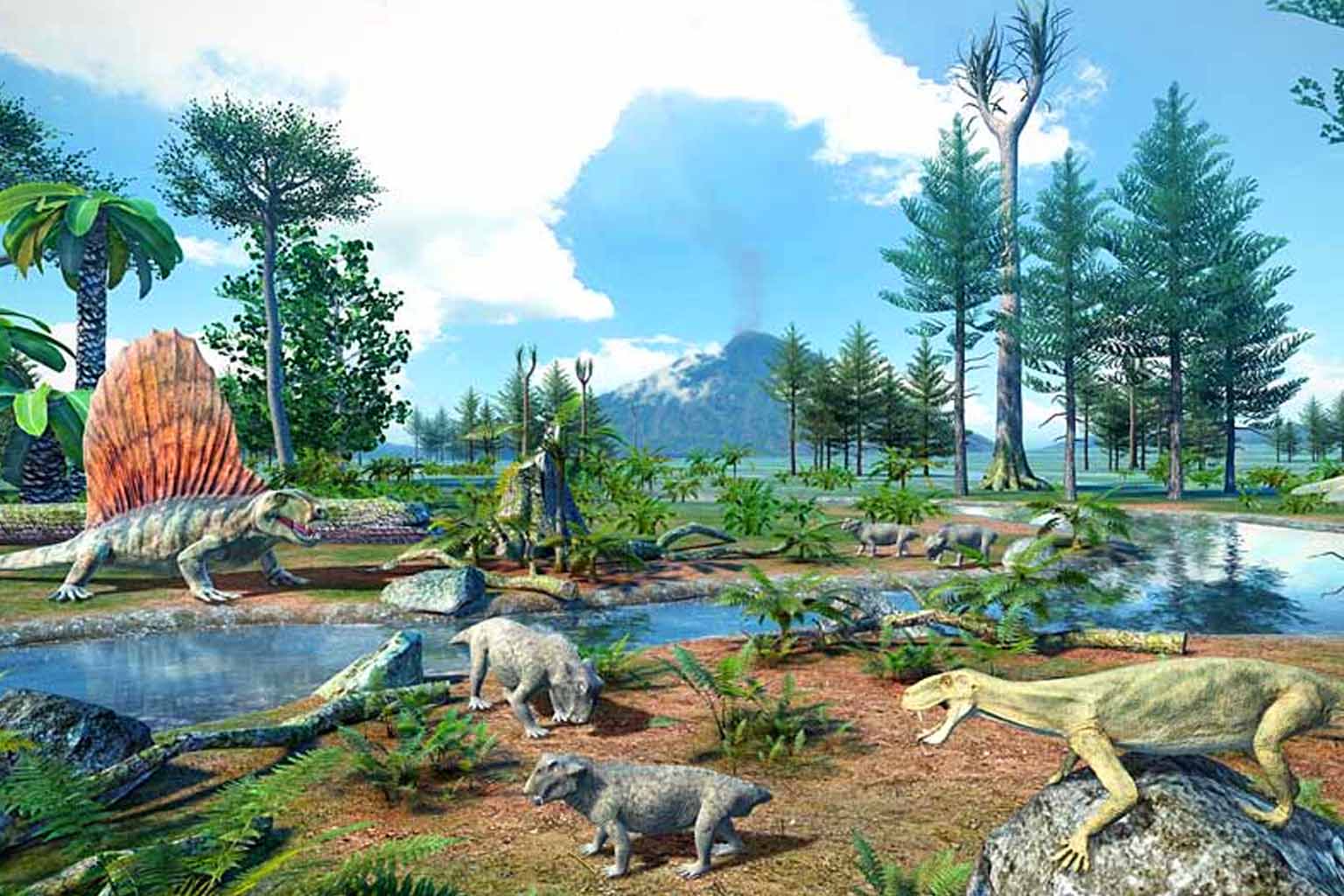
It took a volcanic apocalypse to ravage the planet some 252 million years ago, but tucked away in a corner of China, a forgotten realm of life managed to hold its ground. This enigmatic haven is now revealing its long-buried secrets as scientists delve into the surprising resilience of nature during Earth’s most catastrophic extinction event. Set against a backdrop of fiery upheaval, what pushed this particular “lost world” to thrive while others withered away?
A Mysterious Ecosystem Defies Extinction
Lurking beneath the sands of China’s Turpan-Hami Basin lies a prehistoric ecosystem that stood defiant in the face of the planet’s deadliest mass extinction. Discovered by an international team led by Prof. Liu Feng from the Nanjing Institute of Geology and Paleontology, this region’s fossils are painting a fascinating picture of survival. In a place where over 80% of marine species and vast numbers of land creatures vanished, this “life oasis” served as a sanctuary that nurtured biodiversity and ecological continuity.
It’s curious, isn’t it? How could anything flourish when the rest of the world was plunged into chaos? Published findings in Science Advances unveil the conditions and circumstances that permitted life to maintain its foothold here.
The Catastrophe Known as ‘The Great Dying’
The end-Permian extinction, often referred to as “The Great Dying,” unfolded as massive volcanic eruptions in Siberia released torrents of toxic gases into the atmosphere. This deadly cocktail led to wildfires, choked oceans with acid, and catapulted global climates into disarray. The aftermath was a near-total decimation of marine life and a catastrophic impact on terrestrial species.
But how could the Turpan-Hami Basin have avoided such widespread destruction? It seems that traditional perspectives suggesting the complete obliteration of terrestrial ecosystems are now coming under thoughtful scrutiny.
A Glimpse into Prehistoric Life
In a rather unexpected turn, the fossil trail in the South Taodonggou section of Xinjiang tells a story of perseverance. Instead of a barren wasteland, fossil pollen, spores, and plant debris sketch the contours of a world not entirely lost. These remnants, dating back 160,000 years before and after the extinction event, allow the story of tenacity to unfold—a tale of ferns and conifers that thumbed their noses at planetary peril.
Paleontologist Prof. Wan Mingli remarked, “The presence of intact tree trunks and fern stems further confirms that these microfossils represent local vegetation, not transported remnants.” What an exhilarating find! These were not mere survivors but an entire ecosystem that held its own through upheaval and made a speedy recovery—a feat more rapid than early estimates suggested.
For our senses, imagine the serene beauty of ferns flourishing while an ancient world crumbled around them. It’s the kind of image that makes you ponder the mysteries preserved in the Earth’s layers.
What Shields a Sanctuary?
The eternal question—why did this corner of the world succeed when others failed? Evidence points to climate stability and geographical quirks. Multiple analyses, such as by USGS, suggest an annual rainfall of about 39 inches (1,000 mm) kept the area lush and green, even as vast tracts of land were desiccated elsewhere. Meanwhile, the basin’s natural isolation may have largely shielded it from the worst volcanic repercussions.
Rivers, wetlands, and riparian ecosystems played their roles by providing freshwater resources that served as buffers against climate extremities. Prof. Liu Feng commented, “This suggests that local climate and geographic factors can create surprising pockets of resilience, offering hope for conservation efforts in the face of global environmental change.” Isn’t it comforting to think that, even in dire times, some places might cradle life more effectively than others?
And now, for those of you curious dreamers contemplating what the end-Permian world might have sounded like, here’s a glimpse into how these ancient ecosystems could have resonated with life. Take a moment to explore this captivating soundscape of prehistoric nature:
Our journey through time, etched in the stone and soil, proves once again that the Earth’s resilience and adaptability can often be astonishing. So, next time you gaze upon a fossil—just imagine all the tales waiting to stir our imaginations. Please share this article with anyone fascinated by our ancient planet, and let’s keep looking forward to the new insights that lie hidden, waiting to be unearthed.