


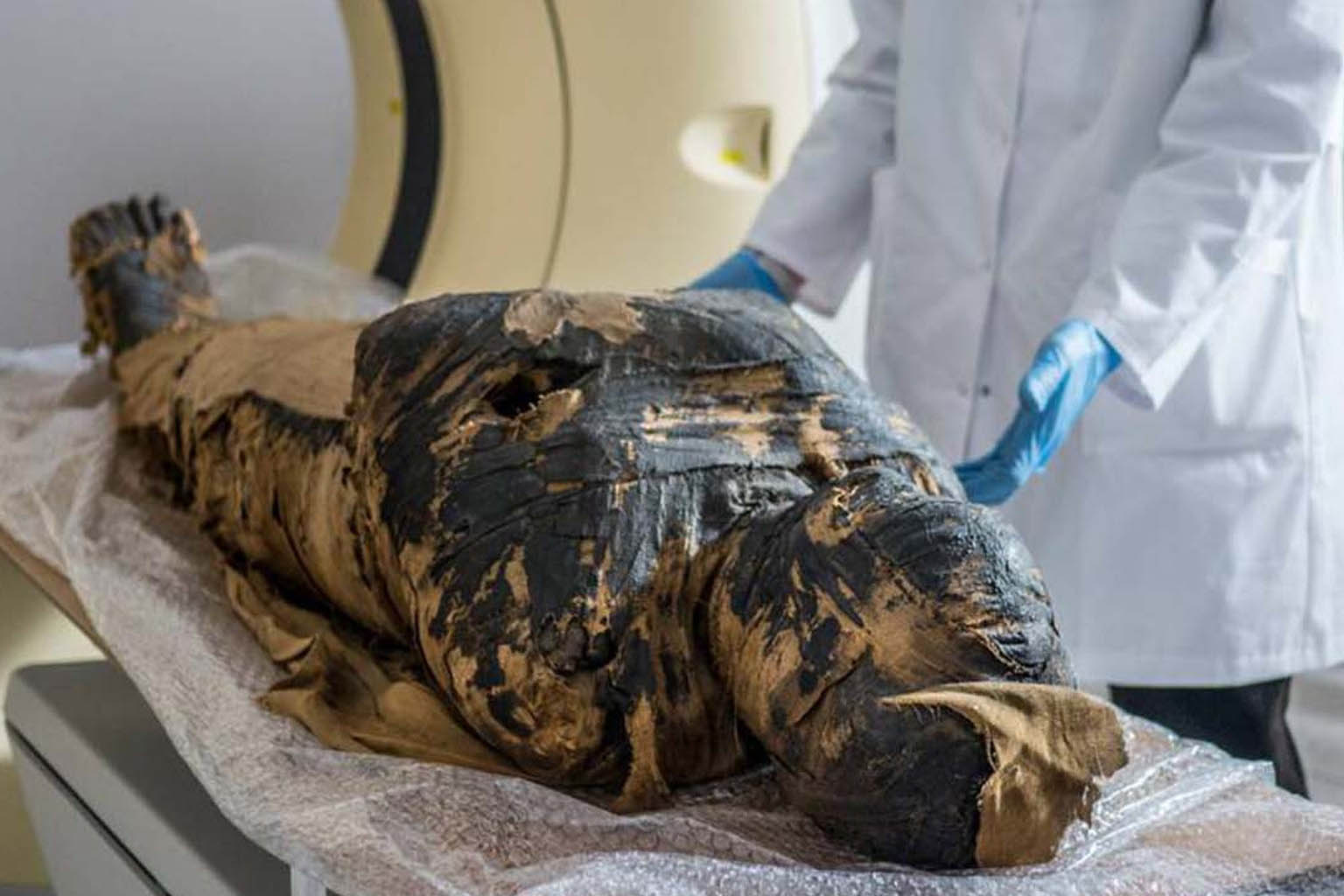
Picture this: a decades-old mystery seemingly solved, yet not in the way any of us expected. We’re talking about the “Mysterious Lady,” an ancient Egyptian mummy. For a while, the buzz was all about her possibly being pregnant and even having cancer. But hold on — a recent study has turned these beliefs upside down. Let’s unravel the twists and turns of this narrative, which has gripped historians and scientists alike.
Revelations From Recent Examination
What’s fascinating and a bit uncanny is how these claims were initially believed. Discovered in Luxor and residing in Poland since 1826, the Mysterious Lady was mistaken for a male priest until a 2021 analysis suggested otherwise. Experts at the Warsaw Mummy Project declared that the mummy was actually a young female, estimated to be carrying a fetus 6.5 to 7.5 months into pregnancy. Also, they suspected nasopharyngeal cancer. Bold claims, right? Yet, a meticulous re-evaluation is now telling a different story.
This new research, published in the journal Archaeological and Anthropological Sciences, relied on an incredibly intricate study of over 1,300 CT scans. An international team of 14 researchers came together to paint a clearer picture, and it’s rather eye-opening. Gone is the fetus theory; what was actually seen appears to be part of the yet elaborate embalming process, not an unborn child. As for the supposed cancer, the evidence simply doesn’t uphold that theory.
Unraveling the Embalming Mystery
So why the confusion? The original claim about the mummy’s pregnancy stemmed from CT scan observations. These scans revealed a mass in her abdomen that scientists theorized could be a fetus, although no distinct fetal bones were found. The initial theory suggested that the acidity of the womb might have dissolved the bones over time. An explanation that, honestly, seemed both intriguing and eerie.
But how do experts respond to this? According to radiologist and mummy expert Sahar Saleem, the Warsaw team made a leap without firm evidence. In her chat with Live Science in 2022, she remarked on the lack of anatomical structures to support their findings. Now, with the help of deeper analysis, researchers established these “remains” as bundles of embalming materials. A common practice in ancient Egyptian mummification, but not a fetus purveyor by any means.
The Cancer Controversy Revisited
What about the cancer claim? An earlier study pointed to skull damage, hinting at nasopharyngeal cancer. Well, like the pregnancy assumption, it didn’t hold up under scrutiny. The latest study attributes these cranial anomalies to post-mortem ritual practices. To preserve bodies, the ancient Egyptians often carried out procedures involving skull breakages to extract the brain — a standard part of mummification, yet often misinterpreted as disease-related damage.
This instance is a prime example of the complexities surrounding mummy research. It’s more than just pathology and history coming together in an intriguing blend. The risks of drawing conclusions based solely on imaging, without direct tissue analysis, are abundantly clear. Why? Because this can lead to significant misunderstanding of biological realities.
“The challenges of interpreting such ancient and decomposed remains emphasize the need for painstaking, multidisciplinary approaches,” emphasizes a representative from the research team, adding that “science must aim for accuracy above all in these delicate investigations.”
Lessons for Future Mummy Research
This story, while a fascinating deep-dive into the past, serves as a vital reminder — or let’s call it a cautionary tale — for those studying ancient remains. Sensational headlines are tempting, aren’t they? But true understanding requires patience and rigorous verification. As an acclaimed finding from the Warsaw Mummy Project shows, even well-intentioned science can misfire.
The latest team’s recommendation? Shift focus toward more expansive studies, delving into broader questions about health practices in ancient Egypt rather than zooming in on isolated cases that could lead to misinterpretations. As highlighted by this case, scientific accuracy, despite all its occasional hiccups, triumphs over quick assumptions.
So, what’s your take on this unraveling of a historical mystery? Fascination with mummies continues, and indeed, they invite countless questions. If you’re as hooked as we are on these ancient narratives, stay curious, keep exploring, and look out for those subtle hints that history often hides in plain sight. Dive into the layers — sometimes, they’re the real stories.