


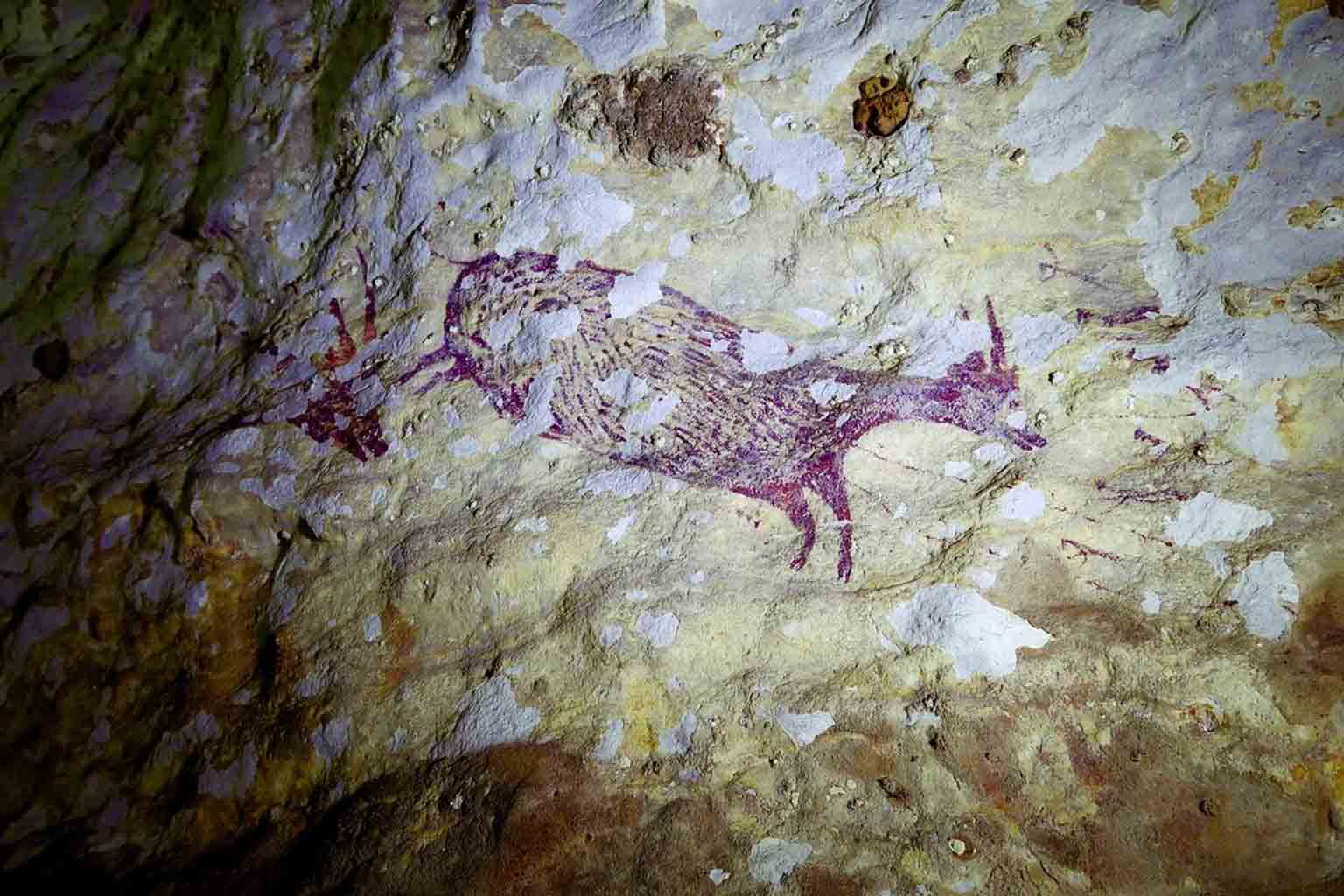
Beneath the lush canopies of Sulawesi, Indonesia, a profound secret lay hidden in a shadowy cave, waiting to tell a story older than human civilization itself. This 44,000-year-old animal painting, stretching across the limestone walls of the Leang Timpuseng Cave, is now thought to be the world’s oldest recorded narrative. But what does this mysterious artwork truly say about us and our ancestors?
A New Dawn in Art History
Remarkably, this **ancient wonder** portrays a scene that feels both familiar and fantastical. It’s not just about animals, but a story of a hunt — an age-old tale depicted with wild pigs and a diminutive buffalo known as anoa. Yet, what’s startling, and perhaps leaving archaeologists puzzled, are the **therianthropic figures** within the scene. These part-human, part-animal figures suggest an intertwining of the mythical with the mundane, hinting at a rich tapestry of mythology, perhaps even religion, in early human life.
According to Brumm, a leading researcher from Griffith University, “We don’t know what it means, but it seems to be about hunting, and it seems to maybe have mythological or supernatural connotations.” This artwork provides an awe-inspiring glimpse into the ancient weave of reality and fantasy as experienced by those who came before us.
The Science Behind the Discovery
The dating of this narrative art has opened up new conversations — not just due to its age but also the methods employed to verify it. Utilizing advanced **radiocarbon dating techniques**, scientists confidently classified this creation within the Upper Paleolithic era. According to a study published in Nature, the analysis validated the painting’s age as approximately 44,000 years old, marking it as one of humanity’s oldest figurative artworks ever uncovered.
The team used a technique known as uranium-series dating to determine the timeline of calcium carbonate deposits in the cave. “I’ve never seen anything like this before,” Brumm shared, excitement tinged with reverence. “This landscape of art places Sulawesi at the cutting edge of our understanding of art and symbolism.”
Rethinking Narrative Origins
This discovery disrupts long-held beliefs that art’s origins are rooted in European history. For decades, sites like the Cave of Lascaux in France, famous for its murals dating back some 17,000 years, have been seen as the cradle of narrative art. Yet, this Indonesian find, now viewed as the dawn of storytelling, relocates the birthplace of narrative expression to Southeast Asia. It challenges the **Eurocentric narrative** of prehistoric art, encouraging us to reframe what we know about human creativity across continents.
Interest in these discoveries isn’t merely academic. It offers insight into early human cognition and the **cognitive leaps** necessary to produce such intricate art. As Pike, a co-author of the study, elaborates, “This shows the tradition does not have its origins in Europe,” a statement that calls into question prior assumptions about the evolution of global art history.
An Enlightened Future
Sulawesi’s painted gallery serves as both a memorial of our past and a testament to human imagination’s boundless potential. This revelation provides more than a glimpse into ancient lives; it hands us a mirror reflecting the complex interplay of symbolism and storytelling innate in us all. Each brushstroke speaks of early man’s attempt to make sense of the world, blending the known with the imagined into a cohesive, albeit enigmatic, whole.
For those engaged in the study of our kind’s artistic roots, this 44,000-year-old message washes over the modern world like a tidal wave. It implores historians, artists, and even casual observers to reconsider where human creativity originates and what stories might yet to be unearthed.
Witness for yourself the intrigue of this discovery; a profound journey situated at the crossroads of human history at Griffith University’s elaborated visual gallery below:
In essence, as we ponder these ancient stories and artistic expressions, imagine the profound sense of connection to those who, millennia ago, left their mark on stone. Journey with us into a realm where history, art, and culture intertwine to tell a tale echoing through time. What other secrets lie hidden beneath centuries of dust, waiting to reshape our understanding of our shared human saga? Whatever they may be, we invite you to explore these discoveries more deeply and ask: What stories will we continue to tell?