


Archaeology, much like piecing together a colossal, three-dimensional puzzle, holds within its soft earth and weathered stones clues to our human past — and sometimes, the finds are so extraordinary that they seem to whisper the secrets of ancient worlds. Recently, in northeastern Thailand, archaeologists stumbled upon such a whisper. An excavation at the Wat Thammachak Sema Ram temple in the Sung Noen District unveiled relics that promise to shed light on the rich tapestry of religious and cultural life in the region, dating back some 1,300 years.
These ancient artifacts, meticulously hidden for centuries, include dazzling gold, silver, and bronze items that speak volumes about craftsmanship and religious traditions. Perhaps you’re wondering how these treasures came to be discovered at this temple, a historical site that has long served as a linchpin of Buddhist practice. Let’s delve deeper.
Buddhist Relics from the Past
You see, the Wat Thammachak Sema Ram temple isn’t just any temple. It’s a site steeped in history dating back to the Dvaravati period, which, if you can imagine, spanned from the 6th to the 11th centuries AD. This era was pivotal for early Thai Buddhism. And here’s where it gets intriguing — during preservation work on the temple’s iconic reclining Buddha statue, archaeologists uncovered a clay vessel buried 1.3 meters underground, packed to the brim with 33 precious items. Talk about a hidden treasure chest!
These relics, believed to be part of a religious offering, offer a rare, tangible glimpse into the spiritual life and artistic achievements of a bygone era, hinting at the cultural influences that resonated throughout Southeast Asia.
A Rich Array of Artifacts
What exactly did these modern-day treasure hunters find? The vessel held an intricate collection: gold rings, silver earrings, and elaborately designed bronze jewelry — all amazingly well-preserved. There’s something poetic about these pieces enduring the passage of time, isn’t there? Among these relics, a set of spiral hoop earrings stands out. They bear a striking resemblance to pieces previously discovered at other sites, like Phu Khao Thong in Ranong Province and Tha Chana in Surat Thani, suggesting a wider cultural exchange throughout the region.
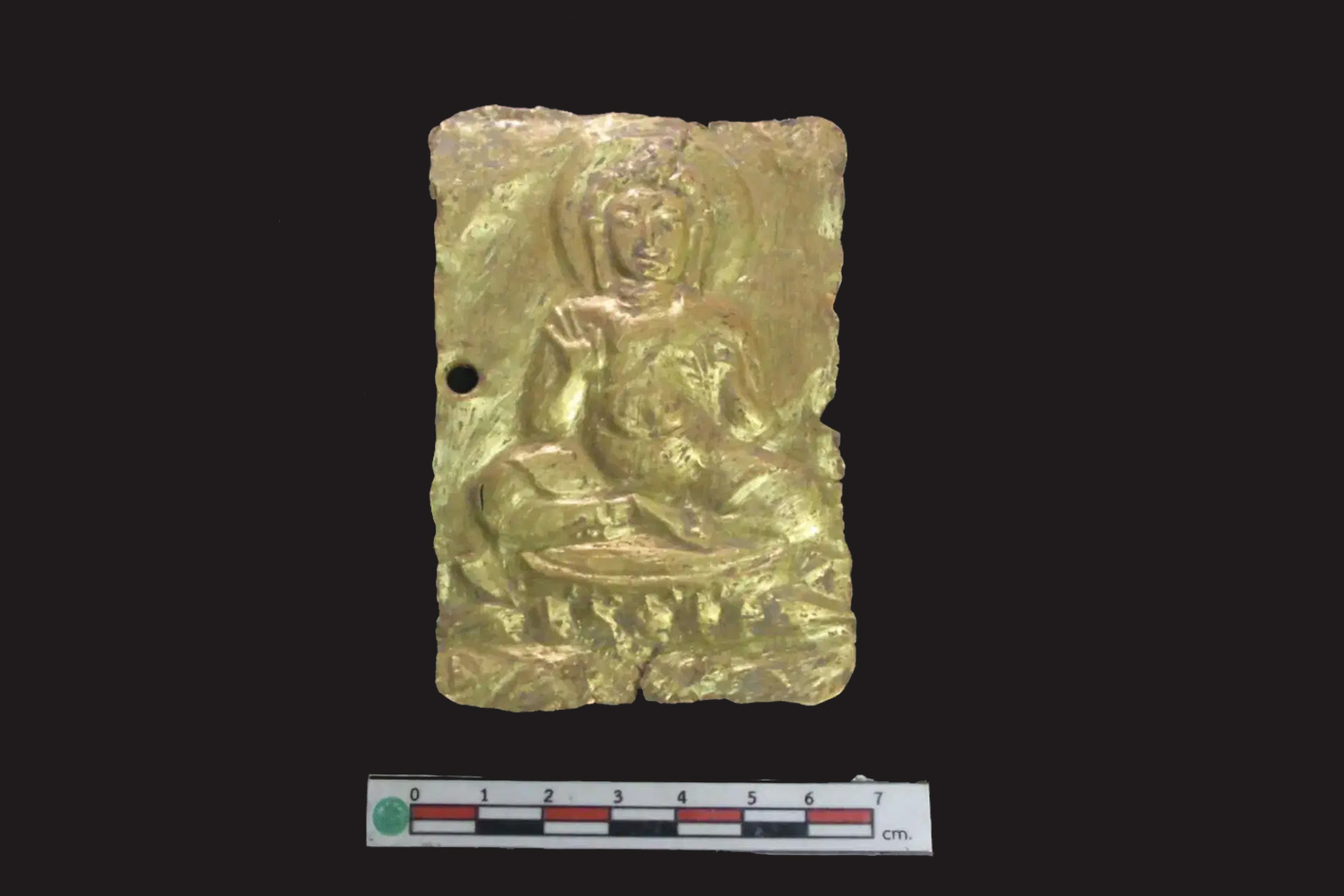
Not only jewelry, but the team also uncovered an embossed plate crafted from a lead-tin alloy. This plate depicts a seated Buddha performing the **Vitarka Mudra**, a hand gesture symbolizing the communication of divine wisdom. According to a scholarly study, such symbolism is pivotal for understanding early Buddhist iconography. Each of these finds is like a thread, weaving into the larger fabric of history.
Exploring Religious and Cultural Symbolism
There’s more than just aesthetic appeal to these discoveries. The **Vitarka Mudra** featured on the lead-tin plate isn’t merely decorative; it’s a profound symbol of religious teachings transcending time. The gesture, associated with the dissemination of the Buddha’s teachings, invites us to consider the spiritual and ritualistic weight such objects held for communities of the past.
But wait, there’s an even deeper story. Alongside these artifacts, the excavation also revealed a damaged relief of a standing Buddha performing the same mudra with both hands, flanked by two attendants. One figure is suspected to be Phra Phrom, the Thai equivalent of the Hindu deity Brahma, the creator god in Hindu lore. This discovery highlights a fascinating religious syncretism — a blending of Buddhist and Hindu iconography that was commonplace in ancient Southeast Asia. Truly, one can almost picture the religious ceremonies, the mingling of different traditions.
The Treasure of Cultural Exchange
These findings are more than just artifacts; they are **portals to a different era**, showcasing the artistic prowess and religious devotion of ancient Southeast Asians. They also highlight the cultural exchanges that influenced these communities. As outlined by a Smithsonian article, such exchanges are vital to our understanding of ancient civilizations.
Uncovering such remarkable relics is like having the past hand us its journal — offering us stories written in gold, silver, and bronze. And as we read these stories, we’re invited to reflect on the interconnectedness of cultural histories and how they continue to shape our world today.
The world of archaeology is about far more than just digging up dirt. It’s about rediscovering our shared human heritage and piecing together tales from the past that shape our understanding of the present. Curious minds, stay tuned for what future excavations may unearth. Who knows — the next chapter in history might just be waiting to surface nearby.