


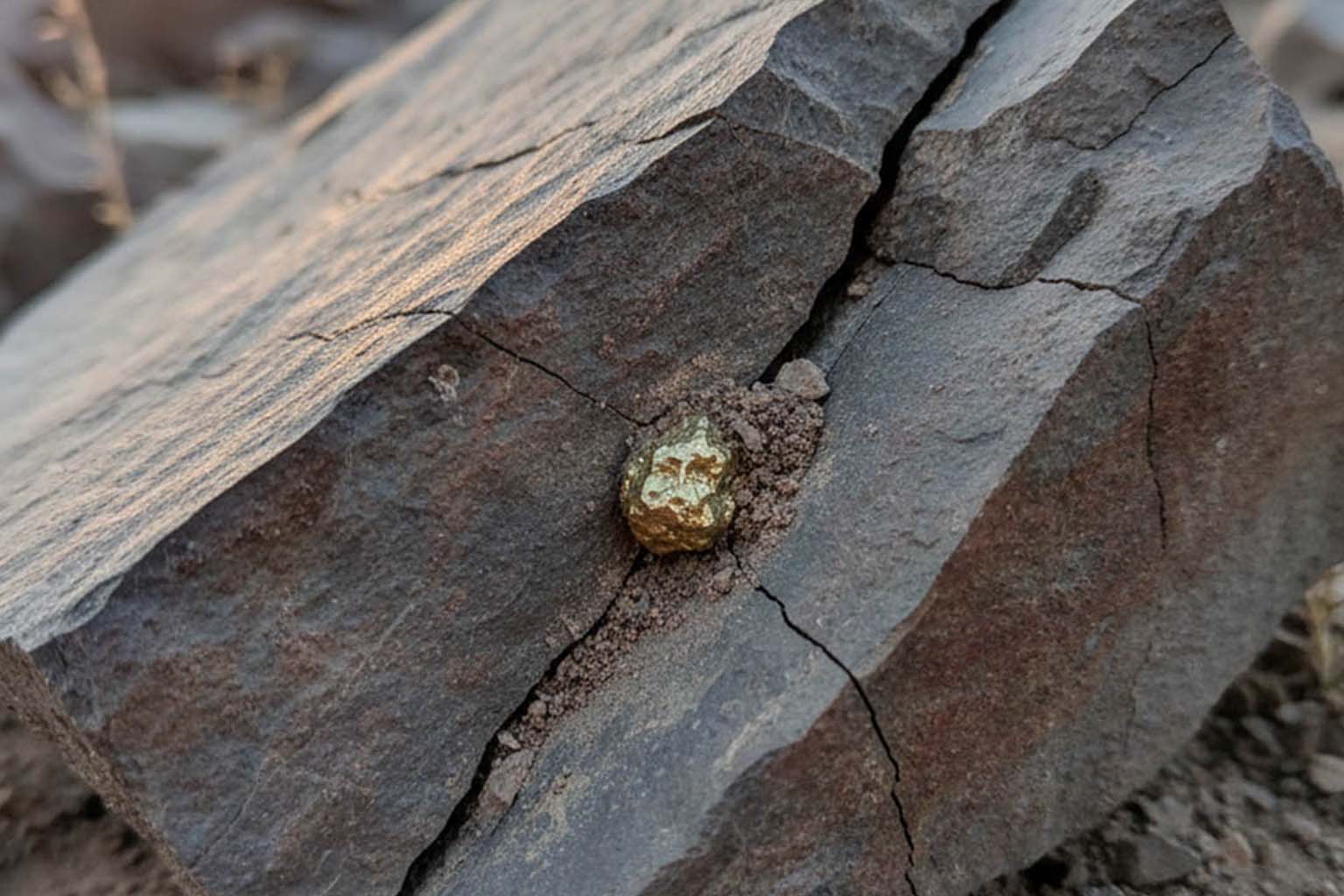
Imagine the ground beneath your feet suddenly shifting, releasing power beyond what we can easily comprehend. It’s a fearsome thought, isn’t it? But here’s a twist — these ground-shaking events, the very **earthquakes** that can cause destruction, might also be responsible for something astonishing: the creation of **gold nuggets**.
For decades, discussions about how nuggets form within quartz veins have kept geologists up at night. It seems these precious deposits don’t line up with the usual patterns we’d expect from hydrothermal models — a scientific conundrum, if you will. In many spots, the gold isn’t spread out evenly, rather huddled in clusters, leaving scientists scratching their heads, pondering alternative explanations for how these **metal-rich fluids** sort themselves out under seismic pressure.
A recent light-bulb moment came in 2024, when an international team opened up new avenues of thought. In a bold move, they **crafted experiments** in laboratories to study how quartz reacts when stressed by tectonic forces.
Earthquakes and the Birth of Gold
Diving into this research, one might ask, how on earth could an earthquake possibly give rise to gold nuggets? The study’s authors recognized a fascinating connection: the piezoelectric tension generated by quartz during a quake might just cue up the formation of these shiny lumps.
Now, let’s unpack this. Quartz has a nifty ability to generate an electric field when it’s hit with sudden geological stress. Quite intriguing, isn’t it? This typically happens in areas with active faults, where fluids carrying gold dissolved from the earth’s crust find their way to the surface. When seismic waves ripple through a **quartz-rich vein**, the mineral may whip up enough tension to tweak gold’s fate within those fluids.
As it turns out, gold is picky. It likes to settle down where conditions make it easy to nucleate, and here’s where quartz’s piezoelectric magic plays a pivotal role. This might just crack the case for why gold doesn’t show up everywhere but tends to be a social creature in certain locales.
The hypothesis dovetails with geological observations, too. Many major orogenic gold deposits have seen episodes of repeated **earthquakes and hydrothermal activity**. Not only do quakes re-crack the earth, but they also invite another act in the performance of transport and precipitation, layering up gold nuggets over time.
Exploring Quartz’s Piezoelectric Power
Researchers at Monash University in Australia cleverly designed an experiment, immersing quartz crystals in **gold-laden fluids** and simulating seismic waves to induce rapid stresses. The upshot? The tension generated sparked a piezoelectric charge that nudged gold to deposit right atop the quartz, forming tiny gold nanoparticles.
According to these insightful researchers, these tiny particles could act as a foothold for growing larger nuggets. Imagine each droplet of gold acting like a sweet spot for more metal to latch onto, especially when subsequent tectonic tremors shake things up.
One of the team members explained it simply: “Gold dissolved in solution tends to prefer settling down on pre-existing gold grains.” This paints a picture of nuggets evolving through cumulative efforts, a byproduct of sequential seismic dramas.
Recurrent quakes nudge along new phases of gold deposition, with each cycle banking additional piezoelectric charges from quartz. Over time, this rearranges the dissolved gold, **consolidating it into clusters** that grow into the chunky, precious nuggets we’re used to discovering in fractured quartzite veins.
Decoding Seismic Gold Deposits
To comprehend why some veins seem like gold magnets, we must spotlight two key forces: quartz’s piezoelectric prowess and the orogenic nature of deposits that yield the biggest nuggets. **Earthquakes** don’t just open new pathways for mineral-laden fluids, they shake things enough to activate quartz’s mineral mojo.
These hydrothermal fluids rise through fractures, packing small quantities of gold that can easily stick to crystals or even already-metallic surfaces. Each quake renews electrical conditions that are ideal for clustering.
It’s worth noting that laboratory experiments have confirmed that quartz’s piezoelectric charge alone is potent enough to precipitate gold from aqueous solutions. Interestingly, the **solidified gold** prefers habitats near pre-existing deposits, reinforcing this clustering narrative. Evidence strongly suggests our mighty gold caches are the happy results of interconnected seismic events — I mean, who would have thought?
Scientific Implications and a Glimpse into the Future
Among the chatter surrounding this 2024 study, speculation has buzzed about recreating gold nuggets under controlled conditions. One can almost hear the hopeful investor asking, “Wait, are we talking alchemy here?” Not quite. As the researchers point out, “It’s not about conjuring gold from thin air; rather, it’s about utilizing the transition of dissolved gold adhering to a surface,” an elegant insight into the geological cycles at work.
So, for now, we might not have a golden treasure map, but the findings do guide us towards quartz veins through detection of piezoelectric signals. And while it doesn’t guarantee every vein contains gold, it opens exciting possibilities.
And there you have it. **Gold formation**, with a seismic twist! Who knew the tremors beneath could lead to such glittering potential? If the earth could whisper, it seems she’d have many more secrets to divulge about her glittering legacy beneath.
Feel like delving deeper? Keep your eyes peeled and your curiosity keen. The earth, after all, might just surprise you again!