


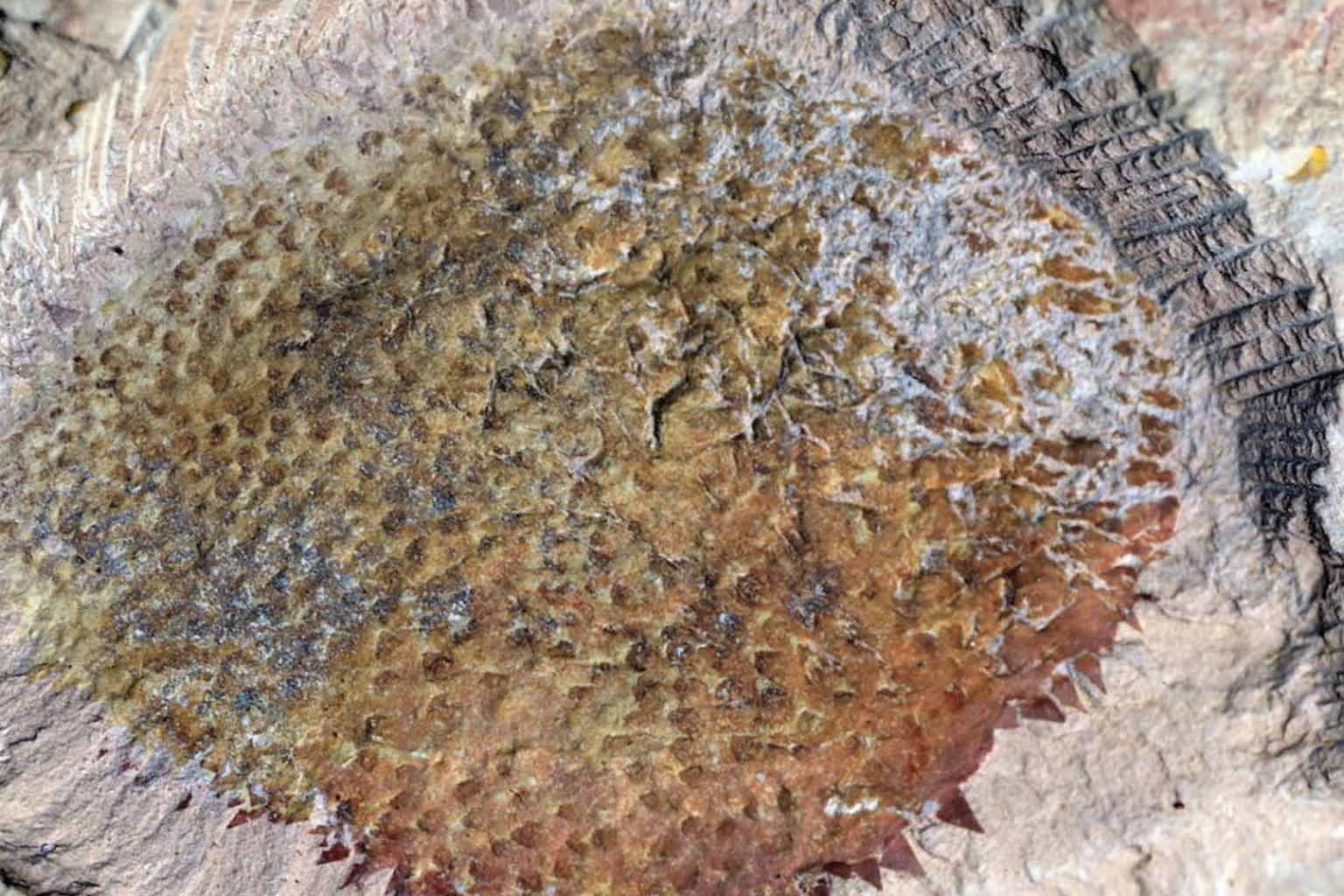
Paleontologists have long been fascinated by fossils that reveal the mysteries of early life on Earth, and the story of one such discovery is no exception. A 500-million-year-old fossil from China has recently been at the center of a remarkable scientific revelation, challenging long-held beliefs and painting a vivid picture of the Cambrian explosion — a period that sparked an explosion of biological diversity.
Unraveling the true identity of a 500-million-year-old fossil
The fossil in question, known as Shishania aculeata, was originally classified as a primitive mollusk, a group that includes creatures like snails and clams. Found in the Yunnan province of China, this spine-covered fossil initially seemed to showcase a typical mollusk anatomy, including what researchers interpreted as a muscular foot and specialized defensive spines. However, this interpretation has now been dramatically revised by a recent groundbreaking study published in Science, led by experts including Dr. Martin Smith from Durham University.
The new research reveals that the features which once guided the fossil’s classification were, in fact, misleading. Fossilization is known to produce distortions — a phenomenon called taphonomic illusion — where the original structure of an organism gets altered during the preservation process. What looked like a mollusk’s foot was actually a distortion artifact caused by this process, leading experts to reconsider the fossil’s true classification.
Fossil origami and the challenge of interpreting ancient life
Paleontological work often involves untangling such distortions, which can resemble a form of “fossil origami.” In this case, closely examining the fossil with advanced imaging techniques revealed that the shapes and textures thought to indicate mollusk-like anatomy were illusory. Dr. Smith remarked, “These ancient fossils turned out to be masters of disguise,” highlighting the complexity researchers face when piecing together the past from incomplete and altered remnants.
Such misinterpretations are not uncommon, but correcting them is crucial. This discovery demonstrates how new analysis can upend decades-old assumptions and nuances in interpreting the earliest animal life forms. The team’s meticulous approach now places the fossil in close relation to a puzzling group known as chancelloriids — enigmatic creatures that dominated Cambrian seas but have remained evolutionary mysteries.
Chancelloriids: Unexpected ancestors emerge
Chancelloriids are ancient, sponge-like organisms distinguished by their star-shaped spicules (tiny spine-like structures) that coated their bodies. Anchored to the sea floor, they once seemed unrelated to more advanced animals. Yet, the fossilization patterns and morphology of Shishania aculeata align closely with these elusive organisms, suggesting it is a distant relative within this group.
This revelation deepens our understanding of early Cambrian ecosystems and the evolutionary pathways that led to modern animals. The chancelloriid body plan — characterized by elaborate spines and unique attachments — now appears to have played a significant role in the rapid biological diversification during this era.
According to Dr. Smith, “The mystery started to unfurl once we found chancelloriids preserved in a very similar way in the same rock unit,” underscoring how comparative fossil analysis is key to unlocking evolutionary relationships.
New insights into the Cambrian explosion’s evolutionary puzzle
The Cambrian explosion, which began around 541 million years ago, marks the sudden emergence of most major animal groups and complex life forms. Understanding how creatures like chancelloriids fit into this picture is vital for assembling the evolutionary puzzle.
This study adds substantial evidence that the diversity of life during the Cambrian was even more complex than previously imagined. The discovery that Shishania aculeata is related to chancelloriids alters prior models of early animal development and suggests that evolutionary experiments in body plans were far more varied.
Experts believe that recognizing fossilization artifacts and reclassifying fossils like this will continue to reshape our interpretations of early animal life. This echoes findings highlighted in a recent Nature Ecology & Evolution report, which emphasized the importance of integrating advanced imaging and taphonomic knowledge in paleontological research.
Why this matters: The quest to understand our earliest ancestors
Finding the true identity of fossils like Shishania aculeata shapes not only our scientific knowledge but our connection to the natural history of Earth. It highlights the continual evolution of scientific inquiry, reminding us that science thrives on revision and discovery. Paleontologist Martin Smith’s team demonstrates how persistent investigation, combined with new technologies, can correct mistakes and open fresh avenues for understanding life’s origins.
For anyone intrigued by the story of life on Earth, this discovery is a testament to patience and precision in unraveling the secrets locked in stone. Each fossil tells a story, sometimes hiding surprises that challenge what we think we know.
If this revelation fascinates you or sparks questions about early life and fossil interpretation, don’t hesitate to share your thoughts or join the discussion below! Your perspective could add new layers to our collective quest to map the origins of life.