


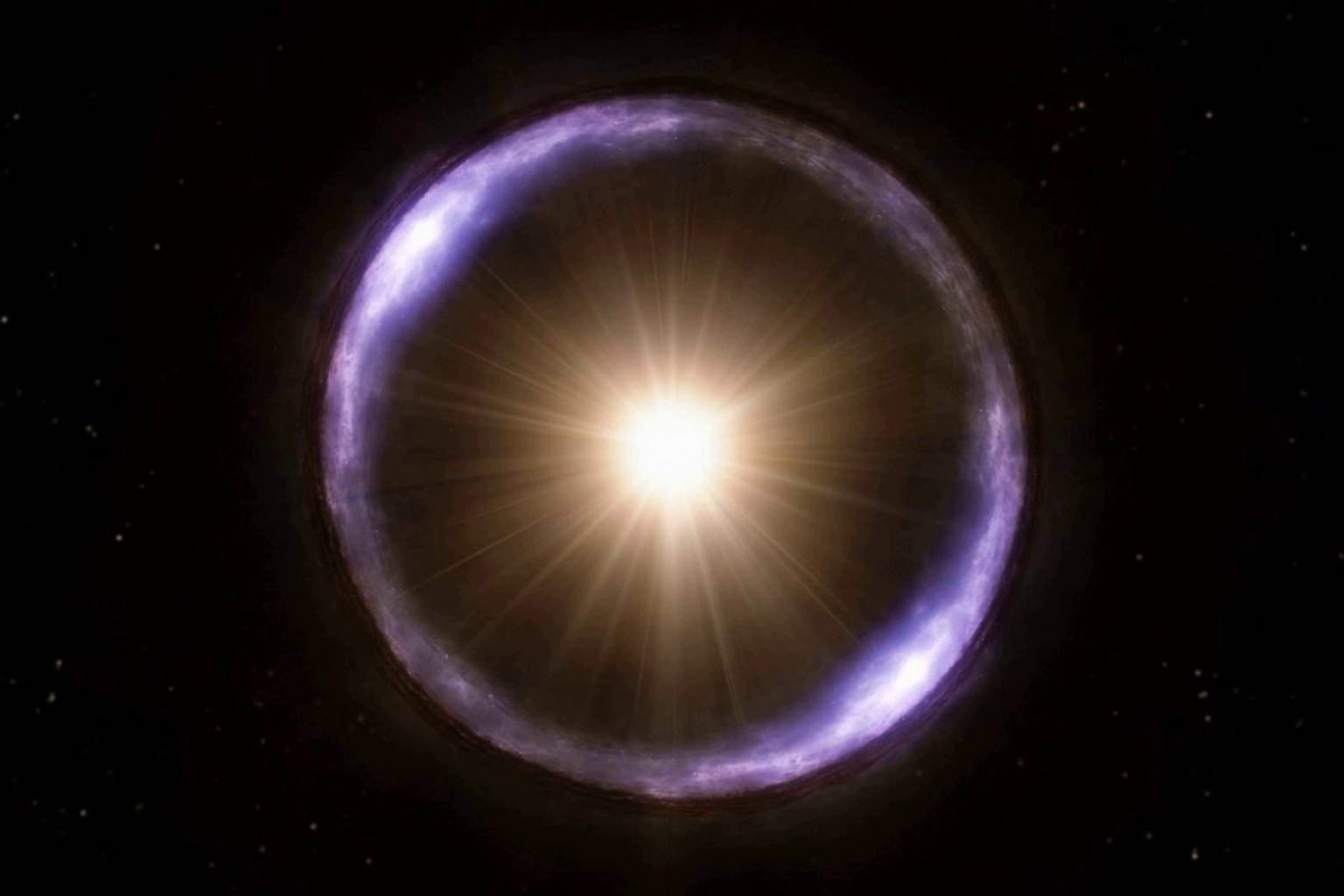
Imagine seeing a glowing ring of light twisted around a distant galaxy, a cosmic spectacle that proves Albert Einstein’s genius beyond a century. The European Space Agency’s Euclid telescope has just delivered this breathtaking image: an Einstein ring, a phenomenon that bends our understanding of space and light in extraordinary ways.
This discovery isn’t just a triumph of technology—it’s a vivid confirmation of Einstein’s general relativity, showing how gravity can shape the very fabric of space-time. Join me, astrophysics writer Emily Carter, as we explore how this recent finding around galaxy NGC 6505 reveals the universe’s hidden architecture, powered by gravity’s invisible hand.
What exactly is an Einstein ring?
An Einstein ring occurs when a massive galaxy’s gravitational pull bends light from a more distant galaxy located directly behind it—an effect known as gravitational lensing. Instead of simply seeing two galaxies, our telescopes witness a stunning, glowing circle of light. This ring is gravity’s signature, warping light around a celestial body to create a natural cosmic lens.
Euclid’s recent capture around NGC 6505—approximately 590 million light-years away—pushes this natural marvel into sharper focus. Although this galaxy has been cataloged since 1884, the precision of Euclid’s instruments allowed astronomers to witness the ring in unprecedented detail. According to Professor Stephen Serjeant of the Open University, such rings are exceedingly rare and offer invaluable clues about the universe’s invisible matter.
The impact of gravitational lensing on modern astronomy
Einstein’s insight that gravity can bend not just matter but light itself revolutionized our understanding of how the universe operates. When gravity curves space-time, it redirects traveling photons, distorting and magnifying distant galaxies. This phenomenon, known as gravitational lensing, plays a critical role in studying dark matter, dark energy, and cosmic expansion.
The clear ring Euclid observed is a rare example of this effect, providing astronomers with a natural telescope that magnifies what would otherwise be invisible galaxies. As NASA explains in a recent report, gravitational lensing contributes significantly to our ability to map the dark universe, revealing structures hidden to even the most powerful traditional telescopes.
Video credit: NASA Goddard Space Flight Center
Why the Euclid telescope is a game-changer for exploring the cosmos
Launched in July 2023, the Euclid telescope is designed to map the universe with unparalleled detail, focusing especially on the mysterious dark matter and dark energy that dictate cosmic acceleration. Its successful detection of the Einstein ring validates its cutting-edge technology and reaffirms Einstein’s theory as a cornerstone of modern physics.
Euclid’s observations around NGC 6505 also bring astronomers closer to understanding how matter is distributed inside galaxies. Such clarity helps refine models of galaxy formation and evolution, revealing that Einstein’s ideas continue to illuminate new cosmic truths.
Reflections on curiosity: Our continuing cosmic quest
From childhood stargazing to cutting-edge astronomy, the delight of uncovering the cosmos’ secrets has never faded for me. Discoveries like the Euclid telescope’s Einstein ring ignite our innate curiosity and remind us that the universe is an ever-unfolding story, waiting for keen eyes and bold minds.
How does the idea of gravity bending light to reveal hidden galaxies resonate with you? Have you ever wondered about the unseen cosmos that surrounds us? Share your thoughts below—let’s connect over the mysteries above and keep the wonder alive by sharing this astonishing journey into space.